The flooring specification that gets made by default
Laminate flooring is often specified in Thai tropical villas not because it is the best choice for the conditions, but because it is familiar, widely available, and cheaper than the alternatives it resembles. It looks like timber, costs less than engineered hardwood, and installs quickly, which makes it appealing on paper and in budget conversations long before anyone has tested it against Thailand’s climate.
The problem is that laminate flooring was designed for temperate climate conditions, and its fundamental construction creates vulnerabilities in Thailand’s sustained high humidity that careful product selection mitigates but cannot eliminate. Understanding these vulnerabilities clearly, rather than accepting marketing claims about moisture resistance at face value, is what allows laminate to be used where it genuinely makes sense and avoided where it consistently does not.
How laminate is constructed and why it matters in Thailand
Laminate flooring consists of four layers bonded together: a backing layer, a core layer typically of high-density fibreboard, a decorative photographic layer, and a protective wear layer on top. The core layer is the vulnerability in tropical conditions. High-density fibreboard, or HDF, is a wood-based composite that absorbs moisture when it reaches the core through joint edges, cut ends, or face penetrations, and when it does, the planks cup, joints gap, and edges lift in ways that cannot be reversed by drying. Once moisture damage occurs in laminate flooring, the affected planks require replacement, not repair.
This is not a marginal risk anywhere in Thailand. Ambient humidity above 70 percent is normal for most of the year, and monsoon season brings sustained high humidity for months at a stretch. Ground floor slabs release moisture upward regardless of location, and any gap in the installation’s moisture protection, whether an inadequate vapour barrier, unsealed edges, or subfloor moisture, allows moisture to reach the HDF core, at which point the failure process begins and does not reverse.
Moisture-resistant laminate, marketed with improved moisture resistance, uses more densely pressed HDF and sealed edge treatments that slow the rate of moisture ingress. It does not make laminate waterproof or immune to the sustained humidity Thailand produces. It extends the time before failure rather than preventing it, and that distinction matters, because it affects where laminate can be responsibly specified and where it cannot, regardless of what the packaging claims.
The specification that reduces risk
Where laminate is specified for an appropriate application, product specification determines how well it actually performs. The AC rating system grades wear resistance from AC1, light residential, to AC5, heavy commercial. AC3 is the minimum for any residential application but should be reserved for light use such as bedrooms with low foot traffic. AC4 is the correct minimum for general villa use, including living rooms, corridors, and rental properties, since its moderate commercial rating translates to heavy residential use in practice. AC5 is worth specifying for high-traffic rental properties or entrance areas where abrasion resistance is the primary consideration. Budget laminate sold in Thailand is often AC2 or unrated, which is inadequate for any villa application that will see regular use.
Edge treatment significantly reduces the rate of moisture ingress at joint lines. Specify laminate with factory-sealed edges rather than cut edges, since factory sealing is more consistent and more water-resistant than any site-applied treatment, with wax-impregnated edges better than unsealed and fully sealed edges better again than wax-impregnated. Total thickness should be 8 millimetres minimum, since thinner laminate feels hollow underfoot, telegraphs subfloor irregularities more readily, and offers less dimensional stability against humidity-related movement.
Formaldehyde emissions from laminate core adhesives can off-gas in enclosed air-conditioned spaces, so specify products with E1 or GREENGUARD certification, meaning emissions below the threshold where indoor air quality is affected. This is a health consideration that applies regardless of climate, but it is more significant in Thailand, where rooms are more often sealed and air-conditioned for long stretches of the day.
Where laminate is a reasonable specification
The applications where laminate is genuinely appropriate in a Thai tropical villa are narrower than its widespread use suggests, but they are real. Air-conditioned bedrooms on upper floors represent laminate’s best performance conditions, since air conditioning keeps humidity below the level that causes rapid HDF core swelling, upper floor positions sit away from ground-level moisture sources, and foot traffic tends to be lower than in living areas. In these conditions, correctly specified laminate with appropriate moisture protection performs adequately for seven to ten years.
Home offices and media rooms are also appropriate applications, being climate-controlled spaces with lower foot traffic than living areas and away from moisture sources, and laminate’s acoustic quality, warmer and quieter underfoot than tile, is genuinely relevant in media rooms where sound and underfoot comfort matter. For temporary or budget-constrained renovation applications, laminate has a legitimate place too. Where a villa needs a flooring update on a limited budget and the floor will be replaced within five to seven years in any case, such as a rental property being upgraded for immediate market without long-term investment, laminate provides acceptable appearance at lower cost than the alternatives. This is an intentional short-term specification rather than a compromise, and a legitimate use case once the timeline is understood clearly by everyone involved.
Where laminate consistently fails in Thai conditions
Ground floor installations in naturally ventilated villas are the most common failure context. Ground floor slabs release moisture upward, the same underlying mechanism behind many foundation problems in flood-prone plots, and in naturally ventilated villas without air conditioning controlling interior humidity, the combination of slab moisture and ambient humidity creates conditions that reach HDF cores regardless of vapour barriers and edge sealing. Ground floor laminate in naturally ventilated Thai villas has a poor performance record, and not because of installation failures. The conditions simply exceed what the material was ever built to handle.
Entrance halls and transition zones are the second consistent failure context. Entrance areas receive moisture from outdoor shoes, wet umbrellas, and the humidity differential between outside and inside air right at the threshold, and that concentrated moisture exposure is exactly the condition that causes rapid laminate failure. The entrance hall is one of the most visible areas of a villa, which makes it one of the worst possible places to have specified laminate.
Any space without climate control follows the same pattern. Utility areas, staff quarters, storage rooms, and service spaces that are not air-conditioned experience ambient humidity at outdoor levels for extended periods, and laminate in these spaces absorbs moisture progressively and fails. These are exactly the spaces where laminate is often specified to save budget, and exactly where that budget saving is lost again in early replacement costs. Kitchens and bathrooms follow the same rule for the same reason: laminate is not appropriate for any space with regular water exposure, and the moisture-resistant claims on the packaging do not extend to these conditions. Porcelain tile and quality vinyl remain the correct specifications for wet spaces.
The alternatives that outperform laminate in most Thai villa applications
Rigid core vinyl outperforms laminate on moisture resistance, dimensional stability, and durability in Thailand’s conditions, at a comparable or only modestly higher cost, which makes it the better specification for most applications where laminate is currently being considered. Engineered hardwood is the aesthetic upgrade from laminate, with real timber veneer over a stable core providing the depth and authenticity of natural timber and better dimensional stability than solid hardwood in tropical conditions, costing more than laminate but significantly less than solid hardwood while outperforming laminate on longevity in appropriate applications.
Large format porcelain tile is the correct specification where moisture resistance is a priority alongside durability. For living areas, entrance halls, and any air-conditioned space where tile underfoot is acceptable, large format porcelain outperforms laminate on every performance criterion that matters in Thailand’s climate. The underfoot warmth argument for laminate over tile is real but modest, and it is addressed more effectively by specifying the right tile finish and underfloor heating in bedrooms where warmth is genuinely a priority, rather than by accepting laminate’s moisture vulnerability as the trade-off.
Underlay specification
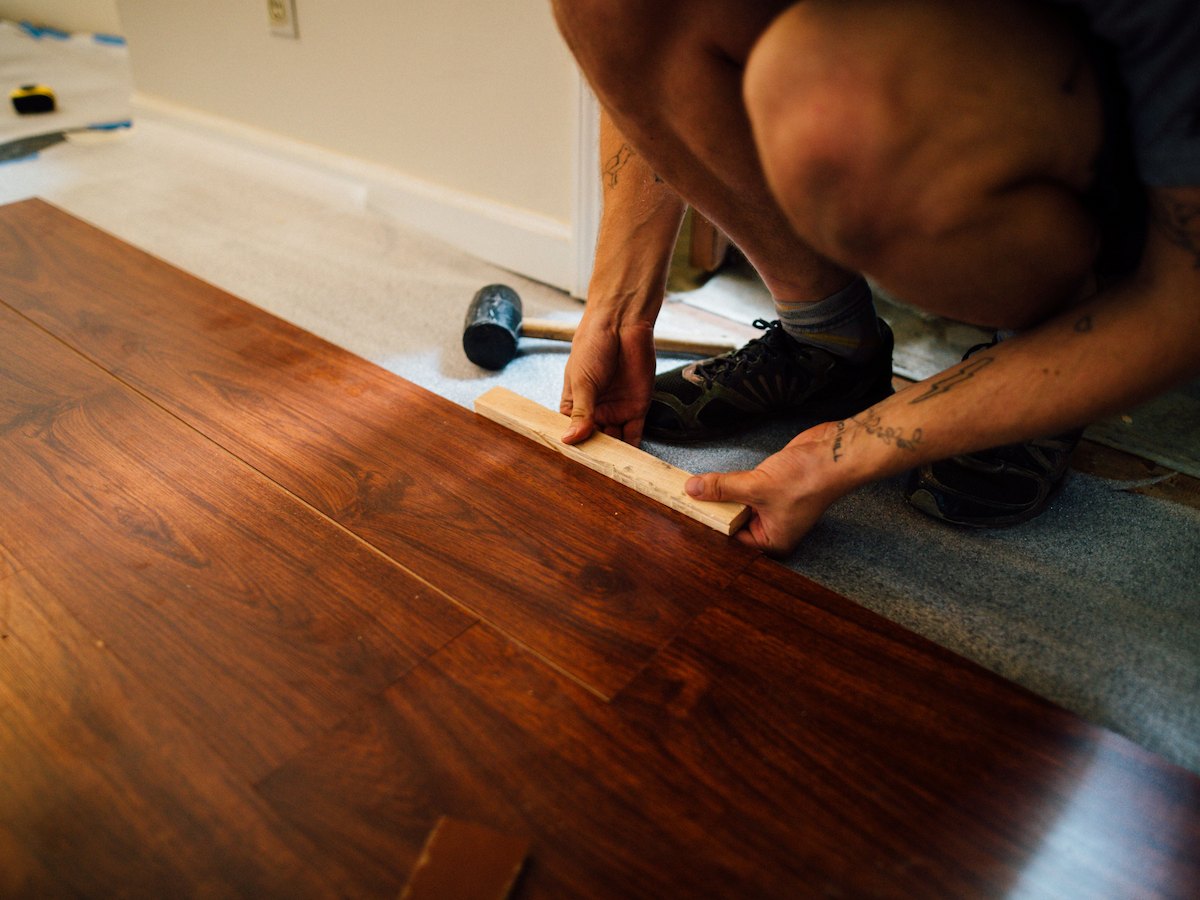
Laminate flooring requires an underlay between the plank and the subfloor, and in Thailand’s tropical conditions the underlay specification matters well beyond basic comfort. The underlay must incorporate or be paired with a vapour barrier, a polyethylene film of minimum 200 micron thickness, that prevents moisture migration from the concrete slab into the laminate core. This is not optional in Thai conditions and is not provided by standard acoustic foam underlays alone, so check the product specification rather than assuming vapour protection is included, since some underlays incorporate the barrier as an integral layer and others simply do not.
Acoustic performance is the second underlay consideration. Laminate over concrete produces impact sound transmission, meaning audible footsteps in the room below and a hollow sound underfoot, and acoustic underlay reduces both. In multi-storey villas where bedrooms sit above living areas or guest areas above service spaces, acoustic underlay is worth specifying beyond the basic vapour barrier requirement. A combined underlay and vapour barrier of 3 millimetres thickness is the practical minimum for Thai villa laminate installation, since thinner underlays provide inadequate acoustic performance and less thermal separation from the slab beneath.
The bottom line
Laminate flooring has a genuine place in Thai tropical villa construction: in climate-controlled upper floor bedrooms, home offices, and budget-constrained renovation applications where the timeline and performance expectations are understood clearly from the outset. It is not the right default flooring choice for Thai villas, and it performs poorly in the ground floor, naturally ventilated, and moisture-adjacent applications where it is nonetheless commonly specified.
The fundamental issue is that laminate’s HDF core absorbs moisture in ways that Thailand’s climate consistently delivers, and no amount of edge sealing, vapour barriers, or moisture-resistant marketing claims changes the underlying material behaviour in sustained high-humidity conditions. Specifying correctly for the conditions means understanding this limitation from the outset rather than hoping the product will overcome it.
The full build process, from land purchase through to handover and beyond, will be covered in The Thailand Build Blueprint™, so sign up for early access.
If something about your own design or construction is genuinely keeping you up at night, whether that is a build issue, a contractor you are not sure you trust, or a structural concern you cannot get a straight answer on, book a Strategy Session with Nay to work through it directly.
Getting this specified and checked on site
Decisions like this one are only as good as the drawings and the site supervision behind them. If you are building on Koh Samui, Nay's full service from land assessment to handover is described at Architect Samui; for Phuket, see Architect Phuket. If you already have a builder and want an independent second opinion on a specification, book a strategy session.