Why stone deserves a more careful conversation
Natural stone cladding is often chosen for its sense of permanence. It is solid, textured, and visually grounded. In Thailand’s tropical climate, performance matters far more than appearance.
Used correctly, stone can last decades with very little degradation. Used incorrectly, it can stain, trap moisture, and begin failing within a few years, often from behind the surface where problems are harder to detect.
The difference comes down to three things: material selection, installation method, and moisture management. Each one is straightforward to address at the design stage and expensive to remedy after the cladding is installed.
How tropical conditions change the way stone behaves
Heat, humidity, salt air, and seasonal downpours create constant stress on building materials. Stone is not immune to this.
The main issue is not surface wear but moisture movement through and behind the stone. When water is absorbed or trapped, the consequences include discolouration and staining on the visible surface, salt deposits forming beneath the finish, mould and biological growth in the right conditions, and damp transferring into internal walls behind the cladding.
Most failures are not immediate. They develop slowly, often becoming visible only once damage is already established and the remediation work involves removing and replacing significant areas of finished cladding.
Why installation engineering decides whether cladding succeeds
Natural stone is one of the most durable cladding materials available for tropical villa construction. It handles humidity, UV exposure, and monsoon rainfall better than most alternatives when correctly selected and installed, and it also fails, sometimes dramatically and expensively, when the engineering behind the installation is not adequate for what Thailand’s climate actually demands.
Our guide to natural stone cladding covers material selection and the broader question of whether stone is right for your project. This article assumes that decision is already made and goes deep on the part that gets far less attention in most conversations about stone: the installation engineering, which is precisely where most stone cladding problems actually originate.
Choosing a stone that suits the climate
Everything else in this article assumes the stone itself meets a basic threshold. Water absorption below 1 percent is the minimum for any external application, and below 0.5 percent for coastal locations within 300 metres of the sea, since porous stone absorbs moisture, allows salt crystallisation within the stone matrix in coastal air, and develops surface degradation and biological growth quickly in humid tropical conditions. Granite, basalt, and quartzite meet this standard reliably, with granite typically running below 0.5 percent absorption and excellent UV stability, basalt offering similar characteristics with strong thermal stability, and quartzite adding low thermal expansion for sun-exposed facades. Highly porous limestone, sandstone, and any unspecified imported stone without documented absorption test data are worth avoiding for external tropical use regardless of how attractive the price or appearance.
Thai quarries, Saraburi granite in particular, offer genuine batch consistency and significantly lower embodied carbon than imported stone, and locally quarried stone has also been exposed to comparable climate conditions during formation, which is worth weighing in the decision. Whatever the source, request batch consistency documentation and test samples under actual site conditions before ordering the full quantity, since colour and texture variation between batches becomes far more visible in Thailand’s direct sunlight than it does in a showroom.
Anchor systems and why mechanical fixing is required
The most consequential installation decision for stone cladding in Thailand is the fixing system, and this is not a cost optimisation decision. It is a structural safety decision. Adhesive bonds degrade under sustained humidity, thermal cycling, and UV exposure, and Thailand’s conditions accelerate that degradation meaningfully. Stone cladding fixed with adhesive alone has failed during tropical storms, with panels detaching from facades, sometimes from height, and the consequences of that are exactly as serious as they sound.
Mechanical fixation with stainless steel anchors embedded into the structural substrate provides fixity that does not depend on adhesive bond strength at all, since the anchor carries the load regardless of what happens to any adhesive component alongside it. Specify grade 316L marine stainless steel for coastal applications, since grade 304 corrodes in coastal salt air faster than most people anticipate, and grade 304 is generally adequate for inland locations without salt exposure. Anchor design must be engineered for the wind loads relevant to the specific location, since coastal Thailand experiences significant storm wind pressures that an inland site may not see to the same degree. Each stone panel needs a minimum of four fixing points for panels above 0.5 square metres, two load-bearing and two restraint, and those fixing points must be pre-formed in the stone during fabrication rather than drilled on site, since drilling completed stone panels creates crack initiation points that undermine the whole system. The cost difference between adequate and inadequate fixing systems is modest relative to total project cost. The risk of inadequate fixing is not.
Drainage cavities, the detail that prevents moisture failure
Stone cladding installed directly against the building structure without a drainage cavity traps moisture between the stone and the wall, and in Thailand’s climate this creates sustained moisture exposure at exactly the building envelope junction where you most need to keep water out. The correct approach is a ventilated cavity system, with a minimum 20mm air gap between the back of the stone cladding and the structural wall allowing moisture that penetrates the outer surface to drain downward and escape rather than accumulate. The cavity also lets the wall behind dry out if moisture does penetrate, which matters in a climate where drying conditions between rain events can be limited for weeks at a time.
Where budget allows, a 50mm ventilated rainscreen cavity outperforms the minimum 20mm gap, since the wider cavity improves airflow through the system, reducing moisture residence time and mould risk in high-humidity conditions, and the thermal performance benefit, reducing heat transfer from the sun-heated stone surface to the building interior, is meaningful in Thailand’s climate on top of the moisture advantage. Whichever width is chosen, the cavity system needs a continuous drainage path from top to bottom of the cladding, insect mesh at the base and top openings to prevent fauna establishing inside the cavity, flashing at all penetrations and junctions to stop water tracking in from above, and a subframe that is itself corrosion resistant, meaning 316 stainless steel again in coastal locations.
Joint detailing for thermal movement
Stone expands and contracts with temperature, and in Thailand’s climate, where stone surface temperatures in direct sun can exceed 60 degrees Celsius while an air-conditioned interior sits at 24 degrees, thermal movement across a facade is significant rather than a rounding error. Expansion joints need designing into the cladding layout from the outset, not added as an afterthought once cracking has already appeared, with joint spacing calculated for the specific stone type’s thermal expansion coefficient and the expected temperature range at the actual location.
Typical thermal movement for granite in Thai conditions runs approximately 0.3 to 0.5mm per metre of panel length, so a 2 metre panel moves 0.6 to 1mm across its length, movement that must be accommodated at the joints rather than transferred as stress into the stone or fixing system. Use epoxy-injected joints for structural connections and polyurethane or hybrid MS polymer sealants for movement joints, chosen specifically for the elasticity needed to accommodate the calculated movement range. Joint width must be adequate for the expected movement, since joints too narrow for what they need to accommodate fail through sealant tearing or direct stone edge contact.
Dry-stack and tight-joint finishes carry higher risk
Current design trends favour tight joints or dry-stack finishes, creating a clean, contemporary look.
These systems are less forgiving than traditional cladding methods. Any inconsistency in fixing, alignment, or waterproofing becomes more noticeable and more problematic over time. The narrower joint widths reduce the system’s capacity to accommodate movement and reduce the visual tolerance for any installation imperfection. They require careful planning, precise installation, and proper structural support behind the surface.
For a villa where the design intention is a contemporary stone facade, the specification and installation cost is higher than for traditional methods, and the consequences of inadequate execution are more visible. This is not an argument against contemporary stone detailing. It is an argument for committing to the level of installation quality that contemporary detailing requires.
Sealing and the maintenance that determines lifespan
Even low-porosity stone benefits from sealing in tropical conditions, since the sealant prevents salt crystallisation within the stone matrix, the mechanism by which salt causes surface spalling and subsurface delamination over time, most aggressively in coastal air but present to some degree everywhere in Thailand’s humidity. Specify breathable silane-siloxane hybrid sealants, which penetrate the stone surface and line the pore structure with a hydrophobic treatment while still allowing water vapour to pass through. Non-breathable sealants trap moisture within the stone, causing the exact problems they were meant to prevent.
Seal initially before installation to protect cut edges and back surfaces, seal the surface again after installation and pointing is complete, and then reseal on a schedule matched to exposure: every 12 months for villas within 300 metres of the coast, and every 2 to 3 years for inland or well-sheltered locations. Annual sealing on coastal properties is a genuine ongoing maintenance commitment, and it is also what extends stone lifespan beyond 25 years rather than seeing progressive surface degradation set in from year five onwards.
Consistency under real conditions
Stone can vary significantly between batches. Under strong tropical sunlight, these differences become far more visible than they appeared during selection.
Testing samples outdoors rather than relying on indoor lighting helps avoid inconsistent finishes across large surfaces. The colour, surface texture, and tonal variation that look unified under controlled showroom lighting often reveal substantial inconsistency under direct tropical sun. For large cladding installations where consistency across the surface is part of the design intention, outdoor sample testing under conditions matching the installation location is the only reliable way to predict the finished appearance.
Strategic applications where stone delivers best value
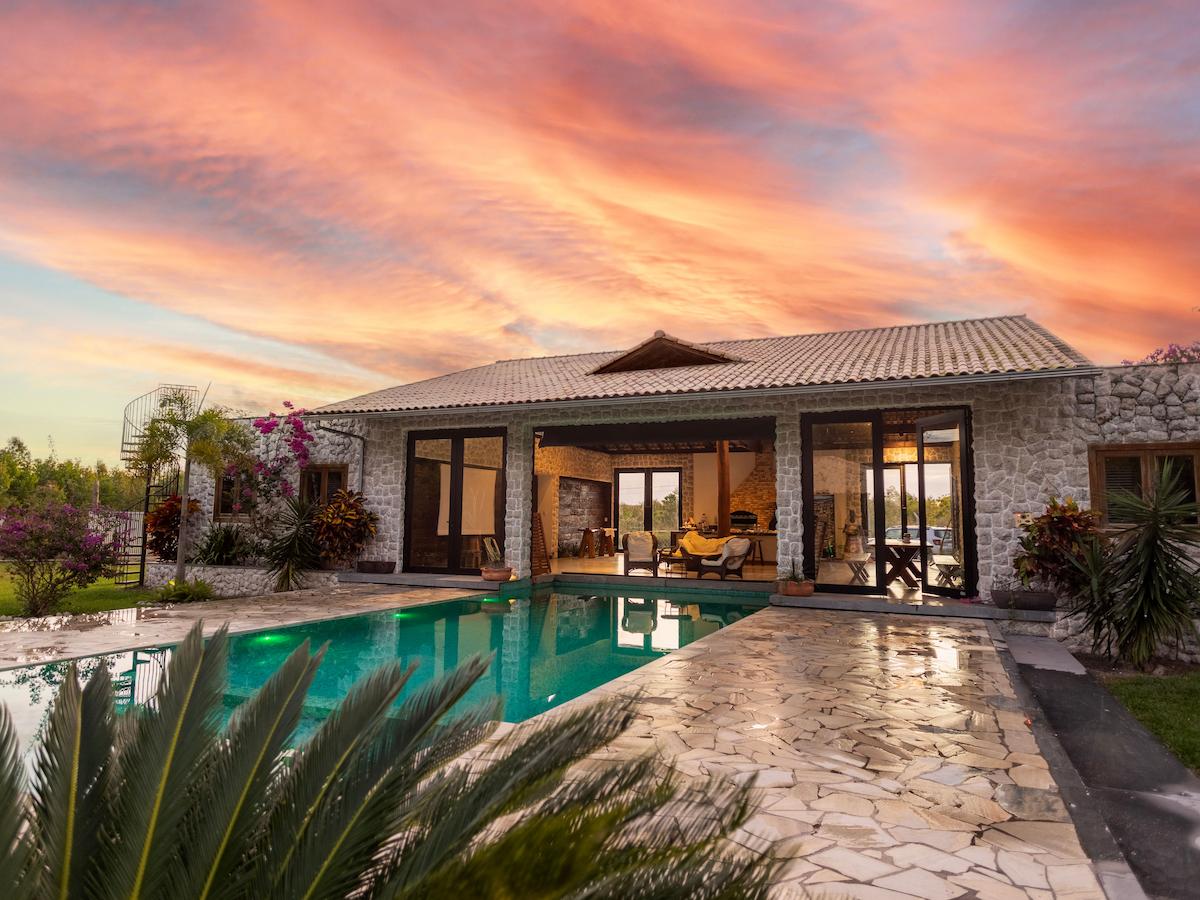
Stone’s weight, cost, and installation complexity mean it delivers the best value where its specific performance advantages are most relevant. Retaining walls suit stone’s mass and drainage characteristics well against the sustained soil moisture and hydrostatic pressure they face, provided proper geotextile drainage layers sit behind the wall to manage water pressure. Pool coping benefits from flamed or brushed finishes that provide natural non-slip texture, with dense stone staying noticeably cooler underfoot than many synthetic alternatives in direct sun, a real comfort advantage at the pool edge, provided edges are specified rounded for safety and the stone type suits sustained water contact. Feature columns and external structural elements gain genuine architectural presence at entrances and boundary walls from stone’s visual mass, though unsupported stone column height should stay under 3 metres without specific structural engineering behind it.
Stone is worth avoiding in small enclosed spaces, where thermal mass increases humidity retention, in areas with frequent seismic activity where local geological conditions need checking first, and in budget-constrained projects where the installation engineering cannot be done correctly, since inadequately engineered stone cladding is worse than the alternatives, not simply a cheaper version of the same thing.
How stone compares to other cladding materials
Many alternatives are marketed as easier or lower maintenance than stone, but in tropical conditions they come with their own limitations.
Painted render tends to peel, crack, and fade under sustained UV and humidity exposure. The maintenance cycle is short and the visible deterioration is constant. Composite panels and tiles can warp or lose colour over time, and the failure modes are often impossible to remediate without panel replacement. Timber cladding requires ongoing treatment and is vulnerable to insects and moisture in ways that other materials are not.
Stone behaves differently. It does not try to resist the environment completely. It weathers gradually and develops character, provided the underlying system is sound. The aged appearance of properly specified stone after a decade of Thai tropical conditions is part of its appeal, in a way that the aged appearance of failed render or warped composite panels is not.
Modern installation techniques worth knowing
Dry-stack engineered systems use interlocking stone panels to create seamless facades without mortar, eliminating the mortar degradation that is a common failure point in traditional wet-set stone installations in tropical conditions, at a higher initial cost but a lower long-term maintenance requirement. Ventilated rainscreen systems, proprietary solutions that engineer the cavity, subframe, drainage, and fixing together, reduce installation risk by standardising the details most often executed incorrectly in bespoke installations, and are worth specifying for large facade areas where the engineering complexity of a fully bespoke system raises the risk accordingly. Thermal break isolation, separating stone cladding from structural concrete slabs with a thermal break material, prevents thermal bridging, the direct heat conduction path from sun-heated stone through the fixing system into the cooled building interior, reducing both energy consumption and the condensation risk at fixing points where temperature differentials otherwise create moisture.
Stone is not just a finish
One of the most common mistakes is treating stone as a final decorative layer. In reality it is part of a broader construction system.
Stone cladding interacts with the structural walls behind it, the waterproofing layers between substrate and stone, the drainage design that moves water away from the building, and the thermal movement that the building experiences across daily and seasonal cycles. Decisions about stone need to be made early in the design process rather than added at the end without coordination.
The structural implications of heavy stone cladding require engineering input at the design stage. The waterproofing detail at the substrate determines whether the stone performs or traps moisture. The drainage path that allows water to escape from behind the cladding is part of the building’s overall water management system, not a detail of the stone installation itself.
The bottom line
Natural stone cladding in Thailand performs exceptionally well when the installation engineering matches what the climate demands. Material selection, anchor system, drainage cavity, joint detailing, and sealing programme are not independent decisions. They are a system, and the weakest element determines how the whole performs, whatever quality went into the rest.
Getting the engineering right from the start costs more than cutting corners. It costs substantially less than remediating stone cladding failures later, and for fixing systems specifically, the safety case for doing it correctly is not a cost argument at all.
The full build process, from land purchase through to handover and beyond, is covered in The Thailand Build Blueprint™, so sign up for early access.
If something about your own design or construction is keeping you up at night, whether that is a build issue, a contractor you are not sure you trust, or a structural concern you cannot get a straight answer on, book a Strategy Session with Nay to work through it directly.
Getting this specified and checked on site
Decisions like this one are only as good as the drawings and the site supervision behind them. If you are building on Koh Samui, Nay's full service from land assessment to handover is described at licensed Koh Samui architect; for Phuket, see licensed Phuket architect. If you already have a builder and want an independent second opinion on a specification, get a second opinion.