
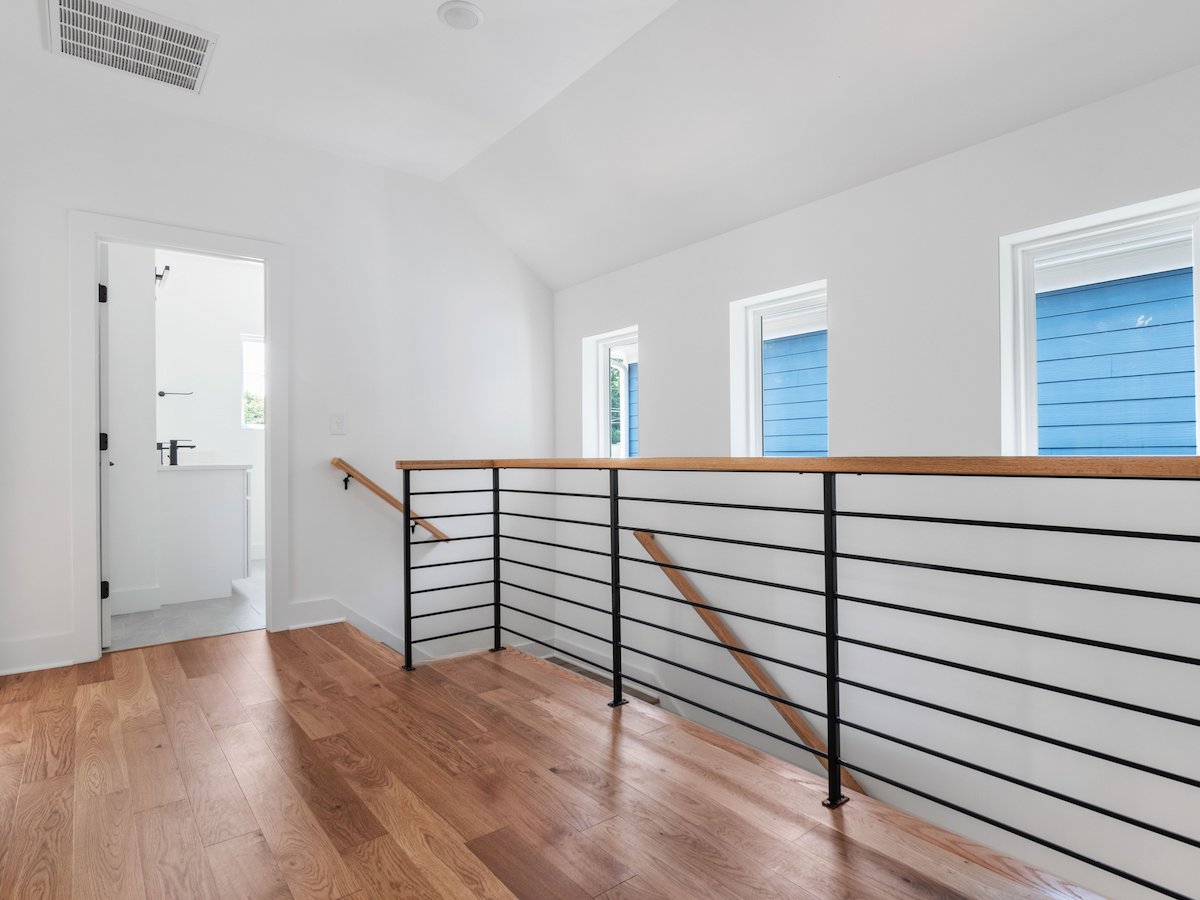
Why hardwood flooring is harder to get right in tropical climates
Timber flooring is one of the most desirable finishes in a tropical villa. The warmth, texture, and connection to natural materials that good hardwood provides is difficult to replicate with any alternative. It is also one of the most demanding specifications to get right in Thailand’s climate.
Wood moves. It expands and contracts with changes in moisture content and temperature. In a temperate climate with relatively stable humidity, this movement is modest and manageable. In Thailand, where humidity swings between 60 and 90 percent seasonally, where monsoon months bring sustained high moisture followed by dry periods, and where concrete slabs retain moisture that migrates upward, wood movement is significant and must be designed for explicitly rather than hoped away.
The hardwood flooring installations that fail in Thai villas are almost always not material failures. They are installation failures: correct materials installed without adequate regard for moisture management, expansion allowances, or subfloor preparation. Understanding what the installation actually requires is the prerequisite for specifying hardwood successfully.
Solid versus engineered hardwood
This is not a quality hierarchy. It is a suitability question that depends on the specific conditions of the installation.
Solid hardwood is milled from a single piece of timber throughout its thickness. In tropical villa applications its advantages are longevity, because solid hardwood can be sanded and refinished multiple times over decades, and the genuine material quality that engineered products replicate but do not fully match. The requirement for solid hardwood in Thailand is controlled moisture conditions. Solid hardwood performs well in naturally ventilated villas where the indoor humidity tracks ambient conditions and the flooring is specified for that environment. It is more demanding in fully air-conditioned spaces where the differential between cool interior and humid exterior creates significant moisture gradients across the floor assembly. Minimum requirements for solid hardwood in Thai conditions are timber kiln-dried to 8 to 12 percent moisture content before installation, acclimatised on site in the installation space for a minimum of two weeks before laying, and installed over a correctly prepared, dry subfloor with adequate vapour barrier.
Engineered hardwood is a real timber veneer, typically 3 to 6 millimetres thick, bonded to a stable plywood or HDF core. The layered construction resists the seasonal dimensional movement that solid timber experiences, because the core does not expand and contract to the same degree as solid wood in response to humidity changes. Engineered hardwood is the more practical specification for fully air-conditioned villas, installations over concrete slabs, and any situation where moisture control cannot be reliably maintained. The quality variation in engineered hardwood is significant. Specify a wear layer of 4 millimetres minimum, because thinner layers cannot be refinished if the surface is damaged. Specify high-quality adhesive bonding the layers, because poor adhesive delaminates in sustained humidity. Specify a plywood core rather than HDF where moisture exposure risk is higher, because plywood handles moisture better than HDF. Avoid budget engineered products regardless of surface appearance, because the failure modes (delamination, surface lifting, edge swelling) are difficult and expensive to remediate.
Species selection
Teak is the benchmark tropical hardwood for good reason. Its natural oil content, dense grain structure, and high silica content make it uniquely resistant to moisture cycling, termites, rot, and salt exposure without requiring chemical treatment. In Thailand’s monsoon climate teak performs better than any temperate species without the maintenance demands that other timbers require. FSC-certified teak is available and worth specifying for both environmental and quality assurance reasons, because certification indicates sustainable sourcing and documented chain of custody. The limitation is cost. Teak is expensive relative to alternative species. For villa owners where budget is a constraint, the right question is whether a smaller area of correctly specified teak delivers better long-term value than a larger area of a less suitable alternative.
Merbau is dense, naturally durable, and reasonably resistant to moisture and insects. It is a practical alternative to teak where budget is a consideration. Less oil content than teak means slightly more maintenance is required to maintain surface quality over time.
The species to avoid in Thai tropical conditions are predictable. Oak expands excessively in high humidity and darkens around moisture points; it performs well in temperate climates and poorly in Thailand’s humidity range. Maple and ash, common in European and American installations, both struggle without continuous dehumidification in tropical conditions. Pine, even when pressure-treated, cups and stains in damp or salty environments and is not an appropriate specification for Thai villa flooring regardless of treatment.
The general principle: temperate-climate species are optimised for temperate-climate conditions. Thailand’s humidity range is outside their design parameters. Specify tropical species or accept the maintenance consequences of specifying outside the climate zone.
Subfloor preparation
The most common hardwood flooring failures in Thai villas trace back to subfloor preparation rather than the flooring itself. A correctly specified floor installed over an inadequate subfloor fails. An adequate subfloor makes the difference between a floor that performs for decades and one that requires remediation within years.
Test concrete slab moisture content before installing any timber flooring. In Thailand’s climate, slabs take longer to reach equilibrium moisture content than in dry climates, and a slab that appears dry may still be releasing moisture at a rate that will cause timber movement problems. Acceptable moisture content is below 75 percent relative humidity measured at the slab surface using a hygrometer, and below 65 percent for solid hardwood installations. If moisture content is above these levels, wait. Installing over a wet slab is the single most reliable way to produce a failed hardwood floor installation.
Install vapour barriers over all concrete slabs regardless of measured moisture content. The barrier protects against future moisture migration as groundwater levels fluctuate seasonally, which is particularly relevant in coastal Thailand where water table variation is significant.
The subfloor must be level to within 3 millimetres across any 1.8 metre span. High points cause localised pressure that cracks flooring. Low points create unsupported spans that develop movement noise and eventual surface damage under foot traffic.
Where timber flooring is installed on a raised timber platform rather than directly over a concrete slab, which is common in traditional Thai architecture, ensure adequate airflow beneath the platform. Trapped humidity beneath a timber floor during monsoon months causes deterioration from below regardless of how well the floor surface is maintained.
Expansion gaps and movement joints
Wood movement in Thailand’s seasonal humidity range is significant. The installation must accommodate this movement or the floor accommodates it by buckling, gapping, or cracking, none of which is the intended outcome.
Maintain a minimum 10 millimetre gap around all fixed elements including walls, columns, cabinetry, and door frames. This gap allows the floor to expand into free space rather than into adjacent structure. Cover with appropriate skirting or threshold profiles, because the gap should not be visible in the finished installation but must exist structurally. The 10 millimetre value is a minimum. In large open-plan spaces, calculate the expected thermal and moisture movement for the specific species and floor width. For wide-board solid teak over a large area in a naturally ventilated space, 15 millimetre gaps may be required.
Install movement joints at transitions between timber flooring and other floor materials, including tile, stone, and concrete. Different materials expand and contract at different rates. The junction between timber and tile without a movement joint either cracks the tile edge or causes the timber edge to lift, and both outcomes are visible and expensive to repair.
Movement joints at structural junctions in the building, including expansion joints in the concrete slab, must be replicated in the flooring system above them. A slab expansion joint sealed over with flooring simply transfers the movement to the flooring surface.
Finishes
Oil-based finishes penetrate the wood fibres rather than forming a surface film. They allow the floor to breathe because moisture can move through the finish rather than being trapped beneath it. Oil is the right specification for naturally ventilated villas and for teak, which benefits from oil penetration that complements its natural oil content. The maintenance requirement is periodic re-oiling, typically annually in high-use areas. The surface can be spot-repaired and damaged areas can be treated without refinishing the entire floor.
Polyurethane finishes form a hard surface film over the timber. They provide excellent UV resistance and durability in high-traffic areas. The limitation in tropical conditions is moisture. If moisture migrates into the floor from below or through gaps at edges, the polyurethane film traps it, causing blistering and peeling. Polyurethane requires excellent moisture control beneath the floor to perform reliably. Satin-matte formulations are more forgiving than high-gloss in tropical villa applications because they show wear and surface imperfections less obviously and are the better aesthetic choice for large floor areas.
UV-cured finishes are applied and cured in the factory rather than on site. They produce an extremely durable surface film with good UV resistance and require professional recoating when the surface eventually wears, which is not a DIY maintenance option. UV-cured is the most durable finish available for engineered hardwood.
Early coordination
Hardwood flooring decisions affect more than the floor surface. Addressing them late in the design process creates problems that are expensive to resolve.
Floor height changes when hardwood flooring is added. Hardwood adds 15 to 25 millimetres to the floor level depending on specification and subfloor build-up. Door thresholds, sliding door tracks, and transitions to adjacent spaces need to be designed for the finished floor height, not the slab level.
Air conditioning load is affected because timber flooring changes the thermal mass of the floor assembly and the cooling load calculation. This is particularly relevant for under-floor air conditioning systems and for calculating cooling capacity in spaces with significant glazed area.
Wet area transitions require careful detailing. The junction between timber flooring and wet areas needs to prevent moisture from bathrooms and kitchens migrating under the timber floor. Design these junctions with proper thresholds and isolation from wet areas.
Acoustic performance matters in multi-storey villas. Timber flooring over concrete without adequate underlay transmits impact sound effectively, which is worth addressing at the design stage rather than after construction.
The bottom line
Hardwood flooring in Thai tropical villas works exceptionally well when the species is right for the climate, the subfloor is properly prepared and moisture-tested, the installation accommodates seasonal movement, and the finish is appropriate for the ventilation conditions. It fails predictably when any of these requirements is not met.
The investment in getting it right from the start, with the correct species, adequate subfloor preparation, and proper expansion allowances, costs far less than remediating a failed installation. A well-specified hardwood floor in a Thai tropical villa, properly maintained, will outlast almost any alternative finish available.
For structured guidance on every stage of a villa build in Thailand (from land purchase through to handover) see The Thailand Build Blueprint™ at thetropicalarchitect.com/the-blueprint
For guidance on any elements of your design or build, book a strategy session with Nay at thetropicalarchitect.com/consultations.
Ceramic tile is worth weighing against hardwood too — our guide to ceramic tile specification and installation covers where it outperforms timber in wet or high-traffic areas of a tropical villa.
Getting this specified and checked on site
Decisions like this one are only as good as the drawings and the site supervision behind them. If you are building on Koh Samui, Nay's full service from land assessment to handover is described at Architect Samui; for Phuket, see Architect Phuket. If you already have a builder and want an independent second opinion on a specification, book a strategy session.
Pingback: Vinyl Flooring for Tropical Villas in Thailand: A Review
Pingback: Specifying Vinyl Flooring for Thai Villas