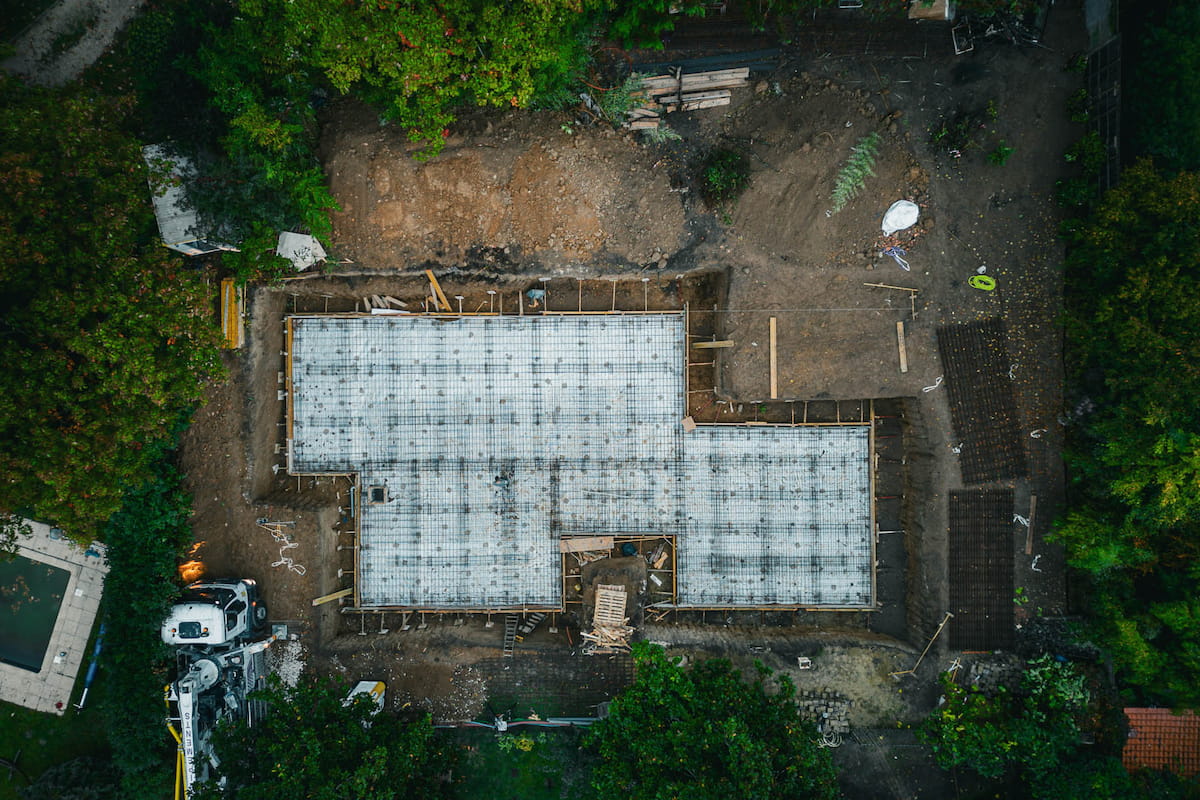
The decisions made underground that determine everything above
Foundation failures in Thai villa construction do not announce themselves at handover. They appear over time, like cracks that open progressively in rendered walls, as doors and windows that gradually stop closing correctly, as floor levels that are no longer level, as water ingress paths that appear during the wet season and cannot be traced to any obvious source. By the time the symptoms are visible, the cause is structural, the remediation is invasive, and the cost is significant.
In flood-prone areas of Thailand such as the coastal lowlands, river valley plots, hillside sites with seasonal water table rise, and any land adjacent to drainage channels or natural watercourses, the foundation decisions are more consequential than anywhere else. The ground beneath these sites changes with the seasons. Water content, soil structure, and load-bearing capacity all vary in ways that a foundation designed without adequate site investigation cannot account for. The consequences of that inadequacy appear predictably, and the timeline is determined by how wrong the assumptions were.
Understanding the specific mistakes that produce foundation failure in flood-prone Thai sites allows them to be avoided at the design stage which is the only stage at which avoidance is possible.
Skipping the geotechnical investigation
The most consequential foundation mistake in Thai villa construction is building without a geotechnical investigation of the specific site. A geotechnical investigation (soil borings and testing that establish the soil profile, load-bearing capacity at depth, groundwater table position, and seasonal variation) is the document that makes every subsequent foundation decision reliable. Without it, every foundation decision is an assumption.
In flood-prone areas, the assumptions made without geotechnical data can be wrong in ways that matter. Coastal and river valley soils in Thailand frequently consist of soft alluvial clay to significant depth, often ten to fifteen metres or more of material with low bearing capacity that consolidates under load and moves with seasonal moisture variation. A foundation designed for normal soil conditions and built on soft alluvial clay will settle. The question is not whether it will settle but whether it will settle uniformly (which is manageable) or differentially, with different parts of the structure settling at different rates, which causes the cracking and distortion that constitutes structural damage.
A geotechnical investigation cost can be modest relative to the total build cost and eliminates the guesswork that produces expensive structural problems. On flood-prone sites specifically, it also establishes the seasonal high water table level, which determines the depth at which pile founding is required and the waterproofing specification for any below-grade elements. Neither of these can be reliably determined without the data.
Underestimating the pile depth required
In areas with soft or saturated soils, a surface foundation is not an option. The load of the building must be transferred to soil or rock at depth capable of bearing it, which usually.requires piles. In some areas and on islands like Koh Samui, the deep underlying rocks make piling tricky, so spread footings are sometimes used, but in most cases, the decision for these conditions is not whether to pile, but only how deep the piling needs to go. Pile depth is determined by where adequate bearing capacity exists in the soil profile, which is established by geotechnical investigation. In soft alluvial areas of Thailand, adequate bearing capacity may not exist until fifteen, twenty, or in some coastal areas thirty metres of depth. Piles that terminate in soft soil above the bearing stratum carry load into material that consolidates under that load. The building settles. If different piles terminate at different depths in material of different stiffness, the settlement is differential and structural damage follows.
The pressure to reduce pile depth comes from cost. Piling is priced per metre and deeper piles cost more. On budget builds and in projects where the geotechnical data has not been obtained, pile depth is sometimes estimated rather than calculated, and estimated conservatively in the direction that reduces cost rather than eliminates risk. The savings at construction stage are real. So is the structural damage that follows when the piles are inadequate for the conditions.
Ignoring seasonal water table variation
A flood-prone site’s water table does not remain at the same level year-round. In Thailand’s wet season, water tables in low-lying coastal and river valley areas rise significantly and sometimes to within a metre or less of the surface on sites that appear stable and dry during the dry season. Foundation and slab designs that are adequate for dry-season conditions can be inadequate for wet-season conditions on the same site.
The practical consequences of inadequate water table consideration are specific. Hydrostatic pressure (the upward force exerted by water on a slab or basement element from below) increases with the height of water above the founding level. A slab designed without consideration of seasonal water table rise and the hydrostatic pressure it produces can lift, crack, or allow water ingress through joints and penetrations as the water table rises beneath it.
Below-grade elements (any part of the building below or close to the seasonal high water table) require waterproofing designed for sustained hydrostatic pressure, not simply for occasional dampness. The distinction between damp-proofing and waterproofing under hydrostatic pressure is significant and the specification appropriate for one is not adequate for the other. In flood-prone areas, the waterproofing specification for any below-grade element must be based on the seasonal high water table level established by geotechnical investigation, not the water table level observed during dry-season site visits.
Building the finished floor too low
In flood-prone areas, finished floor level is a design decision with direct consequences for how the building performs during flood events. The most common mistake is setting the finished floor level at or close to existing ground level without adequate consideration of the flood inundation depth the site is subject to.
The relevant data for this decision is the historical flood level on the specific site or in the immediate surrounding area and not the general elevation of the land and not the flood level on a different part of the same road. Flood inundation in Thailand is highly localised: two plots separated by fifty metres can experience significantly different inundation depths depending on their relationship to drainage channels, roads that act as barriers or conduits, and the micro-topography of the surrounding land.
The correct approach is to establish the design flood level for the site which is usually defined as the highest inundation level observed in living memory, with an additional freeboard, and set the finished floor level above it. The additional elevation required can be achieved through ground raising, through a raised slab on an elevated structure, or through a combination of both. Each approach has implications for access design, step height, and the relationship between indoor and outdoor levels. These implications are design problems with solutions. A flooded ground floor is not a construction problem, it is a consequence of a design decision that cannot be undone without major structural intervention.
Neglecting the drainage design beneath and around the foundation
A foundation in a flood-prone area performs in conditions that include significant water movement through and across the site. Drainage design that manages that water away from the foundation is as important as the structural design of the foundation itself but it is more commonly neglected.
Subsurface drainage beneath a slab-on-grade foundation in high water table conditions — drainage aggregate layers, geotextile membranes, and perimeter drain channels that collect and discharge groundwater before it can exert hydrostatic pressure on the slab — reduces the load on the waterproofing system and improves the long-term performance of the slab in conditions that repeatedly subject it to rising and falling water tables. Without this drainage provision, the waterproofing carries the full hydrostatic load every wet season, and any failure in the waterproofing membrane produces ingress that is difficult to remediate without lifting the floor.
Surface drainage around the foundation perimeter determines whether monsoon rainfall runs away from the building or accumulates against it. Ground that slopes toward the building, planting beds that raise the soil level against the wall base, and hard surfaces that pond water at the building perimeter all direct water toward the foundation. Correct grading (ground that falls away from the building at a minimum gradient throughout the perimeter) is a site design requirement that is established at the earthworks stage and is very difficult to correct after construction is complete.
On hillside flood-prone sites, the additional requirement is intercepting uphill surface runoff and groundwater before it reaches the building. French drains and cut-off drains positioned uphill of the building collect this water and discharge it around rather than through the building site. Without this interception, seasonal water movement from uphill drives moisture toward the foundation from the uphill side regardless of how well the foundation perimeter drainage is designed.
The bottom line
Foundation decisions in flood-prone areas of Thailand are the decisions that determine the structural integrity of the building for its entire life. They are made before the first concrete is poured, they are invisible after construction is complete, and they cannot be corrected without major structural intervention once the building is occupied.
Geotechnical investigation, pile depth calculated from actual soil data, waterproofing specified for the seasonal high water table, finished floor level set above the design flood level, and drainage designed for the water movement the site actually experiences: these are not premium decisions for high-specification projects. They are the proper baseline for any building on flood-prone land that is expected to remain structurally sound over time.
For structured guidance on every stage of a villa build in Thailand — from land purchase through to handover — see The Thailand Build Blueprint™ at thetropicalarchitect.com/the-blueprint
For guidance on your specific project, book a strategy session with Architect Nay at thetropicalarchitect.com/consultations
Working with Nay on your build
If you are planning a build on Koh Samui, the six-step process from land viability to site supervision is set out at the six-step process; for Phuket, start with our Phuket practice. If you are further along and want an experienced second opinion on drawings, a quote or a contractor, talk to Nay directly.