Working with the climate rather than against it
The most common mistake in tropical villa interior design is treating Thailand’s climate as a problem to be solved with air conditioning rather than a condition to be designed around. Villas that fight the climate which are sealed, mechanically cooled, furnished with materials imported from temperate countries, are expensive to run, high maintenance, and often uncomfortable despite significant investment in cooling systems.
Villas designed with the climate in mind are different in character as well as performance. Natural airflow, materials that age well in humidity, lighting that responds to Thailand’s intense and variable light conditions, and spaces that flow genuinely between inside and outside produce interiors that feel right in the tropics rather than merely functional within them.
The principles are not complicated. The application requires thinking about each design decision in terms of what Thailand’s specific conditions demand rather than what looks good in a European design magazine.
Passive cooling starts with furniture layout
Air conditioning is necessary in Thailand’s climate for certain spaces and certain times of year. Designing to reduce dependence on it produces better results at lower running cost than accepting it as the primary comfort strategy from the outset.
Furniture layout directly affects how air moves through a space. Low-profile furniture and open shelving allow air to circulate at floor and mid-levels where it matters most for occupant comfort. High furniture placed across prevailing airflow paths creates barriers that significantly reduce the benefit of natural ventilation even in well-positioned rooms.
Orient seating and work surfaces to benefit from prevailing breezes rather than solely towards the best view. In many Thai villa positions the view and the breeze align conveniently. Where they do not, the breeze usually matters more to daily comfort than the view does.
High ceilings with ceiling fans extend the effective range of natural ventilation by moving air through the full room volume. Fans with corrosion-resistant fixtures and blades, stainless steel or powder-coated aluminium, are the correct specification for coastal humid conditions. Standard fan hardware corrodes and requires replacement within a few years in salt air.
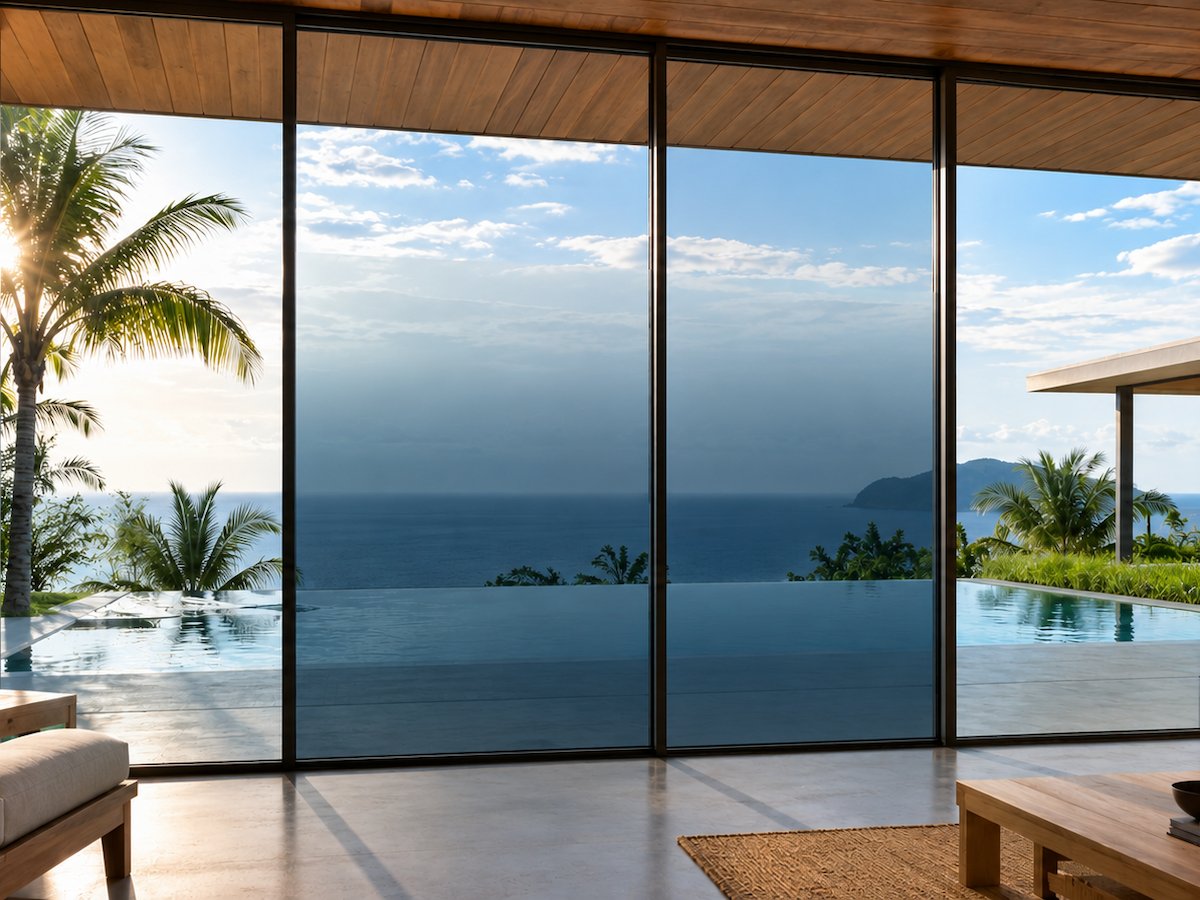
Pocket doors and large folding glass panels that fully open a room to the exterior are the architectural element that makes indoor-outdoor flow genuinely functional rather than a design aspiration. Paired with screened ventilation panels, they allow maximum airflow during dry comfortable conditions and controlled ventilation when insects or rain require partial closure.
Materials that improve with age rather than deteriorating
The material palette for a tropical villa interior is defined by what handles sustained humidity, salt air, and UV exposure without deteriorating. This eliminates a significant proportion of what is standard in temperate climate interior design.
Wall finishes should be breathable: lime-based plasters and breathable acrylic paints that allow moisture vapour to move through the surface rather than accumulating behind it. Vinyl wallcoverings and impermeable surface treatments trap moisture, producing exactly the mould and deterioration they might appear to prevent.
For furniture and joinery, tropical hardwoods, primarily teak and acacia, handle Thailand’s humidity and temperature cycling without the swelling, cracking, and mould that affect softwoods and MDF. The maintenance commitment for tropical hardwood is real, but the alternative is furniture that deteriorates within a few years and requires replacement rather than maintenance. Avoid imported furniture designed for temperate climates. Many adhesives, joinery compounds, and surface finishes that perform well in low-humidity conditions degrade in sustained tropical humidity, sometimes rapidly and in ways that are not apparent until the piece has been in use for a season.
UV-stabilised and mildew-resistant fabrics are the correct specification for any upholstery, cushions, or textiles in the villa. Natural linens and cottons are suitable in well-ventilated spaces with regular maintenance but not in enclosed, intermittently used spaces where they will sit in high humidity between occupation periods.
For flooring, tropical hardwood, large-format porcelain tile, and quality vinyl in appropriate locations all handle Thailand’s conditions well. Laminates and synthetic carpeting do not.
Zoning damp and dry spaces
Moisture management through spatial organisation is one of the most effective and lowest-cost climate strategies available in tropical villa design and one of the most frequently neglected.
Bathrooms, kitchens, and utility areas generate significant moisture. When these spaces open directly into bedrooms or living areas without transition zones, the moisture migrates into spaces where it creates comfort problems and accelerates material deterioration.
Designing breezeways or covered walkways between wet service zones and sleeping and living areas creates a physical separation that allows moisture to dissipate before it reaches living spaces. This is a spatial planning decision made at the design stage and cannot be retrofitted without significant reconstruction.
Within kitchens and utility areas, cross-ventilation is more important than in any other space in the villa. Locate these rooms on the building perimeter with openings on two sides. Utility and laundry spaces that are interior rooms in a tropical villa create persistent humidity problems that are difficult to manage mechanically.
In larger villas, a dedicated drying room with extractor fans handles wet towels, swimwear, and wet-season laundry without adding moisture load to living spaces. This is a small addition to the brief that eliminates a persistent practical problem in tropical living.
Lighting that responds to Thailand’s conditions
Thailand’s natural light is intense, variable, and during monsoon season dramatically changeable within a single day. Lighting design that works in these conditions requires more considered thinking than standard villa lighting.
Clerestory windows, heat-reflective skylights, and light wells in deeper floor plans bring daylight into spaces without the direct solar heat gain that standard windows create. The goal is diffused sky light rather than direct sun penetration: bright enough to reduce artificial lighting dependence without adding significantly to the cooling load.
A single ceiling light per room is inadequate for the range of activities and moods that a well-used villa space needs to accommodate. Layered lighting combines ambient ceiling lighting for general illumination, directional task lighting for work and reading surfaces, and warm accent lighting on dimmers for evening atmosphere. The dimmer is particularly useful in tropical villas where evenings are spent in spaces that transition from daylight brightness to candlelit atmosphere within an hour of sunset.
For fixture specification, avoid standard metal lighting fixtures in coastal locations as they corrode in salt air. Brass, sealed aluminium, or marine-grade stainless steel fixtures maintain their appearance and function in tropical coastal conditions. The selection of lighting fixtures is one of the areas where specifying for conditions rather than appearance alone makes an immediately visible difference within a few years of installation.
Outdoor and indoor continuity: making it genuinely functional
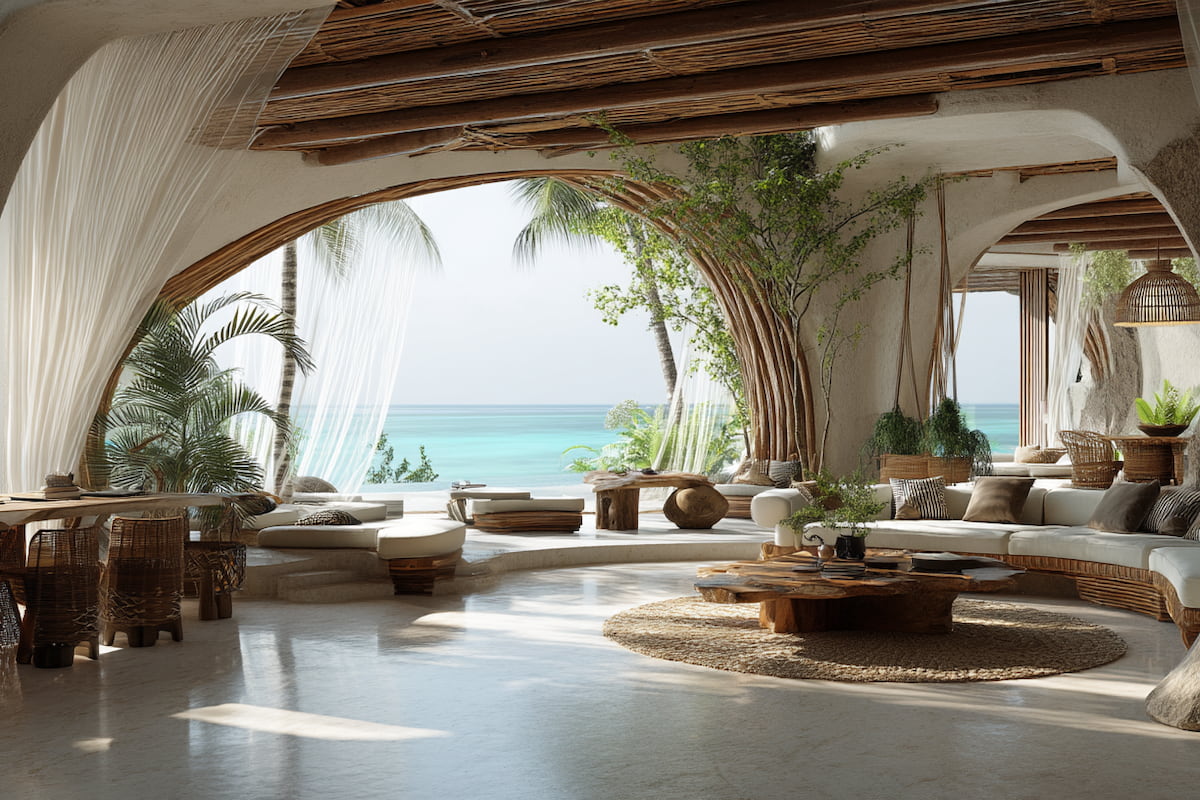
The indoor-outdoor connection is one of the defining qualities of good tropical villa design. It is also frequently executed in ways that look good in photographs but do not function well in practice.
Floor levels that match across inside-outside transitions, both in height and material, create genuine continuity rather than a boundary that is crossed consciously. A step or a significant material change at the threshold signals separation rather than flow.
Outdoor living areas that function as genuine extensions of interior space need the infrastructure that makes them functional: storage for cushions and outdoor equipment, discreet lighting, power and charging points. Outdoor zones treated as decorative rather than functional require items to be carried in and out for every use, which quickly produces a habit of not using them.
Fixed louvres, screens, or retractable shade systems at outdoor-indoor transitions allow the connection to remain open during light rain and high insect activity rather than requiring full closure. Spaces that can only be fully open or fully closed are used less than spaces with intermediate settings.
The mistakes worth specifically avoiding
Sealed interiors without natural ventilation options concentrate on mechanical cooling as the only comfort strategy. When air conditioning fails, and it does during power outages in monsoon weather, these spaces become immediately uncomfortable. Ventilation failure in humid sealed spaces also accelerates mould and decay in ways that are not immediately visible but create persistent problems.
Glossy finishes on floors and walls create glare in Thailand’s bright light conditions, trap heat in dark-coloured variants, and show every mark and water stain from the high-humidity condensation that is normal in tropical living spaces. Matte and satin finishes are the practical specification for most surfaces in a tropical villa interior.
Importing temperate-climate furnishings from international brands with beautiful catalogues introduces pieces designed for conditions that are fundamentally different from Thailand’s. Adhesives soften in sustained heat. Surface treatments degrade in humidity. Metals corrode in coastal salt air. The piece that looks perfect in a European showroom may look acceptable for a season or two in a Thai villa before deteriorating visibly and requiring replacement.
The bottom line
Climate-smart interior design in a Thai tropical villa is the consistent application of clear thinking about what Thailand’s specific conditions require, applied to each design decision in the space. Materials that handle humidity, layouts that support airflow, lighting that responds to intense and variable natural light, and spaces that connect genuinely with the outdoor environment.
The result is a villa that feels designed for where it is rather than adapted from somewhere else, and that performs better, costs less to maintain, and is more pleasant to live in as a direct consequence.
For structured guidance on every stage of a villa build in Thailand — from land purchase through to handover — see The Thailand Build Blueprint™ at thetropicalarchitect.com/the-blueprint
For guidance on your specific project, book a strategy session with Architect Nay at thetropicalarchitect.com/consultations
Designing for the climate from day one
Most comfort problems are decided at the design stage, not fixed afterwards. Nay designs and supervises villas on Koh Samui through our Samui practice and in Phuket through our Phuket practice; the Koh Samui overview and the Phuket build cost guide are useful starting points. For a second opinion on an existing design, talk to Nay directly.