Beyond the tile: choosing a roof covering for a Thai villa
The roof of a Thai villa does more work than any other building element. It intercepts direct overhead sun for most of the day, sheds monsoon rainfall at intensities that would overwhelm a typical temperate climate roof, and determines a significant proportion of the building’s total heat gain. Getting the roof covering right is arguably the single most impactful decision in the thermal performance of the entire building, which is exactly why it deserves more scrutiny than it usually gets.
This series has already covered the assembly beneath the covering in detail, including underlayment and ventilation, and the reasoning behind why roof leaks in Thai villas so often trace back to detailing rather than material choice. This article covers the outer layer itself: the materials and technologies available in 2026, what each one actually contributes to performance in Thailand’s conditions, and where the marketing claims diverge from the operational reality.
Cool roof coatings
Cool roof technology is the category with the widest gap between marketing claims and measurable performance in Thailand’s context, and it is also the one with genuine value once specified correctly rather than chosen on the strength of a brochure.
A cool roof coating is an elastomeric or reflective coating applied to a roof surface that reflects a higher proportion of solar radiation than the uncoated material beneath it. Standard dark roof tiles or metal absorb 85 to 95 percent of incident solar radiation and convert it directly to heat, while a correctly specified cool roof coating with a high solar reflectance index reduces that absorption significantly, lowering the roof surface temperature and the radiant heat load transmitted into the roof space below.
The performance difference is real and measurable rather than marginal. Roof surface temperatures on coated surfaces in Thailand’s direct sun run 20 to 30 degrees Celsius lower than equivalent uncoated surfaces under the same conditions, and that reduction lowers the heat radiated into the roof space, reduces the load on insulation and ventilation systems, and contributes to a meaningfully cooler ceiling surface in the living space below.
For results that actually match this description, specify a solar reflectance index above 80, with higher being better, infrared emittance above 0.85, and UV stability appropriate for Thailand’s radiation levels over a ten-year service life without significant degradation. Products that meet these specifications exist in Thailand’s market, and products marketed as cool roof coatings without meeting them also exist in the same market, performing substantially below what the label implies. Ask for the technical data sheet rather than the marketing brochure, and treat any supplier who cannot produce one with appropriate scepticism.
Application quality determines performance nearly as much as the product itself. A cool roof coating applied over a dirty, cracked, or improperly primed surface will peel, crack, and lose adhesion within a wet season or two regardless of how good the underlying product is. Surface preparation is not a finishing detail here. It is the precondition for the coating performing anywhere close to its specification.
Metal roofing systems
Standing seam metal roofing has become increasingly common in Thai villa construction for reasons that are directly about performance rather than aesthetics. A correctly specified metal roof offers a design life significantly longer than clay or concrete tiles, drainage performance that handles monsoon rainfall intensities without the tile lap infiltration risk that drives rain exposure on lower pitch tile roofs, and a substrate that accommodates solar panel integration more cleanly than any tile system available.
The performance variables that matter in Thailand’s conditions are material specification and fixing method. Steel roofing in coastal salt air environments corrodes at fixings and at any breach in the surface coating within a few years of installation unless the steel substrate is adequately specified from the outset. Zincalume or Colorbond equivalent coated steel provides substantially better corrosion resistance than standard galvanised sheet in coastal applications, and aluminium standing seam is the appropriate specification in the most exposed coastal and island locations, where steel corrosion risk is highest regardless of coating quality.
Thermal expansion in Thailand’s temperature cycling is more significant than in temperate climates, and metal roofing expands and contracts substantially between the temperature of a sun-heated roof surface at midday and its cooled state after night rain. Standing seam systems that allow the panel to float relative to the fixing clip accommodate this movement without stress, while through-fixed metal roofing that does not allow panel movement develops fastener holes that enlarge over time and eventually leak, however well the initial installation was carried out.
The noise performance of metal roofing under monsoon rainfall is a legitimate consideration in a residential building rather than a minor detail. Uninsulated metal roofing in a heavy rain event is genuinely loud in the space below, loud enough to disrupt conversation or sleep. Spray polyurethane foam applied to the underside of the metal deck, covered in the insulation article in this series, addresses both thermal performance and impact sound simultaneously, and is the appropriate specification for metal roofing in habitable villa spaces rather than an optional acoustic upgrade.
Photovoltaic integrated roofing
The integration of solar photovoltaic generation with the roof covering has moved from architectural novelty to practical specification option in Thailand’s market over the past few years, and it is worth understanding as part of the roof covering decision rather than as a separate consideration bolted on afterwards. Two distinct approaches are available, and they perform differently enough to warrant separate treatment.
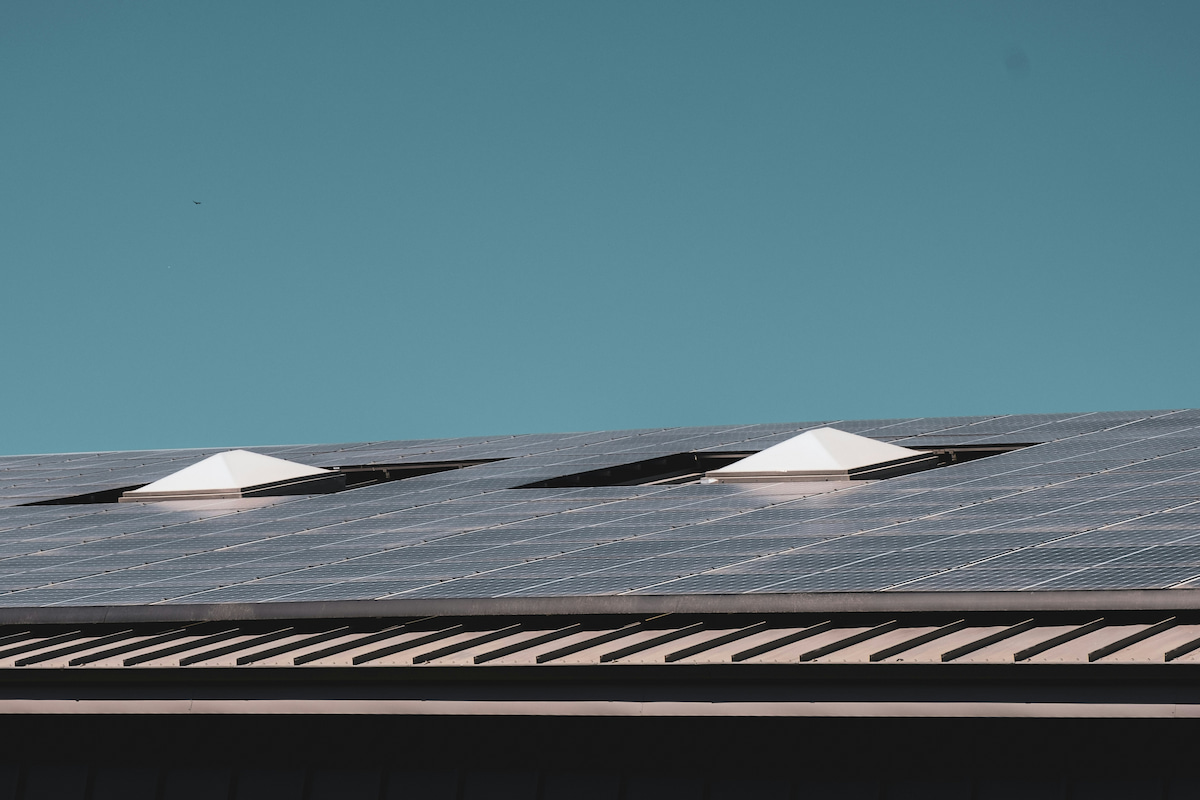
Roof-mounted panel arrays, meaning standard PV panels installed on a racking system above the existing roof covering, remain the dominant approach in Thailand for good reason. The panels are installed by specialist solar contractors, the racking allows air circulation beneath the panel that moderates panel temperature and maintains generation efficiency, and the existing roof covering beneath provides the primary weatherproofing layer independently of the panels above it. If a panel fails or requires replacement, the roof itself continues to function without interruption, which is a meaningful practical advantage discussed further in our overview of solar power for tropical villas in Thailand.
Building-integrated photovoltaics, where the PV module replaces the roof covering rather than sitting above it, eliminate the air gap that moderates panel temperature. Panels operating in direct contact with the roof structure in Thailand’s solar intensity run hotter than rack-mounted panels and produce less power per unit area as a result. They also make the panel itself the primary waterproofing layer rather than a secondary element sitting above an independent weatherproof roof, and in Thailand’s monsoon conditions this requires a level of weather-tight panel integration and detailing that adds cost and complexity without improving generation performance in return.
For most Thai villa projects, the practical specification is rack-mounted panels on a metal or tile roof designed to carry the panel loading, with adequate structural support designed into the roof from the outset rather than retrofitted once the roof is already built. The roof-to-panel interface and the cable penetration detailing require careful specification to prevent water ingress at exactly the points where the panel mounting penetrates or engages the roof covering, which is precisely where the majority of solar-related roof leaks originate.
Membrane roofing for flat and low-pitch applications
Flat and low-pitch roofs present waterproofing requirements that tile and metal systems cannot meet reliably. Tile roofing requires a minimum pitch for drainage, and while metal standing seam can achieve lower pitches, it requires more careful detailing at junctions and penetrations as the pitch decreases. Below approximately five degrees of pitch, a membrane roofing system is the appropriate solution rather than an adapted version of either alternative.
Modified bitumen membrane systems, applied in multiple layers with reinforcement, and single-ply thermoplastic membranes such as TPO or PVC, are the two categories with adequate track records in Thailand’s climate conditions. Both require application by contractors with specific experience in the system, since membrane roofing quality is determined almost entirely by installation rather than by the membrane product alone, regardless of how good that product’s specification looks on paper.
The critical details sit at penetrations, upstands, and drainage outlets. A membrane roof that is perfectly watertight across its field area but inadequately detailed at a pipe penetration or a parapet junction leaks exactly where that one detail was inadequate, no matter how well the rest of the installation was executed. Drainage outlets must be positioned and sized for peak monsoon flow, since a membrane roof that ponds water for extended periods after rain events accelerates membrane degradation and adds structural loading that the roof may never have been designed to accommodate in the first place.
The bottom line
The roof covering decision in a Thai villa is a thirty-year commitment to the performance characteristics of whatever material is chosen, which makes it worth far more design attention than it typically receives. Cool roof coatings reduce heat gain meaningfully when correctly specified and applied. Metal roofing provides longevity and drainage performance that tile cannot match on lower pitch applications. Membrane roofing is the only genuinely viable system for flat roof sections. Solar integration is most practically achieved through rack-mounted panels on a roof designed to carry them from the outset rather than adapted after the fact.
Each of these choices intersects with the underlayment, ventilation, and insulation decisions covered elsewhere in this series, and none of them performs independently of the assembly beneath it, however good the covering material itself might be in isolation.
The full build process, from land purchase through to handover and beyond, will be covered in The Thailand Build Blueprint™, so sign up for early access.
If something about your own design or construction is genuinely keeping you up at night, whether that is a build issue, a contractor you are not sure you trust, or a structural concern you cannot get a straight answer on, book a Strategy Session with Nay to work through it directly.
Designing for the climate from day one
Most comfort problems are decided at the design stage, not fixed afterwards. Nay designs and supervises villas on Koh Samui through licensed Koh Samui architect and in Phuket through licensed Phuket architect; the Koh Samui overview and the Phuket build cost guide are useful starting points. For a second opinion on an existing design, get a second opinion.