The wrong starting point
Most foreign buyers approach insulation with assumptions shaped by experience in temperate climates, where insulation is primarily about thermal retention and the need for keeping heat generated inside the building from escaping through the envelope. The metric that dominates temperate climate insulation decisions is R-value: resistance to conductive heat flow through the material.
In Thailand’s tropical climate, this framing is wrong in ways that matter. The problem is not heat escaping, it is heat entering. Roof surfaces in Thailand’s direct sun reach 60 to 80 degrees Celsius. The air conditioning inside is typically set to 22 to 25 degrees. The insulation system must slow the transfer of that 40 to 55 degree temperature differential from outside to inside, while also managing radiant heat, which is the infrared energy emitted by a superheated roof surface that conductive insulation alone does not address.
The insulation system that performs well in Thailand combines materials that address both conductive and radiant heat gain. Understanding the distinct performance characteristics of each material type is the starting point for making that combination correctly.
Reflective foil insulation
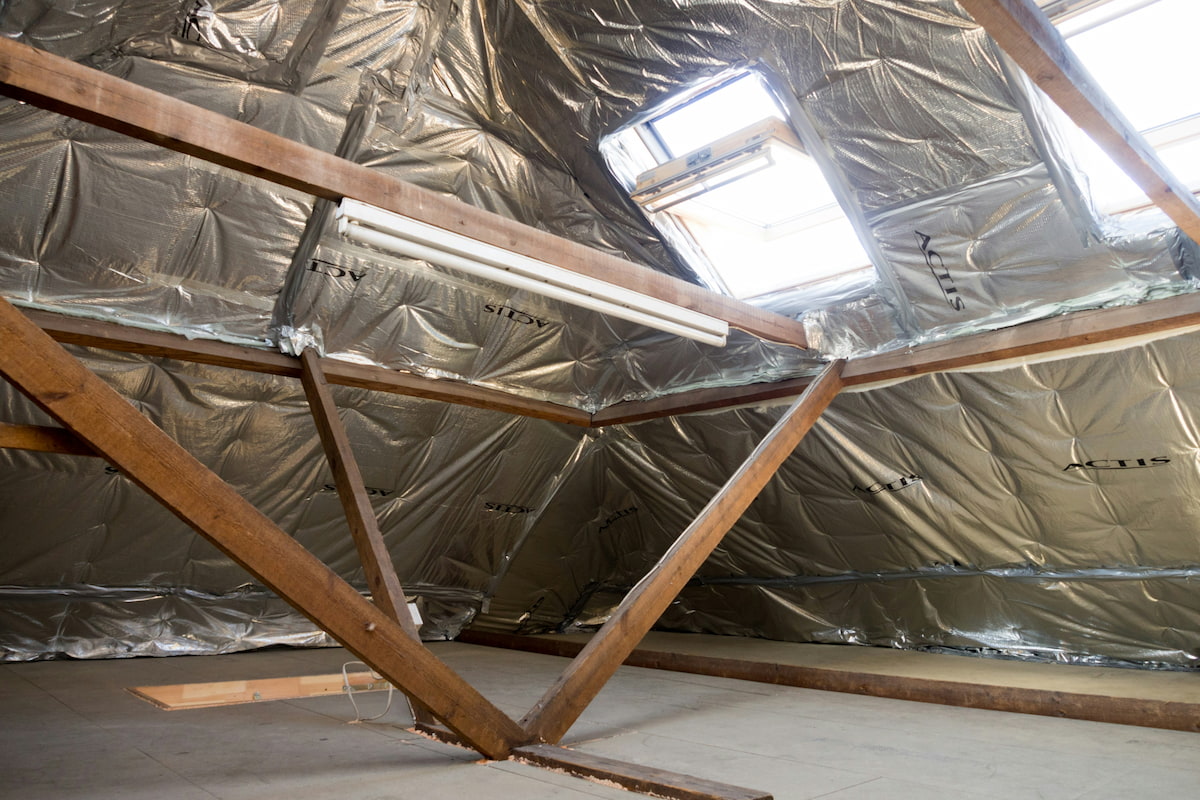
Reflective foil is the most widely used insulation material in Thai villa construction and the most important to understand correctly, because its performance depends entirely on how it is installed, not simply on whether it is present.
Reflective foil works by reflecting radiant heat rather than absorbing and conducting it. A foil surface facing an air gap reflects up to 95 percent of the radiant energy that strikes it. In a roof assembly where a superheated tile or metal surface is radiating intense infrared energy downward, a correctly installed foil layer with an air gap beneath it reflects that energy back before it can be conducted into the ceiling and living space below.
The air gap is the non-negotiable requirement. Foil in contact with a solid surface, whether directly against a roof deck, against insulation batts, or with the air gap blocked by insulation laid on top, loses its reflective function almost entirely. It becomes a thin layer of aluminium with negligible thermal resistance, contributing almost nothing to the assembly’s performance. This is the most common and most consequential installation error in Thai villa roofs.
In practice: the foil must be installed with a minimum 25 millimetre air gap on its reflective face, and ideally with air gaps on both faces. The orientation matters as the foil should face the dominant heat source, which in a roof assembly means facing upward toward the underside of the roof covering and the superheated air space above. Combined with the eave-to-ridge roof ventilation that removes hot air from the roof space, correctly installed reflective foil is highly effective at reducing radiant heat gain in Thailand’s conditions.
Foil is lightweight, easy to install during construction, and widely available in Thailand. It is the appropriate first line of defence against radiant heat gain in any Thai villa roof assembly. Its limitation is that it addresses radiant heat well and conductive heat transfer poorly and so it is not adequate as the sole insulation material in a well-specified assembly.
Glass wool and mineral wool batts
Glass wool batts (also referred to as fibreglass insulation) address the conductive heat transfer that reflective foil does not. Where foil reflects radiant energy, glass wool slows the conduction of heat through the assembly by trapping still air within its fibrous matrix. The R-value of glass wool increases with thickness: a 50 millimetre batt at standard density provides modest thermal resistance, while 100 millimetres provides meaningful resistance to conductive gain.
In Thailand’s climate, glass wool batts perform the role of slowing heat that has already passed the reflective foil layer — the conductive component of total heat gain that foil alone cannot address. Installed in the ceiling plane below the roof space, glass wool reduces the rate at which roof space heat conducts through the ceiling into the living space. Combined with reflective foil above and adequate roof ventilation that keeps the roof space temperature lower, the assembly addresses both components of heat gain effectively.
The installation challenge for glass wool in Thailand’s climate is moisture. Glass wool absorbs moisture and loses thermal performance when wet. In a roof space with inadequate ventilation, condensation can accumulate in glass wool batts, reducing their effectiveness and eventually promoting mould growth within the insulation layer. The specification requirement is a vapour-permeable facing on the warm-side of the batt combined with adequate roof ventilation to prevent moisture accumulation. Batts installed in a sealed, unventilated roof space in Thailand’s humid conditions are working against the climate rather than with it.
Mineral wool (rock wool or slag wool) performs similarly to glass wool in thermal terms and has somewhat better moisture resistance and higher fire resistance. It is available in Thailand but less commonly stocked than glass wool. Where fire resistance of the roof assembly is a design priority, mineral wool is worth specifying.
Rigid foam insulation
Rigid foam boards made up of primarily expanded polystyrene (EPS), extruded polystyrene (XPS), and polyisocyanurate (PIR or polyiso), provide higher R-values per unit thickness than glass wool and are not subject to the moisture absorption that affects batt insulation performance.
XPS and PIR boards are the appropriate specification for any application in Thailand where moisture resistance is required alongside thermal performance: roofs with less than ideal ventilation, under-slab applications in flood-prone areas, and any position where the insulation will be exposed to water ingress risk. XPS has a closed-cell structure that resists moisture absorption; PIR has even higher R-value per millimetre and good moisture resistance, though it requires protection from direct UV exposure and sustained high temperatures at the surface.
EPS (standard white expanded polystyrene) is widely available in Thailand and commonly used in roof assemblies as a low-cost solution. Its R-value per millimetre is lower than XPS or PIR, it absorbs more moisture than closed-cell alternatives, and it degrades under UV exposure without surface protection. For visible or exposed positions, EPS is not the appropriate specification. For enclosed positions within a well-detailed assembly, it provides acceptable thermal resistance at low cost.
In a Thai villa, the most effective roof insulation combines rigid foam boards to block heat conduction and reflective foil to stop radiant heat. For this to work, a ventilated air gap must be maintained above the foil.
On flat or low-pitch roofs where natural airflow (eave-to-ridge) isn’t possible, using high-spec rigid foam alongside reflective foil is the best way to compensate for the lack of a ventilation system.
Spray polyurethane foam
Spray polyurethane foam (SPF) is applied as a liquid that expands and cures to form a rigid closed-cell foam. It provides the highest R-value per millimetre of any insulation type available in Thailand, adheres to the substrate it is applied to, and seals air infiltration pathways as it cures, addressing both thermal resistance and air sealing in a single application.
In Thai villa construction, spray foam is most effectively applied to the underside of the roof deck, creating a conditioned or semi-conditioned roof space rather than a ventilated one. Where this approach is taken, the roof space is brought within the thermal envelope of the building: the insulation layer is at the roof deck rather than the ceiling plane, and the roof space below operates at close to interior temperatures rather than the extreme temperatures of a ventilated or uninsulated roof space.
The advantages are significant for complex roof geometries where ventilation detailing is difficult, and for metal roofing systems where the roof deck is the primary surface preventing heat entry. The disadvantages are cost as spray foam is the most expensive insulation option by a significant margin, and the expertise required for correct application. Incorrectly applied spray foam with inadequate density, inconsistent thickness, or poor adhesion performs substantially below its rated R-value. Specifying spray foam requires a contractor with documented experience in tropical roof applications, not simply experience with the product.
UV exposure degrades the surface of exposed spray foam rapidly. Any spray foam application that will be exposed to light requires a protective coating (typically a UV-stable elastomeric coating) applied over the cured foam. This is not an optional finish detail; it is the protection that prevents the foam’s performance from degrading within a few years of application.
Aerogel insulation
Aerogel insulation is available in blanket form for construction applications and provides the highest R-value per millimetre of any insulation material in commercial use. In positions where thickness is severely constrained, aerogel provides thermal resistance that no other material can match at the same thickness.
In Thai villa construction, aerogel is relevant for specific applications: thin wall assemblies where adding thickness for conventional insulation would compromise the architectural intent, retrofitting thermal improvement into existing buildings where opening walls is not practical, and high-specification details around thermal bridges in otherwise well-insulated assemblies.
The barrier to specification is cost. Aerogel blanket insulation costs significantly more per square metre than any conventional insulation alternative, and the performance advantage over a thicker rigid foam assembly is not always sufficient to justify the premium except in the specific positions where thickness is genuinely the constraint. It is a specialist material for specific applications rather than a primary insulation specification for most Thai villa projects.
How the materials work together
The correct insulation approach for a Thai villa roof assembly is a combination of materials, each addressing a different component of heat gain rather than a single material at maximum thickness.
The sequence that performs well in a pitched roof with adequate ventilation: a breathable underlayment beneath the roof tiles to manage any water ingress; a ventilated air space beneath the underlayment removing hot air continuously; reflective foil with its own air gap below, reflecting radiant heat from the roof space; and glass wool or rigid foam batts in the ceiling plane below, addressing the conductive heat that passes through the assembly despite the reflective layer above.
For flat or low-pitch roofs where ventilation is limited: high-specification rigid foam (PIR or XPS) at adequate thickness beneath the roof deck, combined with reflective foil on the underside facing the interior air space, addresses both components without depending on the ventilation that the roof form cannot provide.
For metal roofs specifically: metal roofing transmits radiant heat with particular efficiency and generates significant noise under monsoon rainfall. Spray foam applied to the underside of the metal deck addresses both — the closed-cell foam provides thermal resistance and substantially reduces impact sound transmission from rainfall. The application requires the UV-protective coating over any exposed foam edges.
What correct specification looks like in practice
The material selection decision follows from three questions: what is the roof form and what ventilation strategy is achievable; what is the building’s proximity to the coast and what moisture resistance is required of the insulation; and what is the budget position relative to the performance target.
For a well-ventilated pitched roof in a non-coastal location, reflective foil with air gaps combined with glass wool batts in the ceiling plane is the standard appropriate specification. It is effective, widely available in Thailand, and reasonable in cost.
For a coastal location with higher moisture exposure, substituting XPS or PIR boards for glass wool addresses the moisture resistance requirement without compromising thermal performance.
For a flat or complex roof where ventilation is limited, rigid foam at adequate thickness becomes the primary thermal mass and reflective foil the supplementary radiant barrier, with the understanding that the assembly is working harder than a ventilated pitched roof assembly and the foam specification needs to reflect that.
For any roof the performance of the insulation system is determined by the quality of the installation as much as the quality of the materials. Air gaps that are blocked, foil that is installed without clearance, and batts that are compressed below their rated thickness all perform below specification. Verification during construction done before the ceiling or roof lining closes the assembly, is the only point at which installation errors can be identified and corrected without significant remediation cost.
The bottom line
Insulation in Thailand is not the same problem as insulation in a temperate climate and the solutions are not the same. The materials that address radiant heat gain such as reflective foil, correctly installed with maintained air gaps, are as important as the materials that address conductive gain. Neither is sufficient alone.
Specify the combination appropriate to the roof form and site conditions. Verify the installation before the assembly is closed. The difference between a villa that requires continuous air conditioning to remain habitable and one that maintains comfortable temperatures with moderate cooling load is largely determined by what is inside the roof and in the layers that. no one will ever see again once the building is complete.
For structured guidance on every stage of a villa build in Thailand — from land purchase through to handover — see The Thailand Build Blueprint™ at thetropicalarchitect.com/the-blueprint
For guidance on insulation specification for your specific project, book a consultation at thetropicalarchitect.com/consultations
Designing for the climate from day one
Most comfort problems are decided at the design stage, not fixed afterwards. Nay designs and supervises villas on Koh Samui through licensed Koh Samui architect and in Phuket through licensed Phuket architect; the Koh Samui overview and the Phuket build cost guide are useful starting points. For a second opinion on an existing design, get a second opinion.