Why solar in Thailand makes sense
Thailand sits between 5 and 20 degrees north of the equator. At these latitudes solar irradiance is high, consistent, and unlike temperate countries where seasonal variation dramatically affects system output, relatively stable year-round. A solar system in Thailand generates useful power on most days including overcast ones, rather than producing significant output only during summer months as systems at higher latitudes do.
For Thai villas carrying significant electrical loads, air conditioning, pool pumps, water heating and refrigeration, this consistency matters practically. The system can be sized for actual year-round use rather than oversized to compensate for poor winter performance. The return on investment calculation is more straightforward because output does not vary dramatically by season. This is the genuine solar advantage for Thai villa owners and it is worth understanding as physics that affects how a system should be specified and what it can realistically deliver, not as marketing language.
What a complete solar installation actually involves
The most common misconception among foreign buyers commissioning solar is that panels constitute a solar installation. They do not. A complete system has five components and the decisions made on each one determine whether the installation performs as specified or quietly underdelivers for years.
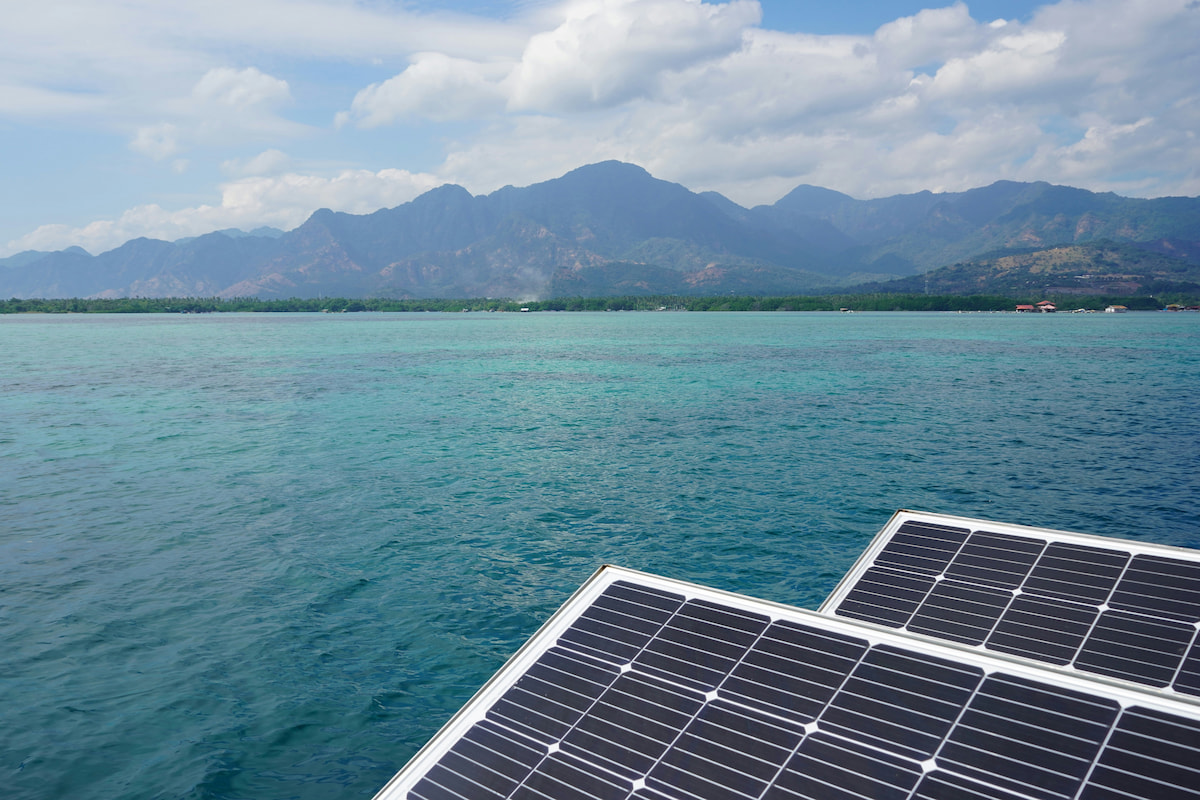
The photovoltaic panels convert sunlight to direct current electricity. Panel output is rated in watts peak, which represents output under standard test conditions. Real-world output is typically 75 to 85 percent of that rated figure due to temperature effects, soiling and installation factors. The inverter converts that direct current to alternating current for villa use, and in grid-tied systems it synchronises with the grid supply. Inverter quality significantly affects system efficiency and reliability and it is not a component to economise on.
Battery storage, where included, holds excess daytime generation for night-time use or grid outage backup. The mounting system fixes panels to the roof or ground and its specification for wind loads and salt air conditions matters as much for longevity as the panels themselves. The grid connection or generator backup determines how the system behaves when solar generation is insufficient. Grid-tied systems export surplus power and import when needed. Off-grid systems rely on battery storage and typically include a backup generator for extended low-generation periods.
Panel specification for tropical conditions
Not all solar panels perform equally in Thailand’s specific combination of high temperature, humidity, salt air and UV intensity. The specification details that determine long-term performance are precise and worth understanding before signing off on any contractor proposal.
Solar panels lose efficiency as temperature increases, a characteristic expressed as the temperature coefficient of power. At Thailand’s typical panel surface temperatures of 50 to 70 degrees Celsius in direct sun, this coefficient becomes a meaningful performance differentiator between products. Panels with a temperature coefficient below minus 0.35 percent per degree Celsius should be the minimum specification. Better-performing panels reach minus 0.26 percent and maintain higher output during the hottest months when cooling loads are at their peak and the solar resource should be delivering maximum benefit.
For coastal locations, salt mist corrosion resistance becomes a separate and non-negotiable requirement. Standard panel certifications do not include salt mist testing. The corrosion affects frame aluminium, junction box seals and electrical connections over time, reducing output and eventually requiring panel replacement. Specify panels with IEC 61701 salt mist test certification and anodised aluminium frames for any location within 500 metres of the sea. This is not a refinement. It is the difference between a system that holds its performance for 20 years and one that begins degrading visibly within five.
Quality panels from established manufacturers carry 25-year linear power output warranties, guaranteeing output above a specified percentage of rated power throughout that period. That warranty is only as good as the manufacturer’s ability to honour it, so specify panels from manufacturers with established international presence and financial stability rather than unknown brands offering equivalent warranty language on paper.
Sizing a system correctly
The figure of 10 to 12 panels for a three-bedroom villa that appears frequently in contractor proposals is a reasonable starting point only if the objective is partial offset rather than full daytime coverage. Correctly sizing a solar system requires an actual load assessment, not a room count.
The approach is straightforward. Identify all significant electrical loads with their wattage and daily operating hours. A 12,000 BTU split air conditioning unit draws approximately 1,200 watts. Running eight hours per day produces a daily load of 9.6 kilowatt hours per unit. A pool pump running six to eight hours adds 750 to 1,500 watts over that period. Water heaters, refrigeration, lighting and appliances complete the picture. Sum the daily kilowatt hour requirement and divide by the average daily solar generation per panel in Thailand, approximately 1.2 to 1.5 kilowatt hours per 300 watt peak panel per day, to arrive at the panel count required for daytime demand coverage.
A three-bedroom villa with two air conditioning units, a pool and standard appliances typically carries a daily load of 25 to 40 kilowatt hours. Full daytime coverage requires 20 to 35 panels, not 10 to 12. The lower figure covers partial offset. Both are valid system designs depending on the financial objective, but they should be understood as different outcomes rather than equivalent ones. A contractor who does not begin with a load assessment is not sizing a system. They are guessing.
Battery storage and the decision that defines the system
Battery storage transforms solar from a daytime electricity source into a 24-hour power system. It is also the most significant cost component and the specification decision with the most variation in quality and consequence.
Lithium iron phosphate chemistry, known as LFP, is the correct specification for Thai tropical villa battery storage. LFP batteries operate safely at higher ambient temperatures than standard lithium-ion NMC chemistry, which matters in Thailand where battery systems are typically installed in plantrooms or outdoor enclosures that reach sustained high temperatures. LFP delivers a longer cycle life, typically 3,000 to 5,000 charge cycles against 500 to 1,000 for NMC, and a safer failure mode without the thermal runaway risk that makes NMC chemistry a genuine fire concern in tropical heat. Any contractor proposing NMC chemistry for a Thai villa battery installation is either uninformed or cutting costs at the owner’s expense.
Capacity should be sized against realistic overnight load rather than total daily load. Daytime solar generation covers daytime demand directly and the battery only needs to carry overnight requirements. For a villa wanting overnight coverage of essential loads, one air conditioning unit, refrigeration and basic lighting, 10 to 15 kilowatt hours of usable capacity is a practical minimum. LFP batteries should not be discharged below 20 percent of rated capacity for longevity, so the effective usable capacity is 80 percent of the rated figure. A 15 kilowatt hour battery provides 12 kilowatt hours of usable storage.
The installation environment is as important as the specification. Battery systems generate heat during charge and discharge cycles. A sealed, unventilated enclosure in direct Thai sun creates temperature conditions that accelerate degradation regardless of chemistry. Ambient temperatures above 40 degrees Celsius sustained over time reduce LFP cycle life significantly. This is a detail that appears in no sales brochure and costs nothing to get right during construction, but costs considerably more to rectify afterward.
Orientation, tilt and ventilation
In Thailand’s northern hemisphere location, panels face south for maximum annual output. Where roof geometry does not provide a south-facing surface, east-west split installations provide lower peak output but more consistent generation across the day, which suits villa load profiles distributed throughout the day rather than concentrated at midday.
A tilt angle of 15 to 20 degrees from horizontal optimises annual output at Thai latitudes. Flat or near-flat roofs benefit from tilt frames that achieve this angle. Steeper tilts reduce annual output and should be questioned if a contractor proposes them without clear justification.
Ventilation beneath the panels is a specification point that is frequently overlooked and consistently undervalued. Panel efficiency decreases with increasing temperature and at Thailand’s ambient temperatures, panels operating without underside ventilation reach surface temperatures that reduce output by 10 to 15 percent compared to well-ventilated installations. Mounting systems should provide at least 100 millimetres of clearance between the panel underside and the roof surface. This also extends roof membrane life, since a panel held tight to a roof surface transfers heat directly to the waterproofing layer below, accelerating its degradation from two directions simultaneously.
Grid-tied, hybrid or off-grid
The simplest and lowest-cost configuration is a grid-tied system without battery storage. It exports surplus daytime generation to the grid and imports at night. It provides no power during grid outages, which is a relevant limitation in Thailand where monsoon weather causes periodic disruption. This configuration suits villas with reliable grid supply where reducing electricity costs is the primary objective.
A grid-tied system with battery backup provides outage protection for defined critical loads while still using the grid as the primary backup for full villa demand. This is the practical configuration for most Thai villa owners who want the benefit of solar without compromising on reliability.
Full off-grid operation requires a larger panel array and battery capacity to cover all loads including extended low-generation periods during cloudy weather. It almost always includes a backup generator. This is the correct configuration for villas in locations without reliable grid access, remote hillside positions, island locations with poor grid infrastructure, or sites where the cost of grid connection makes off-grid economics favourable from the outset.
What the financial returns actually look like
Solar system financial returns in Thailand are genuine but should be based on accurate assumptions rather than optimistic projections from contractors with an interest in the sale.
A quality grid-tied system without battery for a typical three-bedroom villa, 20 to 25 panels with a quality inverter and professional installation, costs approximately 300,000 to 500,000 baht (2026). Adding LFP battery storage adds 150,000 to 300,000 baht depending on capacity. At Thai residential electricity tariffs and with a correctly sized system, payback periods of six to ten years are realistic for grid-tied systems. Battery storage extends payback periods. The financial case for battery is energy security rather than pure financial return in most Thai villa situations, and it should be evaluated on those terms.
For rental villas the calculation shifts. Solar-equipped properties carry genuine marketing value, reduced electricity costs improve net rental yield directly, and the combination of operational savings and positioning advantage improves the financial case compared to owner-occupied equivalents. Whether that improvement closes the payback gap depends on occupancy rates and electricity consumption patterns specific to each property.
Thailand’s solar resource is consistently strong, the technology is mature, and the financial returns over a 10 to 15 year horizon are real. None of that matters if the system is incorrectly specified. Panel temperature coefficient and salt air certification, LFP battery chemistry, system sizing from an actual load assessment, proper panel ventilation, quality inverter specification and correct installation environment for battery storage are not refinements to a standard proposal. They are the specification. A system that gets these decisions right performs as expected for 20 years. A system that gets them wrong looks identical on the day of installation and reveals its failures gradually, expensively and usually after the contractor has moved on.
For guidance on anything specific for your project, book a Strategy Session with Nay, a senior Thai architect with over a decade of experience.
The full build process (from land purchase through to handover) is covered in The Thailand Build Blueprint™ which will be released in July 2026, so sign up for early access.
Designing for the climate from day one
Most comfort problems are decided at the design stage, not fixed afterwards. Nay designs and supervises villas on Koh Samui through Architect Samui and in Phuket through Architect Phuket; the Koh Samui overview and the Phuket build cost guide are useful starting points. For a second opinion on an existing design, book a strategy session.