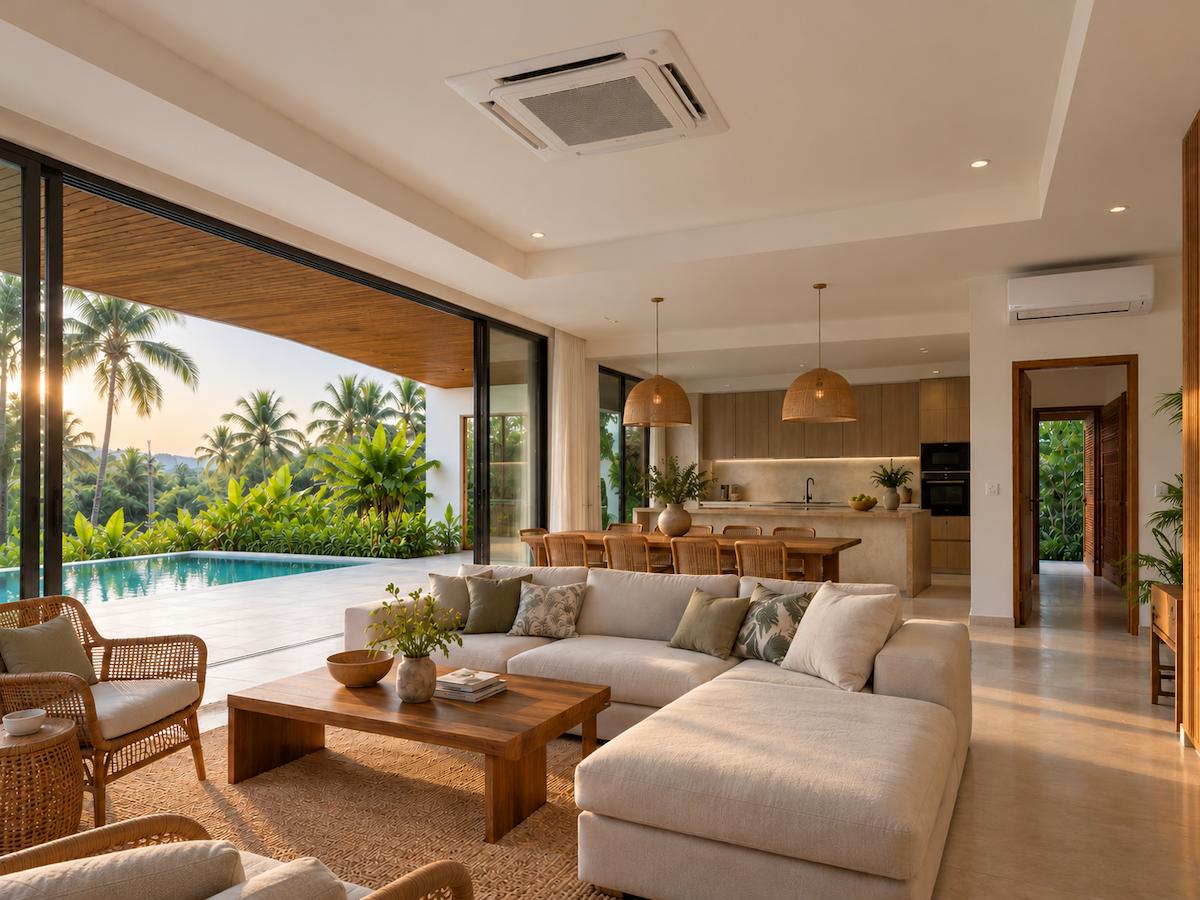
Ceiling cassette or wall-mounted air conditioning for a tropical villa
Almost every villa and house built in Thailand, from Bangkok and the beach resorts to the islands and the north, ends up with split-system air conditioning in its bedrooms and living spaces, and at some point during design the question comes up of which indoor unit to use. The two common choices are the wall-mounted split, the familiar white unit fixed high on the wall, and the ceiling cassette, which sits inside a dropped ceiling with only a square grille showing. Both connect to an outdoor condensing unit in the same way and both cool the air with the same refrigeration cycle. Where they differ is in how they move air around a room, what they demand from the building around them, and what it takes to keep them clean in a hot, humid climate where air conditioning runs for most of the year.
The short answer is that cassettes are better at spreading cool air evenly through large open rooms and they keep walls clear, but they cost more, depend on a ceiling designed around them, and are noticeably harder to maintain. In most villas the right result is a mix of the two rather than one system throughout, and the decision belongs at the design stage, not at the point when the electrician arrives.
How each system moves air
A wall-mounted unit blows air from a single outlet along one side of the room and relies on its louvres and fan to throw that air across the space. In a reasonably square room of up to around 25 to 30 square metres this works perfectly well. In a long or very large room it starts to struggle, and the result is a familiar pattern where people sitting close to the unit feel a cold draught while the far end of the room stays warm.
A cassette is normally placed near the centre of the ceiling. It draws room air up through the middle of its grille and pushes cooled air out in four directions at once, so the cooling spreads more evenly and there are fewer hot corners. At the same BTU rating, a cassette does not cool harder than a wall unit. The difference is distribution, and that difference only really pays off in larger, open rooms with people spread around them, such as an open-plan living and dining space.
Why room size and humidity matter here
This is the point that is most often missed. Cassettes are built for bigger spaces, and the smallest models on the Thai market start at roughly 13,000 BTU, with most ranges beginning at 18,000 BTU or more. A typical villa bedroom of 16 to 20 square metres usually needs somewhere in the region of 9,000 to 12,000 BTU, and wall units are widely available in exactly those sizes. Our guide to sizing air conditioning for a tropical villa explains how that capacity should be worked out room by room.
Putting an oversized unit into a small room is not a harmless safety margin in the tropics. An oversized air conditioner reaches its set temperature quickly and then spends much of its time running at minimum or switching off, and during that time it removes far less moisture from the air. The room ends up cool but clammy, bedding and wardrobes stay damp, and the conditions for mould improve rather than worsen. Inverter compressors soften this effect, but they cannot fully correct a unit that is simply too big for the room. For bedrooms, studies and smaller rooms, this alone usually decides the matter in favour of a correctly sized wall unit.
What a cassette asks of the building
A cassette cannot be added as an afterthought. It needs a dropped ceiling with enough depth above it to take the body of the unit, the refrigerant pipes, the electrical feed and a drain line with a proper fall. Manufacturers in Thailand typically ask for at least 25 to 30 centimetres of clear void depending on the model, and some installers will not fit one without around 40 centimetres between the finished ceiling and the underside of any beam. That depth has to be found somewhere, which usually means either a taller floor-to-floor height or a lower finished ceiling in the room.
The unit itself is heavy and is hung from the structure above on threaded rods, while the gypsum ceiling needs extra framing around the opening so the grille sits flush. Beams, downlights, ceiling fans and pipe routes all have to be coordinated around it on the drawings. In villas designed with exposed timber, raked or vaulted roofs, or a fair-faced concrete soffit, a cassette is either impossible or forces a ceiling that undermines the architecture.
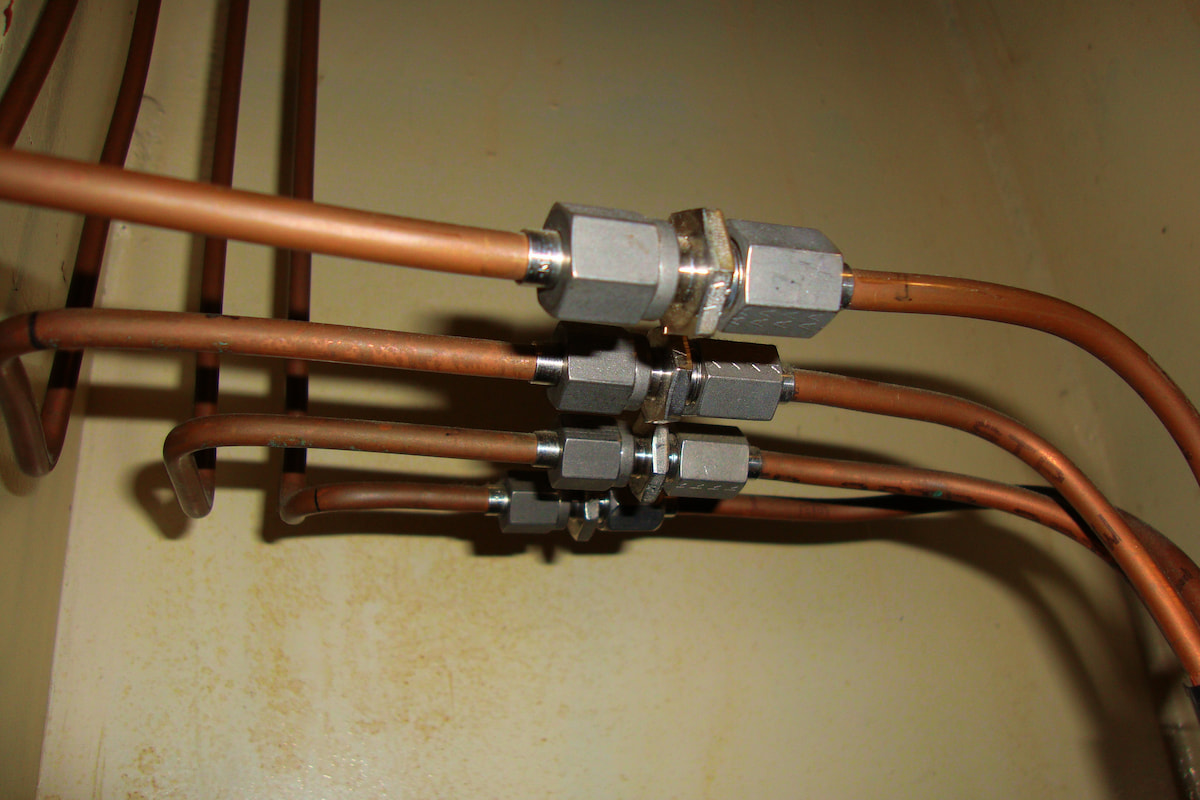
There is a climate issue in the void as well. Under a hot tropical roof the space above a dropped ceiling can get very warm, and any refrigerant pipe or drain line that is not fully insulated will sweat. That moisture drips onto the back of the gypsum board, where nobody sees it until a stain or a sagging panel appears. Proper insulation of every cold pipe, and a well-insulated roof above, are part of specifying a cassette properly.
Wall units ask much less of the building. They need a stretch of solid wall near the ceiling, clear of curtains and with a short, direct route for pipes to the outdoor unit. The one situation where this becomes difficult is the modern villa with full-height glazing on most sides of a room, where there may simply be no suitable wall. That is where a cassette, or one of the alternatives described further down, earns its place.
The drain is the weak point
In a humid climate an air conditioner pulls a surprising volume of water out of the air every day. A wall unit sends this straight out through the wall in a short pipe, and if anything goes wrong the drip appears below the unit where it is obvious and easy to deal with.
A cassette sits above the ceiling, so most models use a small built-in pump to lift the condensate up to a drain line that then falls away by gravity. That pump is one more component that can fail, and in a warm climate drain lines also tend to build up slime that slowly restricts the flow. If the pump stops or the line blocks, the tray overflows into the ceiling void. Because the unit is hidden, the first sign is often a damp patch or a stained ceiling board, by which point the gypsum may already need replacing. Specifying a cassette well means a generous drain fall wherever possible, an accessible cleanout, and an overflow safety switch that shuts the unit down rather than letting it flood the ceiling.
Maintenance, access and posture
This is where the day-to-day difference between the two systems is greatest. Air conditioning filters in a Thai villa need cleaning often, and manufacturers here recommend rinsing them at least once a month when the system is in regular use, more often in dusty or coastal locations.
On a wall unit, this is a five-minute job from a step stool. The front cover lifts, the filters slide out, they get rinsed and they go back in. Owners and housekeepers can do it without any training, which means it actually gets done.
On a cassette, the same job happens directly overhead at ceiling height. Someone has to climb a ladder, release and lower a grille panel that is close to a metre square, and then work with arms raised and head tilted back while dust and dirty water fall towards their face. It is awkward and tiring, and on ceilings above three metres it needs a tall platform ladder or a mobile tower rather than a household stepladder, and installers commonly charge extra for scaffolding at that height. In practice, the overhead access means cassette filters are cleaned far less often than wall unit filters, and the consequences follow: dirty coils, reduced airflow, higher power bills, musty smells and mould growing inside the unit.
Professional servicing reflects the same difficulty. A professional clean of a cassette typically costs around twice as much as a wall unit clean from the same contractor, and takes the technician up to an hour per unit. Most villas running air conditioning daily need a full professional clean two or three times a year, and rental villas with high occupancy often need more, so across a whole house that difference adds up every year.
Repairs follow the same pattern. Checking a refrigerant joint or replacing a drain pump on a cassette can mean dropping the unit or opening the ceiling, which is why a removable access panel next to every cassette is worth specifying from the start. Replacement in ten or fifteen years is also worth thinking about. Grille and body sizes vary between brands and models, so a new unit may not match the old ceiling opening, and that turns a straightforward swap into a ceiling repair and repaint. A wall unit, by contrast, can usually be replaced in a morning with no building work at all.
Budget, mid-range and premium
Prices for equipment and installation move every year and vary by region, so it is more useful to compare the two systems in relative terms. A cassette from a major brand typically costs roughly one and a half to two and a half times as much as a wall unit of the same capacity from the same brand, before the dropped ceiling, extra framing and access panels are added. Quotes in resort areas, on the islands and in more remote provinces generally run higher than in Bangkok once transport and local labour are included.
A budget approach uses good-quality inverter wall units throughout, sized correctly room by room, with large living spaces served by two well-placed wall units rather than one oversized one. It is the cheapest to install, the easiest to maintain and the simplest to replace.
A mid-range approach keeps wall units in the bedrooms and smaller rooms but uses one or two cassettes in the main open-plan living and dining space, where even air distribution and a clean wall really matter. This is the pattern that suits most villas.
A premium approach uses cassettes or ceiling-concealed ducted units across the main living areas, with premium wall units or ducted systems in the bedrooms, independent louvre control, overflow safety switches, access panels at every unit and a regular professional maintenance contract. The extra spend buys appearance and comfort, but it only pays off if the servicing actually happens.
Running costs are close enough that they rarely decide the question. The most efficient wall units carry very high seasonal efficiency ratings, and some HVAC engineers note that cassettes are slightly less efficient than the best wall units, but a correctly sized unit of either type, kept clean, will perform far better than a dirty or oversized one. Maintenance discipline makes a bigger difference to the electricity bill than the choice of indoor unit, as our guide to reducing a villa’s energy bills explains. In a large open-plan space, a single large cassette can sometimes replace two or three wall units, which means fewer outdoor units, fewer pipe runs and fewer units to service, and that narrows the cost gap considerably.
Comfort, noise and placement
Neither system is automatically quieter. Modern wall units are very quiet at low fan speeds, and a cassette adds the faint sound of its drain pump to the fan noise. In bedrooms, placement matters more than type. A unit that blows cold air across the bed leads people to turn the temperature up and complain of draughts, whether that air comes from the wall or the ceiling. Many current cassettes allow each of the four louvres to be controlled or closed independently, which helps when one side faces a bed or a sofa, and wall units can usually be placed on the wall at the foot of the bed or above the door so the air washes across the room rather than onto the occupants.
Other options worth knowing about
Two further indoor unit types are worth mentioning. A ceiling-concealed ducted unit sits entirely within the ceiling void and delivers air through slim linear grilles, which gives the cleanest appearance of all, but it needs even more ceiling depth and has the same overhead access and drainage issues as a cassette, usually to a greater degree. An under-ceiling or suspended unit hangs below the ceiling surface and throws air a long way, which suits large rooms with high or sloping ceilings where there is no void to hide anything in. Some of these can be hung at heights of over four metres. Neither is ideal in every room, but both solve specific problems that wall units and cassettes cannot.
It is also worth remembering that the best air conditioning load is the one that never has to be met. Deep roof overhangs, shading to west-facing glass, a well-insulated roof, ceiling fans and proper cross ventilation all reduce how hard any system has to work and how many hours a year it needs to run.
Choosing the right mix for a villa
For most villas and houses in Thailand, the sensible pattern is clear. Large open-plan living and dining areas with a properly designed dropped ceiling are the natural home for cassettes, placed where the grille can be reached safely, with an access panel alongside, a well-insulated drain with a good fall and the pump on the most accessible side. Bedrooms, studies, media rooms and other smaller spaces almost always suit correctly sized wall units better, positioned so that they do not blow onto the bed.
For rental villas, or for owners who will be away for long periods and rely on staff for upkeep, there is a strong argument for favouring wall units wherever possible, simply because the routine maintenance on them is far more likely to happen. Pavilions with high exposed roofs are usually better served by wall or under-ceiling units supported by ceiling fans and cross ventilation than by a dropped ceiling added just to take a cassette.
Whatever the mix, the choice should be made while the villa is still being drawn. A cassette affects ceiling heights, beam layouts, drainage routes, the electrical layout and the position of every light and fan in the room, and getting those decisions right on paper costs very little compared with trying to fit a cassette into a ceiling that was never designed for one.
For those of you doing a full build, from land purchase through to handover and beyond, you can find everything you will need in The Thailand Build Blueprint™, so sign up for early access.
If something about your own build is keeping you up at night, whether that is a cooling problem, a contractor you are not sure you trust, or a structural concern you cannot get a straight answer on, book a Strategy Session with Nay to work through it directly.
Designing for the climate from day one
Most comfort problems are decided at the design stage, not fixed afterwards. Nay designs and supervises villas on Koh Samui through our Samui practice and in Phuket through our Phuket practice; the Koh Samui overview and the Phuket build cost guide are useful starting points. For a second opinion on an existing design, talk to Nay directly.