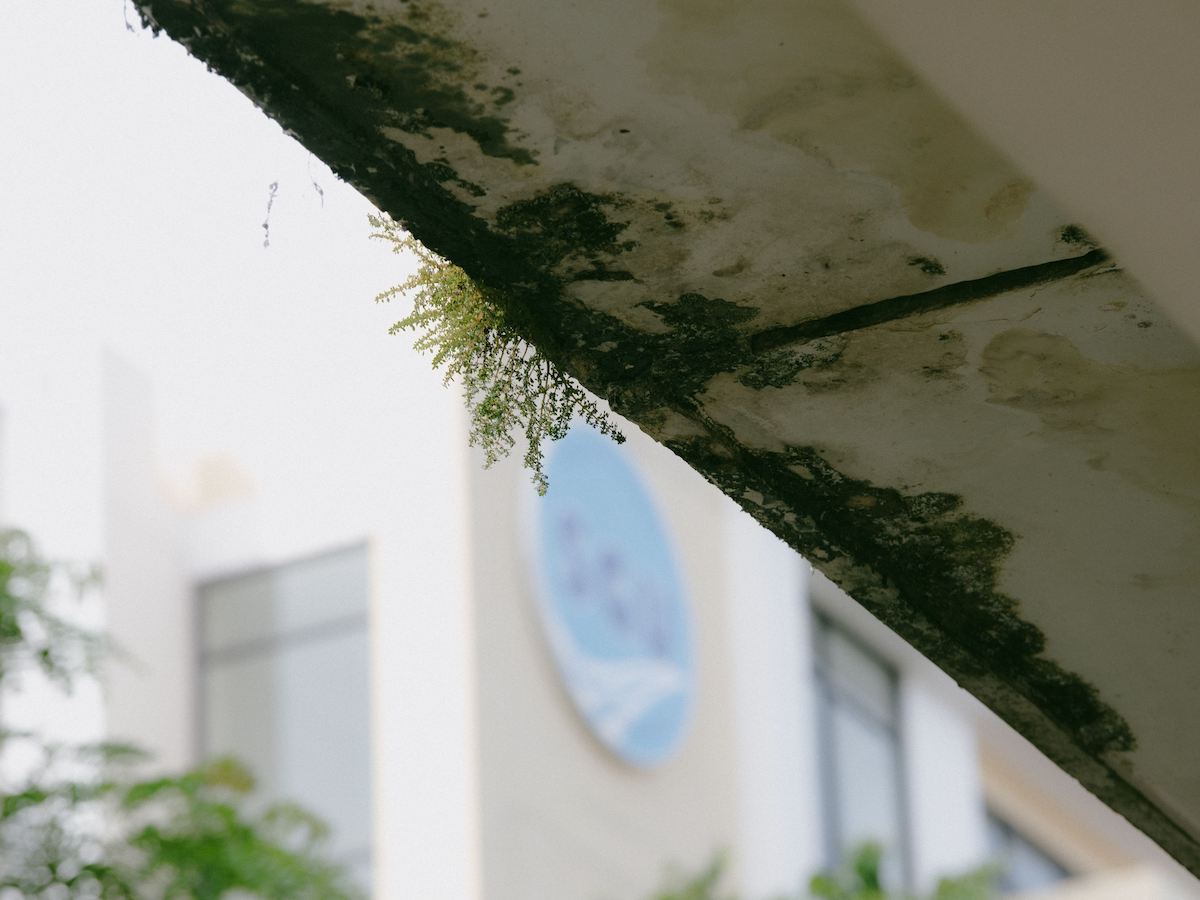
Understanding the real causes of mould in Thai homes
Thailand’s climate is not a background condition, it is an active force acting on every surface of a building, every day. Humidity runs between 70% and 90% year-round. Temperatures stay warm through the night. Rain is frequent, often heavy, and sometimes sustained for days. In these conditions, mould does not indicate a poorly built house. It indicates a house that was not designed for where it sits.
Most owners who encounter mould in the first one to three years, like black spots at wall junctions, a persistent smell in bathrooms, growth behind wardrobes and curtains, assume it is a maintenance problem. It is almost never a maintenance problem. It is a design and specification problem that became visible after handover.
The good news is that mould in Thai residential construction is largely preventable. Not through vigilance and cleaning products, but through decisions made at the material selection, detailing, and construction stages, before the walls go up.
Why Thai buildings are vulnerable
Mould requires three things: warmth, organic material to feed on, and moisture. The first two are constants in Thailand. Moisture is the variable that design and construction can actually control.
It enters buildings in several distinct ways, and understanding the routes matters because each one requires a different response.
Condensation forms wherever a surface is cooler than the surrounding humid air. In an air-conditioned room, this means walls adjacent to exterior conditions, ceilings, and anything in contact with poorly insulated refrigerant pipework. Running air conditioning at very low temperatures like 20 or 21°C in a room where exterior humidity is 85%, dramatically increases the condensation risk on every surface in the building envelope.
Rising damp moves upward through ground floor slabs and masonry that has no effective moisture barrier between the soil and the structure. It is invisible until finishes begin to fail, by which point the substrate is already compromised.
Water ingress through inadequate external render or failed waterproofing in wet areas saturates wall material that then stays wet for extended periods, particularly during the rainy season when walls have no opportunity to dry between rain events.
Roof space moisture is one of the least-considered sources. An unventilated roof cavity in a Thai climate accumulates humid air that has nowhere to go. Over time, this creates conditions for mould growth in the structure above the ceiling, which eventually presents as staining or smell inside the room below.
Once any surface sustains moisture above 60–65% relative humidity for a prolonged period, mould spores (which are present in the air everywhere) will begin to colonise it.
How condensation actually forms in this climate
Mould thrives on three elements: a surface, a food source, and moisture. While Thailand’s climate virtually guarantees the presence of moisture, the outcome depends on the building. The design must either prevent sustained surface moisture or actively manage it to stop mould from establishing itself.
Relative humidity in Thailand remains above seventy percent for most of the year and above eighty percent during the wet season. At these ambient levels, any surface that is cooled below the dew point temperature (the temperature at which air at a given humidity deposits moisture) will accumulate condensation. The dew point at eighty percent relative humidity and thirty degrees Celsius ambient is approximately twenty-six degrees Celsius. Any surface held below this temperature by air conditioning, cold water pipes, or thermal bridging through the building envelope will be wet, and wet surfaces in Thailand’s ambient temperatures grow mould.
This is the mechanism that produces the condensation mould patterns specific to air-conditioned buildings in tropical climates: cold spots on walls adjacent to air conditioning units, condensation on cold water supply pipes that are not insulated, mould at the junction between air-conditioned rooms and unair-conditioned spaces where temperature differentials are greatest, and mould on surfaces in enclosed spaces like wardrobes, storage rooms and ceiling voids, where air circulation is insufficient to prevent localised humidity from rising above ambient levels.
Wall construction and external envelope
The choice of masonry block has a material effect on how much water enters and is retained in the wall system. AAC (autoclaved aerated concrete) blocks absorb significantly less water than traditional clay brick and can be the more appropriate choice for the Thai climate. Clay brick walls are not disqualifying, but they require more rigorous external treatment to compensate for higher absorption.
External render should be a minimum two-coat system made up of a scratch coat and a finish coat, using a waterproof cement render rather than standard plaster. Single-coat thin render, which is common on lower-budget Thai builds, does not provide adequate protection against sustained rain penetration. Over the external render, the finish coating should be an acrylic or silicone-based waterproof formulation rather than standard emulsion paint. Standard paint provides colour and some surface protection; it does not meaningfully resist water penetration under prolonged rain.
For internal walls in wet areas like bathrooms, utility rooms, anywhere with regular water exposure, moisture-resistant cement board is more appropriate than standard plasterboard or gypsum board. The difference becomes significant within the first few years of use.
Waterproofing in wet areas
The most consistently underspecified element in Thai villa construction is the waterproofing membrane in bathrooms and wet areas. Tiles are not waterproofing. Grout is not waterproofing. Both are permeable, and water that passes through them (which it will) reaches the substrate beneath.
A liquid-applied waterproof membrane should be installed on the floor and walls of every wet area before tiling begins. Polyurethane or cementitious membranes are both appropriate; the critical detail is coverage and continuity. The membrane must extend a minimum of 150 to 200mm up the wall at every floor-wall junction, and it must be applied without gaps, pinholes, or inadequate thickness. A membrane that is 80% complete is not 80% effective — water will find the gaps.
Grout is the other frequently underspecified element. Standard cement grout is porous. It absorbs water, harbours mould, and discolours progressively in wet conditions. Epoxy grout is non-porous, chemically resistant, and does not support mould growth. In showers particularly, the difference in long-term performance is significant enough that epoxy grout should be the specification default rather than an upgrade.
Ground floor slabs require a damp-proof membrane such as a polyethylene sheet or bituminous layer, installed beneath the slab before the concrete pour. This is a simple measure that costs almost nothing relative to the problems its absence creates over time.
Ventilation as a structural strategy
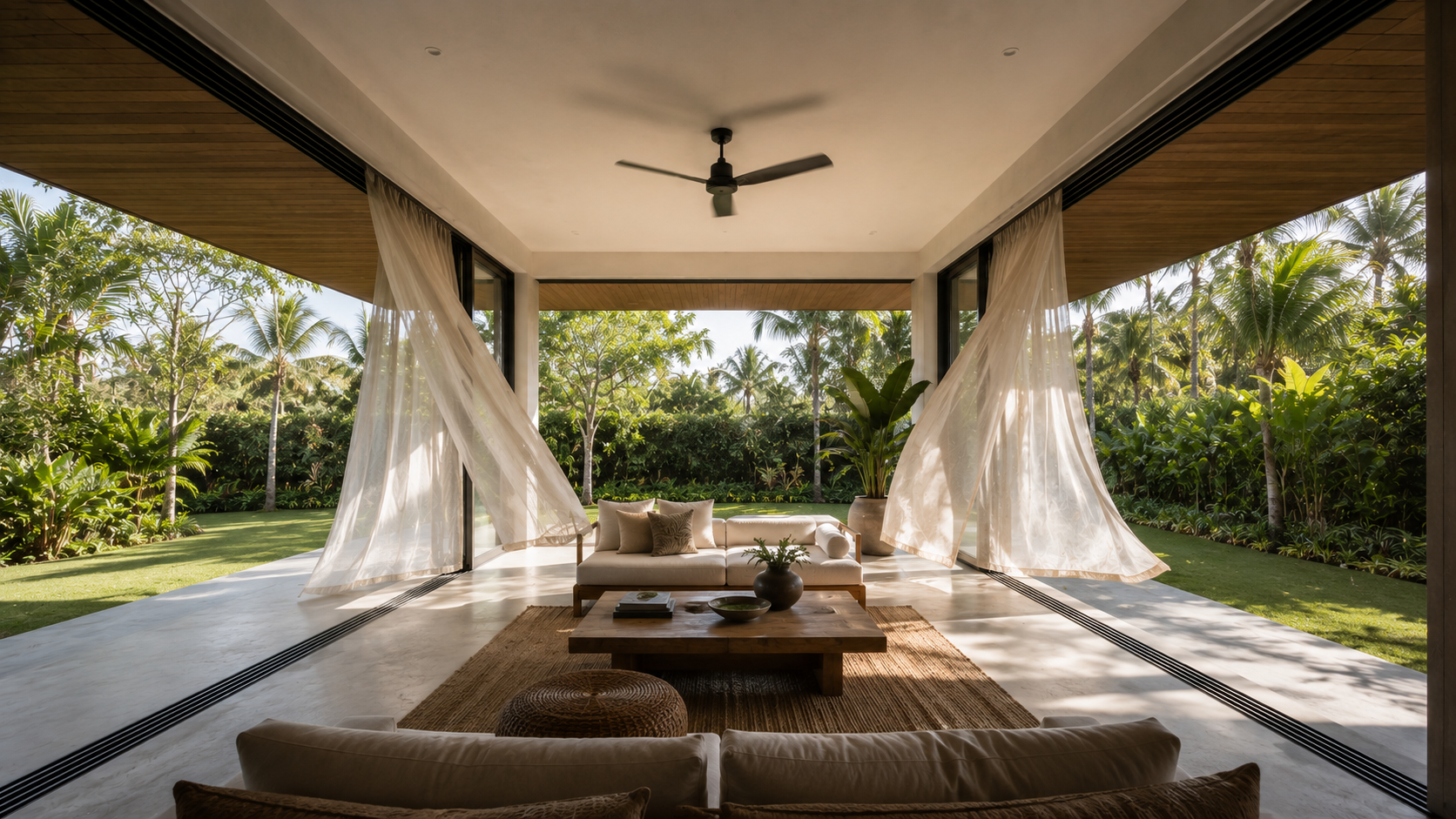
Ventilation is not a comfort feature in a Thai climate. It is the primary mechanism for preventing moisture accumulation, and it needs to be designed into the building rather than added as an afterthought.
Cross-ventilation requires operable windows positioned on opposite sides of each room so that wind can move through rather than stagnate. Stack ventilation that uses the tendency of warm air to rise, works through the roof space when roof vents are positioned to allow air to enter at the eaves and exit at the ridge. Both strategies work without mechanical assistance when the building is designed to allow them.
Roof spaces in particular need deliberate attention. A sealed roof cavity in a Thai climate accumulates heat and humidity that accelerates the deterioration of everything within it. Ridge vents, eave vents, or roof turbines and any of these, properly sized and positioned can keep the roof space in continuous exchange with outside air and dramatically extend the life of roof timbers, insulation, and the ceiling membrane below.
Bathrooms and kitchens need exhaust fans that vent directly to outside. The critical word is directly. Fans that discharge into a roof cavity, which is not uncommon in poorly detailed Thai construction, only move moisture from one enclosed space to another. The fan runs, the humidity in the roof space increases, and the problem migrates rather than resolves.
In contemporary closed-plan designs where natural ventilation is limited by the architectural brief, mechanical ventilation with heat recovery or whole-house dehumidification becomes necessary rather than optional. A sealed building with insufficient ventilation in a tropical climate will accumulate indoor humidity regardless of how well the external envelope is detailed.
Air conditioning and condensation
The relationship between air conditioning and mould is less obvious than it appears. Air conditioning removes moisture from indoor air and that is part of how it cools. But it also creates cold surfaces that cause condensation when the temperature differential between the room and the surrounding conditions is large enough.
Running air conditioning at 25 to 26°C rather than at 20 or 21°C substantially reduces the condensation risk on walls and ceilings. The room is still cool and comfortable; the temperature differential between conditioned surfaces and ambient humid air is simply less extreme.
Refrigerant pipework that is inadequately insulated produces condensation drips at the point where the pipe passes through walls or ceilings. This is one of the more common sources of localised mould that owners find difficult to diagnose such as a damp patch on a ceiling or wall that has no obvious water source, because the source is the pipework inside the wall cavity. Proper pipe insulation, continuous without gaps at joints or penetrations, prevents this entirely.
Materials and finishes
Paint choice matters, but it matters less than the substrate preparation that precedes it. New plaster should be primed with an anti-fungal primer-sealer before any finish coat is applied. Mould-resistant paint formulations which are widely available in Thailand from major brands under various “mould guard” or equivalent labels, contain fungicides that inhibit surface mould growth. They are worth specifying throughout the building, not only in areas already identified as wet.
Insulation in roof and wall cavities must be kept dry. Insulation that becomes saturated loses its thermal performance and creates a sustained moisture reservoir inside the building fabric. The detail that allows this to happen is almost always inadequate vapour control — insulation installed without consideration of where condensation will form within the assembly and how moisture will escape if it does.
Furniture placement has a simple and effective rule: maintain a gap between large furniture and external walls. Air needs to circulate behind wardrobes and storage units on external walls; when it cannot, the cooler wall surface and the trapped air create localised conditions for mould growth that no amount of ventilation elsewhere in the room will resolve.
The construction phase risk
One of the more overlooked mould risks in Thai villa construction is the construction phase itself. Walls left unrendered and exposed to rain for weeks or months become saturated. If finishing coats go on over wet or damp masonry, the moisture is sealed inside the wall rather than allowed to dry out. The building completes looking pristine, and the mould appears six months later as the trapped moisture finds its way to the surface.
Specifying that external render and waterproof coatings are applied in sequence without extended exposure periods, and that walls are adequately dry before internal finishes are applied, is not a construction management detail but rather a material performance requirement that should be in the specification from the start.
Mould in a Thai home is almost always a specification problem. The conditions that produce it are fixed because the climate is what it is. What can be controlled is how the building is designed and detailed to respond to those conditions. That work happens before construction begins, not after the first monsoon season reveals what was missed.
Why mould that keeps returning is not a cleaning problem
Mould in a Thai villa is the visible symptom of conditions that the building is creating continuously. Cleaning removes the symptom. It does not change the conditions. A villa where mould is cleaned regularly and returns within weeks has a design, specification, or management problem that cleaning cannot resolve, and the mould will continue to return, in the same locations, for as long as those conditions persist.
Understanding why mould forms in Thailand’s climate, and where condensation creates the moisture that drives it, is the only basis for preventing it reliably rather than managing it continuously. The causes are specific, the failure modes are consistent across Thailand’s villa construction market, and the majority of them are addressable at the design and specification stage, or, for existing properties, through targeted remediation that addresses the cause rather than the symptom.
The cold pipe mistake
Uninsulated cold water supply pipes running through walls, floors, and ceiling voids in air-conditioned spaces are among the most consistent sources of condensation-related mould in Thai villas, and among the least considered at the design stage.
A cold water supply pipe running through an air-conditioned room operates at ten to twenty degrees Celsius. The ambient dew point in that room, even with air conditioning running, is typically above the pipe surface temperature. Moisture condenses on the pipe surface continuously during operation, drips or tracks along the pipe run, and saturates the building material surrounding the pipe. The surrounding material stays wet. Mould establishes in the wet material, which may be inside a wall cavity or above a ceiling where it is invisible until the staining penetrates through to a visible surface.
Insulating all cold water supply pipes with closed-cell foam insulation (specified to the thickness required to prevent the pipe surface from falling below the ambient dew point) eliminates this condensation source entirely. The insulation must be installed continuously, with correctly sealed joints at fittings and valves, because any gap in the insulation creates a cold spot that condenses moisture regardless of how well the rest of the pipe run is insulated.
The air conditioning drainage mistake
Air conditioning units produce condensate that must be drained away from the unit continuously during operation. The condensate drain is a component that receives almost no attention during installation and creates significant mould problems when it fails.
Condensate drains that are blocked, incorrectly pitched, or inadequately sized for the unit’s condensate production rate overflow. The water that overflows accumulates behind ceiling linings, saturates insulation above the unit, and tracks along structural elements, creating the sustained moisture that mould requires in locations that are difficult to inspect and even more difficult to remediate without opening the ceiling.
Each air conditioning unit requires a condensate drain line that is correctly pitched to drain under gravity without relying on the unit’s internal drain pan to hold water before it overflows. The drain must discharge to a location where the water does not contact the building structure, so not into a ceiling void, nor onto a flat roof section that ponds. The drain lines require periodic flushing to clear any algae and fungal material that accumulates in the pipe and blocks the drain, typically every six months in a regularly used villa and more frequently in a rental property with continuous occupancy.
The enclosed space mistake
Wardrobes, storage rooms, under-stair spaces, and ceiling voids in Thai villas create enclosed volumes where air circulation is insufficient to prevent localised humidity from rising significantly above ambient levels. At elevated localised humidity, mould establishes on stored clothing, on the interior surfaces of the enclosure, and on any organic material present, particularly timber shelving, cardboard storage boxes and leather goods.
The design response is ventilation of enclosed spaces. Wardrobe interiors that have louvred doors or ventilation gaps that allow air movement between the wardrobe interior and the room maintain humidity close to ambient levels. Enclosed storage rooms with passive ventilation to an exterior or to a ventilated ceiling space do the same. Ceiling voids that are ventilated as part of the roof ventilation strategy described in the roof underlayment article in this series do not accumulate the stagnant humid air that produces mould on ceiling structure and insulation.
The management response for existing enclosed spaces without adequate ventilation is a small continuously running fan that exchanges air between the enclosed space and the adjacent room or exterior. This is a remediation measure rather than a design solution as a correctly ventilated enclosure does not require powered ventilation to prevent mould. But in an existing villa where the design cannot be changed, it is the intervention that actually works, as distinct from silica gel sachets and dehumidifier blocks that manage small volumes of moisture and are quickly overwhelmed by the humidity that Thailand’s climate continuously supplies.
The thermal bridge mistake
A thermal bridge is a point in the building envelope where a material of higher thermal conductivity creates a path for heat to bypass the insulation layer. In a tropical climate with air conditioned interiors, thermal bridges cool the interior-facing surface of the envelope at the bridge location. If that surface falls below the dew point of the interior air, it condenses moisture and grows mould.
In Thai villa construction, common thermal bridges include concrete columns and beams that lack a thermal break. Other examples include uninsulated concrete lintels above windows and doors, along with metal fixings that penetrate insulated panels.
The resulting mould pattern is diagnostic. When mould appears specifically along structural lines, such as columns or window perimeters, it indicates a thermal bridging issue. This specific placement distinguishes the problem from a more general failure in humidity control or ventilation.
Addressing thermal bridges in new construction requires identifying every structural element that connects exterior to interior through the insulated envelope and either insulating it in continuity with the envelope insulation or replacing the thermally conductive element with a thermally broken alternative. In existing construction where the thermal bridges are already built in, insulating the interior surface of the affected wall section to bring the cold surface inside the insulation layer is the available remediation, which adds interior insulation board and reduces the room dimension slightly, but eliminates the cold surface and the condensation it was producing.
The management mistake that compounds all the others
Even a correctly designed and specified villa can develop mould problems under management practices that create the conditions mould requires. The most common management-related mould causes in Thai villas are specific and correctable.
Leaving air conditioning running at low set points in unoccupied rooms creates a large temperature differential between the cooled room and adjacent unair-conditioned spaces and corridors. The wall surfaces at this boundary cool toward the set point temperature on the air-conditioned side and experience condensation from the warm humid air on the unair-conditioned side. Turning air conditioning off rather than leaving it running at low temperature in unoccupied rooms eliminates this condensation source.
Wet towels and laundry dried indoors in air-conditioned rooms add significant moisture load to the interior air that the air conditioning removes at energy cost while also creating localised high-humidity conditions around the drying items. Providing outdoor or ventilated covered drying space, and communicating its availability to rental guests, reduces this moisture load without requiring guest compliance with complex instructions.
Failing to clean air conditioning filters at the intervals the unit requires reduces airflow across the evaporator coil, reduces the unit’s cooling and dehumidification performance, and creates conditions in which the coil itself grows biological material that the unit then distributes into the room air. Filter cleaning every two to four weeks during regular use is not excessive in Thailand’s dust and humidity conditions.
The bottom line
Mould in a Thai villa appears at specific locations for specific reasons. Cold pipe condensation, air conditioning drainage failure, enclosed space humidity accumulation, thermal bridging at structural elements, and management practices that create sustained moisture conditions each produce identifiable mould patterns that point back to their cause.
Addressing the cause eliminates the mould. Addressing only the symptom ensures it returns. The design and specification decisions that prevent mould are made before construction. The management decisions that prevent it are made every week the villa is in operation. Both matter, and neither substitutes for the other.
For structured guidance on every stage of a villa build in Thailand — from land purchase through to handover — see The Thailand Build Blueprint™ at thetropicalarchitect.com/the-blueprint
For guidance on your specific project, book a strategy session with Architect Nay at thetropicalarchitect.com/consultations
Getting this specified and checked on site
Decisions like this one are only as good as the drawings and the site supervision behind them. If you are building on Koh Samui, Nay's full service from land assessment to handover is described at our Samui practice; for Phuket, see our Phuket practice. If you already have a builder and want an independent second opinion on a specification, talk to Nay directly.