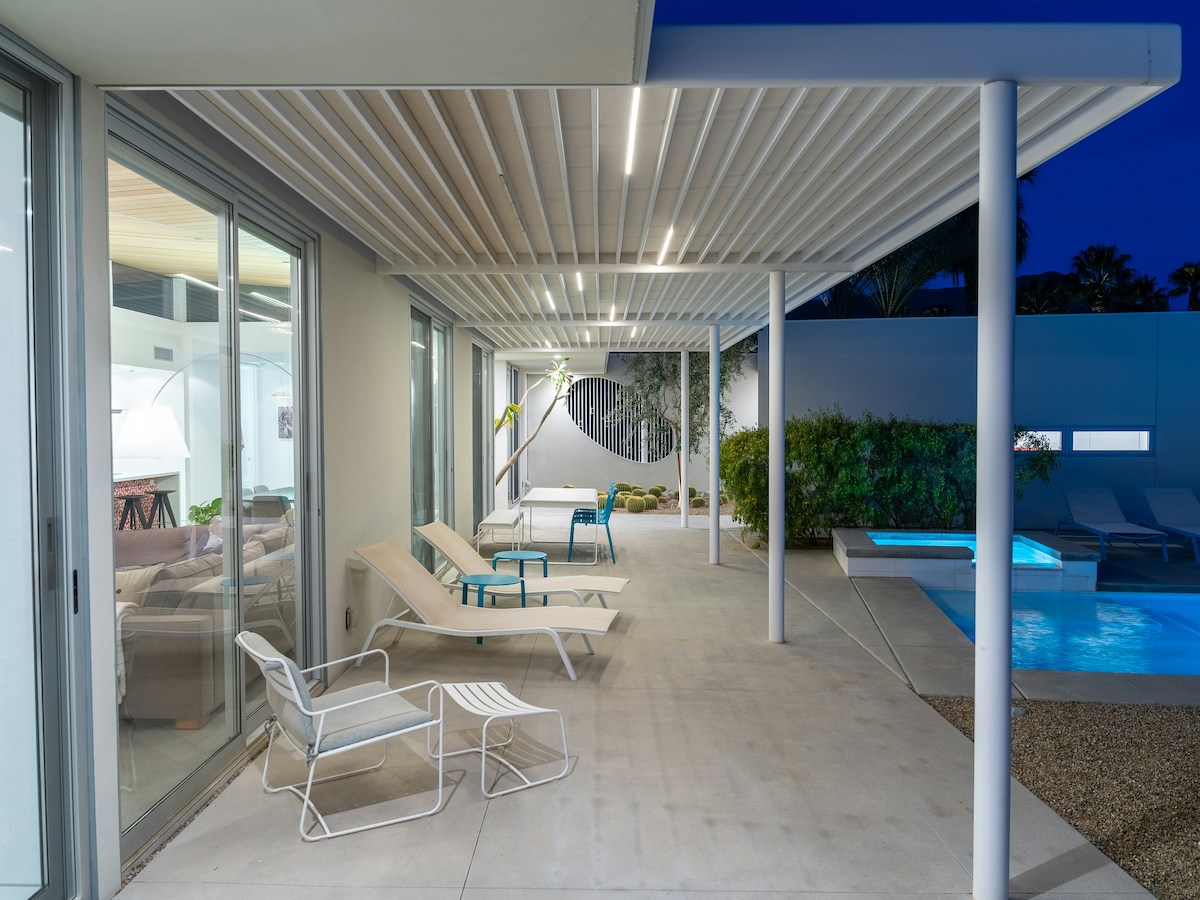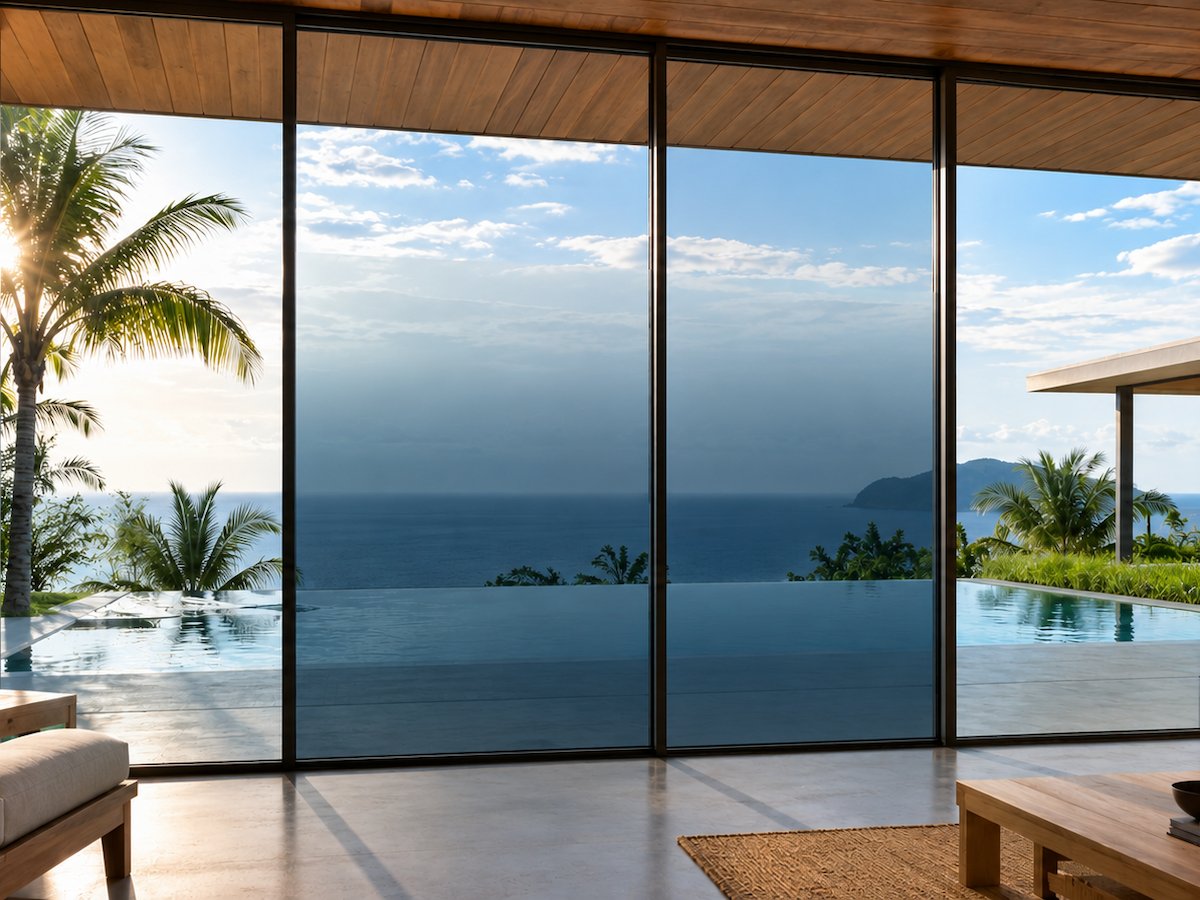
Smart glass, specifically electrochromic glazing, adjusts its tint level dynamically in response to sunlight or manual control. In a tropical villa context the appeal is straightforward. You get the expansive views and natural light that make a well-designed tropical home feel connected to its setting, while managing the solar heat gain that makes west and south-facing rooms uncomfortable and expensive to cool.
In Thailand, where air conditioning can account for more than half of a villa’s total energy consumption, anything that meaningfully reduces solar heat gain through glazing has real value. The real question is whether smart glass delivers that value reliably enough to justify its considerable cost, and in which situations it earns its place against the alternatives.
How the technology behaves in tropical conditions
Electrochromic smart glass uses layered coatings, typically tungsten oxide, laminated within safety glass. Apply voltage and the coating darkens, reducing visible light transmission and solar heat gain. Remove the voltage and it clears again, with the transition controlled either manually or through a building automation system.
Thailand’s coastal tropical environment places specific stresses on this technology that a temperate-climate specification simply does not anticipate. High ambient humidity combined with air-conditioned interiors creates significant condensation risk at glazing junctions, which makes quality framing and sealants a genuine requirement rather than an optional upgrade, since they determine whether the installation lasts five years or twenty. In coastal locations, salt accelerates corrosion of framing, fixings, and the electrical connections that power the glass, so marine-grade framing materials and high-quality silicone sealants are essential specifications rather than a premium add-on. Thailand’s UV intensity is extreme, and while the electrochromic coating itself provides genuine UV resistance, the framing system around it needs to be specified for tropical UV exposure just as carefully as the glass. Smart glass also requires electrical power to function, and during the outages that occur during monsoon weather, the glass defaults to either its clear or tinted state depending on how it was specified, so battery backup is worth including in the design wherever consistent performance during outages actually matters to how the space is used.
Where it genuinely earns its cost
Smart glass earns its considerable cost in a fairly specific set of situations, and understanding which ones matters more than the technology itself. West and south-facing facades, where afternoon sun creates intense heat gain and glare, are the clearest case, since dynamic tinting provides a real, measurable comfort benefit and a genuine reduction in cooling load in exactly these positions. Double-height atriums and large glazed openings, where fixed shading would block views or compromise the spatial quality of the interior, are another strong fit, since smart glass lets these spaces perform well across changing light conditions without a permanent visual obstruction standing in the way. Sea-facing master bedrooms and living areas, where the view is a primary design driver and conventional blinds or curtains would undermine the aesthetic entirely, round out the short list. In these three situations, the combination of view preservation and solar control is genuinely difficult to replicate with any single alternative.
Where it does not justify the cost
Smart glass is not a whole-building glazing solution, and specifying it across every window in a villa is rarely cost-effective. Standard low-E glass, fixed external louvres, or well-designed roof overhangs deliver solar control at a fraction of the cost in positions where dynamic adjustment adds limited practical benefit over a fixed solution.
It is also not a substitute for good passive design, a distinction worth being explicit about. A room that relies entirely on smart glass for solar control, without adequate overhangs, cross-ventilation, or insulation behind it, will still overheat when the glass is clear and still feel dark when it is tinted. Smart glass works best as one layer within a well-considered passive strategy, not as a replacement for one, and treating it as the latter is one of the more expensive misunderstandings an owner can carry into a glazing specification.
Comparing the alternatives honestly
Static tinted glass permanently reduces heat and glare, but compromises views and daylight even when solar control is not actually needed at that moment. It costs considerably less and carries zero maintenance complexity, making it the right choice where views are less critical to the room in question.
Low-E glass reflects solar radiation without visible tinting, offering good performance at a lower cost than smart glass and with no power dependency at all. It lacks dynamic adjustment, but suits a large proportion of a typical villa’s glazing perfectly well.
External louvres are highly effective at shading when correctly designed, though they require regular maintenance in salt air environments given their moving parts and exposed metalwork. For most positions on a villa, they remain the most cost-effective shading solution available.
Roller blinds and curtains are affordable but genuinely problematic in tropical conditions. Mould, fading, and mechanical wear in high humidity mean they need regular replacement and ongoing maintenance, and they are not recommended as a primary solar control strategy in Thai coastal villas.
Smart glass sits at the top of this comparison as the highest-cost option with the most complex installation requirements, supplied and installed for somewhere in the region of 25,000 to 60,000 baht per square metre depending on panel size, framing specification, and control system, against roughly 2,000 to 4,000 baht per square metre for quality low-E glass. That cost is genuinely justified in the specific high-value positions already discussed. It is not justified as a default glazing specification applied indiscriminately across a villa.
Installation: what goes wrong and how to avoid it
The most common smart glass failures in tropical environments trace back to installation rather than to the technology itself, which is worth knowing before assuming a failed panel means the product was simply the wrong choice. Poor sealing at glazing junctions allows moisture ingress that causes fogging and delamination, and this is expensive to repair and often impossible to fix without full panel replacement once it has progressed. Low-voltage wiring that is not properly concealed and protected during construction corrodes or gets damaged during finishing works, and framing materials specified for temperate climates corrode rapidly once exposed to coastal salt air.
Smart glass installation requires early coordination between architect, electrical engineer, and glazing contractor, ideally before structural work begins, since the wiring infrastructure needs to be designed into the building rather than added later as an afterthought. Retrofitting smart glass into an existing villa is generally impractical and rarely worth attempting given how much of the value depends on infrastructure planned in from the start.
Specify panels with a visible light transmission range of 10 to 60 percent, which suits Thailand’s variable light conditions across both dry season and monsoon months, providing adequate solar control when it is needed without over-darkening the space on genuinely overcast days. Annual inspection of seals and electrical connections is the minimum acceptable maintenance requirement, and in coastal locations, fixings and framing should be checked for early corrosion signs at every inspection rather than only when a problem becomes visible.
The verdict
Smart glass is a genuinely useful technology for tropical villa builds in the right positions, specified correctly, and installed with proper attention to the demands of the tropical environment it will sit in. It is not a universal solution, it is not cheap, and it is not forgiving of installation shortcuts in the way some more conventional materials are. Used selectively in high-exposure, high-value positions within a well-designed passive strategy, it performs well and justifies its cost convincingly. Used as a default glazing specification across an entire villa, it is expensive, unnecessarily complex, and largely unwarranted.
The decision should be made position by position with your architect, weighing each facade and opening on its own merits, rather than settled once as a blanket specification for the whole build.
The full build process, from land purchase through to handover and beyond, will be covered in The Thailand Build Blueprint™, so sign up for early access.
If something about your own design or construction is genuinely keeping you up at night, whether that is a build issue, a contractor you are not sure you trust, or a structural concern you cannot get a straight answer on, book a Strategy Session with Nay to work through it directly.
Designing for the climate from day one
Most comfort problems are decided at the design stage, not fixed afterwards. Nay designs and supervises villas on Koh Samui through our Samui practice and in Phuket through our Phuket practice; the Koh Samui overview and the Phuket build cost guide are useful starting points. For a second opinion on an existing design, talk to Nay directly.