A wall system decision that determines daily comfort
Choosing between AAC blocks and clay bricks for a Thai tropical villa is a thermal performance decision that determines indoor comfort, air conditioning running costs, and the daily liveability of the finished building. It is not a materials procurement decision to be resolved on unit price or builder familiarity alone.
Both materials build walls. What they do with Thailand’s heat is fundamentally different, and that difference is felt every day the building is occupied. Understanding it properly is what separates a building that works well in Thailand’s climate from one that works adequately despite it.
What each material is and how it behaves
Clay bricks are dense, kiln-fired units made from natural clay. They are heavy, solid, and have been used in construction across Southeast Asia for decades. Their structural behaviour is well understood, they are widely available across Thailand, and virtually every builder has experience working with them.
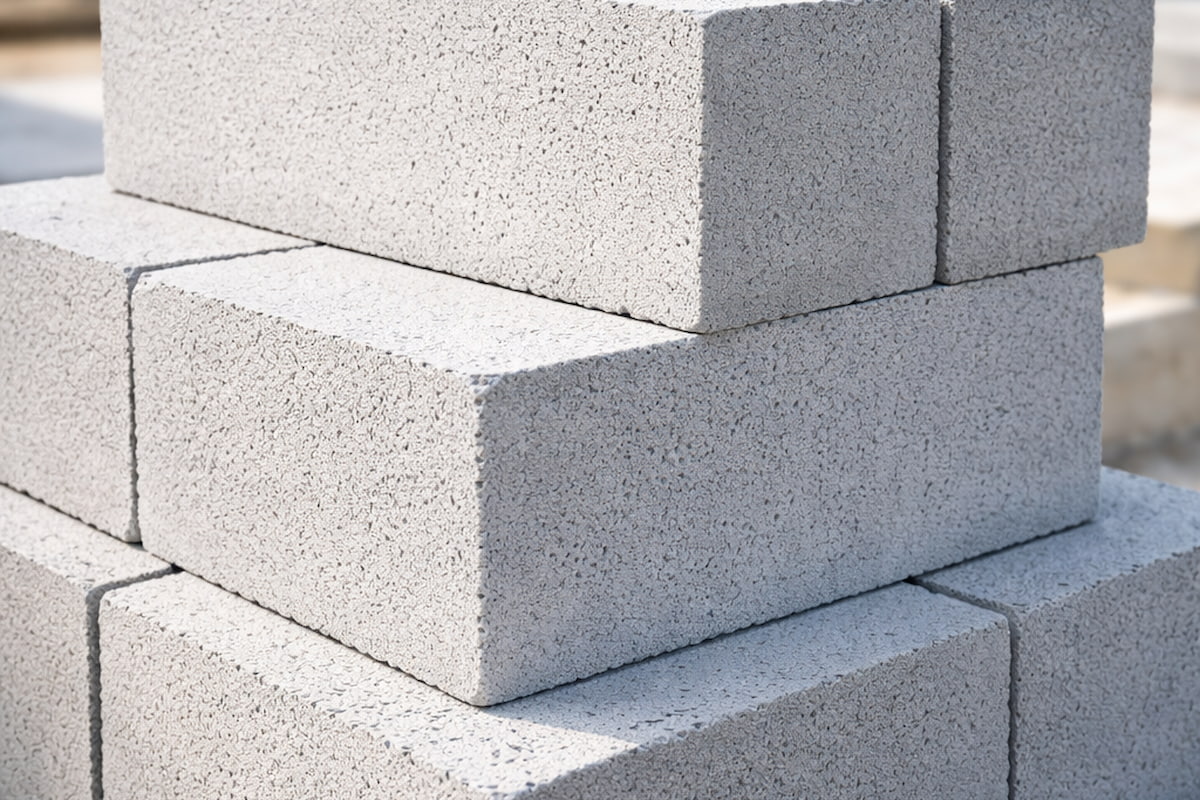
AAC blocks are autoclaved aerated concrete, manufactured from cement, lime, sand or fly ash, and a small amount of aluminium powder. During production the mix is poured into moulds where a chemical reaction causes it to expand, creating millions of tiny air bubbles throughout the material. The expanded block is then cut to size and cured under steam pressure in an autoclave. The result is a block composed of up to 80 percent air by volume. That internal structure, not the cement or lime, is what drives AAC’s performance advantage in tropical conditions.
The difference becomes clear in thermal performance
Heat management is the defining criterion for wall material selection in Thailand’s climate. Walls that absorb and retain heat increase the cooling load on air conditioning systems and reduce the comfort of naturally ventilated spaces. Walls that resist heat transfer do the opposite.
The relevant measurement is thermal conductivity, the rate at which heat moves through a material. Lower values indicate better thermal resistance. Clay bricks have a thermal conductivity of 0.6 to 0.8 W/mK. AAC blocks have a thermal conductivity of 0.2 to 0.24 W/mK, approximately one third that of clay brick.
In practical terms, external wall surfaces exposed to Thailand’s direct sun transfer significantly less heat into the building interior through AAC than through clay. Internal wall surfaces in an AAC building are cooler to the touch than in a clay brick building under the same external conditions. The air conditioning system works less to maintain the same interior temperature. In a naturally ventilated space, the lower heat gain through walls extends the hours during which the interior remains comfortable without mechanical cooling.
The thermal mass argument in favour of clay brick deserves direct consideration. Dense clay walls can absorb heat during the day and release it slowly, which moderates temperature swings in naturally ventilated buildings. This effect is genuine in climates where nights are significantly cooler than days, allowing the stored heat to dissipate overnight. In Thailand’s tropical conditions where night-time temperatures remain high year-round, the heat stored in dense clay walls has limited opportunity to dissipate to outdoor air and releases instead back into the building interior. The thermal mass advantage that clay brick offers in temperate climates is substantially reduced in Thailand’s conditions.
Weight, structure, and construction economics
Clay bricks weigh between 1,600 and 1,900 kilograms per cubic metre. AAC blocks weigh between 550 and 650 kilograms per cubic metre, approximately one third the weight of clay brick. This difference has cascading effects on structural design and construction economics.
In Thailand’s standard construction approach, reinforced concrete frame with infill walls, the walls carry no structural load. The concrete frame carries the building loads and the walls manage environmental conditions. The compressive strength of the wall material is therefore not the primary selection criterion in this context. The weight reduction from AAC walls reduces the dead load that the structural frame must carry, which allows columns, beams, and foundations to be designed for lower loads. On larger villas and multi-storey projects this can produce meaningful savings in structural materials.
AAC blocks are also larger than clay bricks, and the mortar joint used with AAC is thin-bed adhesive at approximately three millimetres rather than the conventional ten millimetre mortar bed used with clay bricks. This combination of larger unit size and thinner joints means AAC walls go up significantly faster than equivalent clay brick walls, typically two to three times faster for equivalent wall areas. Mortar use is reduced by up to 70 percent. The thinner joint structure also produces less differential shrinkage in the wall assembly, making AAC walls less prone to the cracking at mortar joints that appears over time in clay brick walls as mortar and brick age differently.
Moisture performance in Thailand’s conditions
Both materials face the same challenge: Thailand’s annual rainfall of 1,500 to 2,500 millimetres in most villa locations, sustained high humidity, and the conditions that result from them year-round.
Clay bricks have higher water absorption than AAC. Unsealed or inadequately rendered clay brick walls absorb moisture during rain events and release it slowly as conditions dry. In sustained coastal humidity this means the walls may never fully dry between events. The consequences over time include efflorescence on brick surfaces, increased mould risk on internal surfaces, and progressive deterioration of brick and mortar in aggressive coastal conditions.
AAC has lower water absorption but is not inherently waterproof. Unsealed AAC in direct rain exposure will absorb moisture, particularly at cut surfaces where the internal pore structure is directly exposed.
The critical point for both materials is that neither performs adequately without proper external rendering, correctly specified waterproofing systems, and appropriate architectural detailing: roof overhangs that keep rain off walls, drainage that moves water away from the building base, and sealed penetrations at windows, doors, and service entries. The wall material contributes to moisture performance but detailing determines it.
Compressive strength in context
Clay bricks achieve compressive strength of 4 to 7.5 N/mm². AAC blocks achieve 3 to 5 N/mm². For pure compressive strength, clay brick has the advantage.
In the context of how Thai villas are actually built, this figure rarely determines material selection. In a reinforced concrete frame structure, the walls are non-structural infill and the frame carries the building loads. The compressive strength of the infill material is not the limiting factor in structural performance. Where compressive strength does become relevant is in load-bearing wall construction without a concrete frame, an approach used in some smaller or lower-budget builds. In these applications the structural adequacy of the wall material should be verified through engineering assessment regardless of which material is selected.
Where clay bricks remain appropriate
AAC blocks are not the correct choice for every project. Clay bricks have a legitimate place in Thai villa construction in specific circumstances.
Where the project budget is tight and the total wall cost comparison, including labour, mortar, and plastering, still favours clay, it remains a viable choice. Where experienced AAC builders are scarce in the project location, clay brick construction with known local builders may produce better results than AAC construction by builders unfamiliar with the material. Projects that specifically call for the visual character of clay brick, or designs that use genuine thermal mass as a passive cooling strategy in appropriate conditions, may legitimately specify clay. And in renovation and extension work on existing clay brick buildings, matching materials is often the most practical approach because mixing materials creates differential movement that can cause cracking at the junctions between old and new construction.
A combined approach
Many well-designed Thai villas use both materials strategically rather than choosing one exclusively. A common and effective approach specifies AAC for external walls where thermal performance is the primary criterion and clay or alternative materials for internal partition walls where thermal performance is less critical and cost or builder familiarity may be the deciding factor.
This targeted use of AAC maximises the thermal benefit, keeping heat out of the building through external walls, while allowing flexibility in internal construction where the performance advantage of AAC over clay is less significant.
The cost comparison that includes all factors
Unit cost comparisons present an incomplete picture. Clay bricks cost less per brick, but the total wall cost comparison includes material quantity (AAC’s larger block size means fewer units for the same wall area), labour time (AAC’s faster installation reduces labour cost per square metre), mortar quantity (thin-bed AAC mortar is used in significantly smaller quantities than conventional mortar), plastering (AAC’s more consistent surface requires less plaster build-up), potential structural savings from reduced wall weight, and the running cost reduction from lower air conditioning energy consumption across the building’s life.
When all factors are included the comparison between AAC and clay brick is closer than unit price alone suggests. On larger builds and villas where thermal performance affects years of air conditioning costs, AAC’s total cost of ownership case is strong.
The bottom line
In Thailand’s tropical climate, wall materials are not interchangeable. They determine how much heat enters the building, how hard the cooling system works, and how comfortable the interior is to live in across seasons.
AAC blocks offer a meaningful thermal performance advantage over clay bricks in these conditions, one that translates into lower air conditioning energy consumption, cooler internal surfaces, and better passive comfort in naturally ventilated spaces. They also offer faster construction and reduced structural load that can produce project cost savings offsetting the higher unit material cost.
Clay bricks remain appropriate where budget, builder availability, or specific design requirements favour them, and on projects where a combined approach uses each material where it performs best. The decision is worth making on full information rather than unit price or default builder practice.
For structured guidance on every stage of a villa build in Thailand — from land purchase through to handover — see The Thailand Build Blueprint™ at thetropicalarchitect.com/the-blueprint
For guidance on your specific project, book a strategy session with Architect Nay at thetropicalarchitect.com/consultations
Designing for the climate from day one
Most comfort problems are decided at the design stage, not fixed afterwards. Nay designs and supervises villas on Koh Samui through our Samui practice and in Phuket through our Phuket practice; the Koh Samui overview and the Phuket build cost guide are useful starting points. For a second opinion on an existing design, talk to Nay directly.