Why ceramic tiles remain a serious specification choice
In an era of increasingly sophisticated alternatives, from large format porcelain to luxury vinyl and engineered stone, glazed ceramic tiles continue to be specified for good reasons in tropical villa construction across Thailand. They handle humidity well, resist mould and salt damage naturally, stay cooler underfoot than most synthetic alternatives, and are easier and less expensive to install than much of what competes with them.
The qualification matters, though. Ceramic tiles perform well when correctly specified and properly installed, and incorrectly specified or poorly installed ceramic in Thailand’s climate deteriorates in ways that are entirely avoidable, from adhesive failure through grout degradation to tile movement that shows up within a few years rather than a few decades. This article covers what to specify, how installation differs in tropical conditions, and where ceramic remains the right choice against where the alternatives genuinely perform better.
Where ceramic tiles perform well in tropical villas
Kitchens and bathrooms are the clearest case. The combination of moisture resistance, easy cleaning, and a hygienic non-porous surface makes glazed ceramic the natural specification for wet interior spaces, since the glazed surface does not absorb moisture, resists mould establishment, and cleans completely with minimal effort, advantages that compound meaningfully over years of use in high-humidity conditions rather than showing their value only occasionally.
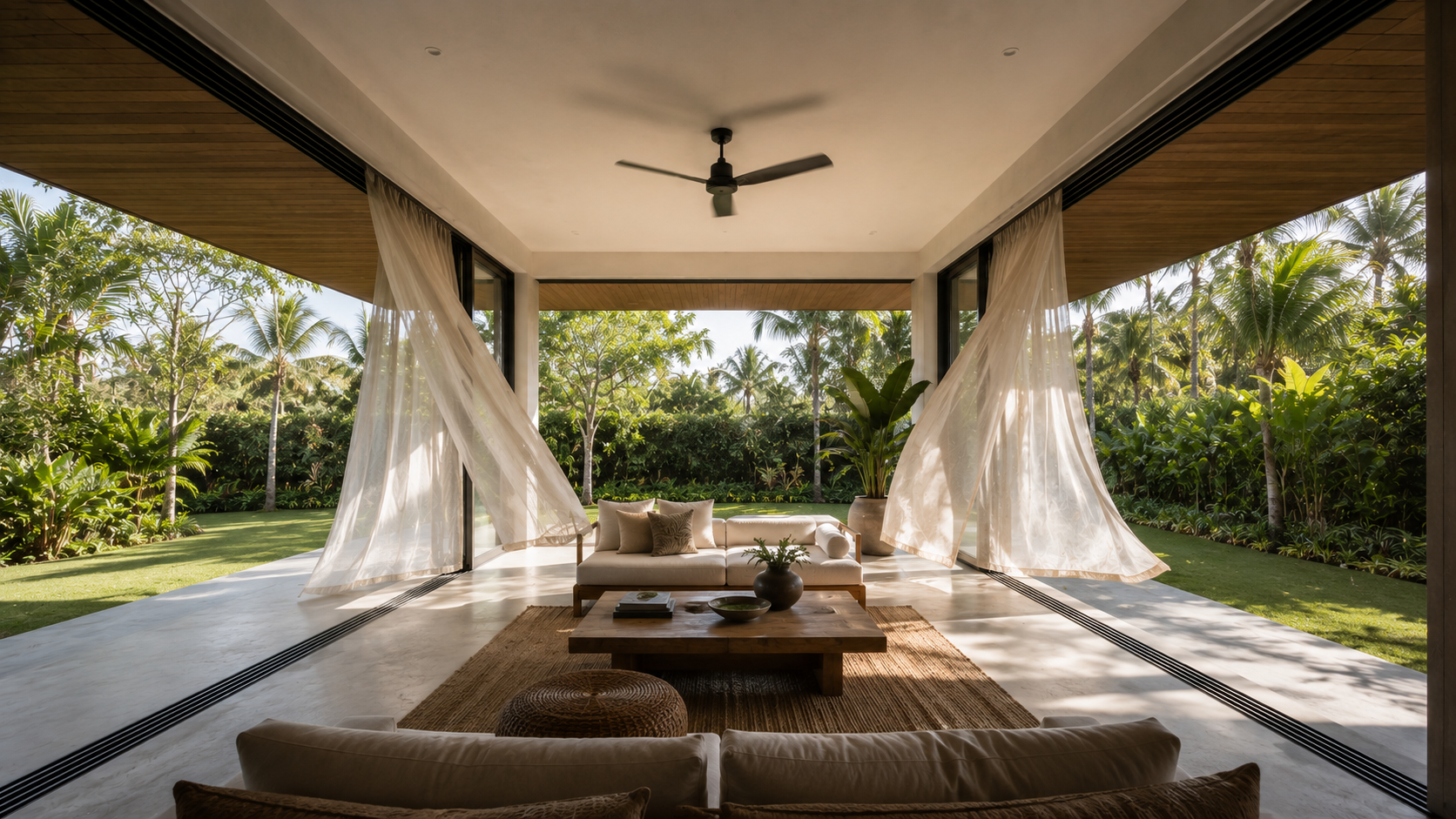
Shaded outdoor living areas suit ceramic just as well. Covered verandas, shaded terraces, and outdoor kitchen areas benefit from a surface that stays noticeably cooler underfoot than many synthetic alternatives, a genuine comfort advantage in spaces without air conditioning where direct contact with the floor is frequent throughout the day. In non-air-conditioned or partially air-conditioned interior living spaces, ceramic’s thermal mass, its capacity to absorb heat during the day and release it slowly, contributes to comfort in a way that is easy to underestimate until you have lived with the alternative, and the cool surface underfoot remains genuinely pleasant across Thailand’s ambient temperatures.
Glaze and UV specification: the detail most buyers miss
Thailand’s UV intensity is extreme, and bold or vibrant colours on lower-quality glazes fade visibly within a few years of exposure to direct tropical sunlight. This is not a theoretical risk. It is a common and entirely predictable outcome of specifying tiles without UV resistance in mind, and one of the easiest specification errors to avoid once you know to ask about it.
Ask suppliers for genuine UV resistance data on any glaze formulated for tropical exposure rather than accepting general quality claims at face value, and test tile samples in the actual installation location under local sunlight before committing to a large-scale purchase, since colour behaviour under showroom lighting and under direct Thai sun are reliably different. For any exposed or partially exposed outdoor application, specify tiles rated for external use specifically, because internal tiles simply do not carry the UV resistance coatings that outdoor conditions require, regardless of how similar they may look on the showroom floor.
Salt resistance deserves its own line in the specification for coastal Thai villa locations. Specify tiles with salt-resistant glazes for any application within range of salt spray, since unglazed or highly absorbent ceramics in exposed coastal positions discolour and deteriorate structurally over time. The specification cost difference here is modest. The remediation cost of replacing incorrectly specified tiles, once they have already failed and the villa is occupied, is not.
Installation in tropical conditions: what actually changes
Standard tile installation practice is not adequate for Thailand’s climate. The thermal expansion, sustained humidity, and occasional salt spray involved place specific demands on substrates and adhesives that a generic specification simply does not anticipate.
The concrete subfloor must be genuinely cured, not merely set, before tiling begins. Thailand’s humidity means concrete retains moisture for considerably longer than it would in temperate conditions, the same underlying issue behind many foundation problems in flood-prone plots, and tiling over inadequately cured concrete is one of the most common causes of adhesive failure in tropical villa construction. Level the substrate to within 2mm tolerance across the installation area, since high points cause tile lippage and cracking under foot traffic while low points leave hollow spots where adhesive coverage is inadequate and failure eventually follows.
Use water-resistant, flexible adhesives specifically formulated for tropical conditions rather than a standard product chosen on cost alone. Standard adhesives soften in sustained heat and humidity, while flexible formulations accommodate the thermal movement that occurs as tile surfaces heat under direct sun, a genuinely important consideration for any exposed or partially exposed installation.
Consistent grout lines of approximately 3mm for tiles around 10mm thick provide the flexibility needed for thermal movement without stressing the tiles themselves, and expansion joints at wall junctions and at regular intervals across large floor areas, typically every 4 to 5 metres, accommodate structural movement without causing tiles to crack or lift. Skipping expansion joints is a common cost-cutting measure during construction, and it is a false economy that reliably results in tile cracking and lifting within a few years, well within the timeframe an owner will still hold the contractor’s warranty in mind.
Grout selection and maintenance carry their own weight here too. Use tropical-rated grout formulations, since standard grout in Thailand’s sustained humidity absorbs moisture, darkens, and becomes a mould establishment point over time regardless of how well the tiles themselves were chosen. Epoxy grout provides the best moisture resistance available but requires real skill to apply correctly, while polymer-modified cement grouts offer a practical middle ground, better moisture resistance than standard cement grout without the application complexity that epoxy demands. Reseal grout periodically, annually in wet areas and every two to three years in dry interior spaces, and clean with pH-neutral detergents, since harsh chemical cleaners damage glaze surfaces and accelerate grout degradation rather than genuinely cleaning them.
Slip resistance deserves explicit specification rather than an assumption based on appearance. For wet zones, meaning bathrooms, shower areas, kitchen floors, and outdoor terraces, specify a minimum R10 slip resistance rating. Matte and textured glazes provide natural grip without the institutional appearance that some heavily textured safety tiles carry, but check the actual slip rating on the technical data sheet rather than assessing grip by touch, since wet performance is what genuinely matters and it is not reliably predicted by how a tile feels dry in a showroom.
Ceramic versus the alternatives, honestly assessed
Porcelain tiles are denser and less porous than ceramic, with lower water absorption and higher breaking strength, making them the better specification for high-traffic areas, fully exposed outdoor terraces, and commercial applications. They require more specialised cutting tools and leave a smaller margin for installation error. For interior wet zones in residential villas, high-quality glazed ceramic provides equivalent real-world performance at better cost efficiency, so the useful rule of thumb is ceramic indoors, porcelain for exposed outdoor and high-traffic applications.
Vinyl flooring is moisture resistant, comfortable underfoot, and straightforward to install, but it lacks ceramic’s thermal comfort entirely, never achieving the same cool underfoot quality, and it has a shorter lifespan in tropical conditions. It suits utility areas and spaces where installation cost and flexibility matter more than long-term performance, but it is not a genuine competitor to ceramic for quality villa specification.
Natural stone offers the highest aesthetic quality available, but it requires sealing and ongoing maintenance to preserve that quality in Thailand’s climate, and it is heavy enough to carry real structural implications for elevated villas. Slip resistance varies significantly between stone types and must be verified specifically for any wet area application. It remains the right choice for feature areas where the aesthetic justifies the ongoing maintenance commitment and the budget allows for it, rather than a default specification.
Unglazed ceramic is worth avoiding altogether in moisture-prone areas. The unglazed surface absorbs water, stains, and deteriorates in coastal tropical conditions, and it is not the right specification for any wet or exposed application in Thailand regardless of how attractive the price looks on paper.
Large format tiles: the specification trend worth understanding properly
Large format tiles, 600 by 600mm and above and increasingly up to 1200 by 2400mm, have become common in contemporary tropical villa design, and the reduced grout line area they offer creates both a cleaner aesthetic and fewer of the mould establishment points that grout otherwise provides.
The installation demands rise with the tile size, though, and this is where a well-intentioned design choice can go wrong if the contractor is not genuinely experienced with large format work. Larger tiles need flatter substrates, since the 2mm tolerance becomes more critical as tile size increases, and full adhesive coverage becomes both harder to achieve and more important to verify, because large tiles with inadequate adhesive coverage develop hollow spots that crack under load in a way smaller tiles are more forgiving of. Specify full-bed adhesive application and verify the coverage during installation rather than assuming it has been done correctly. Large format tiles also need proportionally larger expansion joints, since the thermal movement of a 1200mm tile is considerably greater than that of a 300mm tile, and this needs factoring into the joint design from the outset rather than as a correction once cracking appears.
The bottom line
Ceramic tiles remain a genuinely practical specification for most interior and shaded exterior applications in Thai tropical villa construction, and the performance advantages, moisture resistance, a hygienic surface, thermal comfort, and durability, are real and well matched to what Thailand’s climate actually demands rather than being a compromise dressed up as a virtue.
The specification decisions that determine whether ceramic performs well as intended, glaze quality, UV resistance, adhesive specification, grout selection, expansion joints, and slip resistance, are all made before installation ever begins. Getting these right is entirely straightforward with the right guidance, much like the material and preparation decisions behind avoiding roof leaks in Thai villas. Getting them wrong produces problems that are expensive, disruptive, and largely avoidable to remediate later. If sustainability is part of the brief, the environmental case for ceramic tiles explains why this traditional material holds up well against the alternatives.
The full build process, from land purchase through to handover and beyond, is covered in The Thailand Build Blueprint™, so sign up for early access.
If something about your own design or construction is genuinely keeping you up at night, whether that is a build issue, a contractor you are not sure you trust, or a structural concern you cannot get a straight answer on, book a Strategy Session with Nay to work through it directly.
Getting this specified and checked on site
Decisions like this one are only as good as the drawings and the site supervision behind them. If you are building on Koh Samui, Nay's full service from land assessment to handover is described at licensed Koh Samui architect; for Phuket, see licensed Phuket architect. If you already have a builder and want an independent second opinion on a specification, get a second opinion.