Why bathroom fixture selection matters more in tropical climates
A bathroom fixture that performs perfectly in a temperate climate can fail within two or three years in Thailand’s coastal tropical environment. Sustained high humidity, salt-laden air, mineral-rich water, and the constant thermal cycling between air-conditioned interiors and ambient heat combine to expose weaknesses in materials and finishes far faster than most owners, and many contractors, expect.
Luxury in a tropical villa bathroom is not simply a matter of how it looks at the point of installation. It is how the bathroom looks and functions after five years of these conditions, which means thinking about material integrity and finish durability from the outset rather than discovering their limitations once the villa is already occupied.
Ceramic sanitaryware and why it remains the foundation
Glazed ceramic for sinks, basins, and toilet bowls is not a compromise in a luxury tropical bathroom. It is the correct specification, and the reasons are practical rather than a matter of taste. Ceramic is non-porous, so it does not absorb moisture, and in sustained humidity that matters considerably more than it would in a drier climate, since porous materials develop mould and mildew internally over time regardless of how diligently the surface is cleaned. Ceramic simply has nowhere for moisture to penetrate.
The smooth glazed surface also cleans thoroughly with minimal effort, which is a genuine daily advantage in an environment where condensation is constant and cleaning needs to happen more often than it would elsewhere. Ceramic handles the temperature differential between an air-conditioned bathroom interior and ambient tropical heat without cracking or degrading, unlike materials with a higher thermal expansion coefficient that can develop stress cracks over years of this cycling. High-quality ceramic is also genuinely beautiful in its own right, and the assumption that it is a practical fallback rather than a luxury choice simply does not hold up once the product quality is high enough.
Wall-hung toilets and concealed cisterns
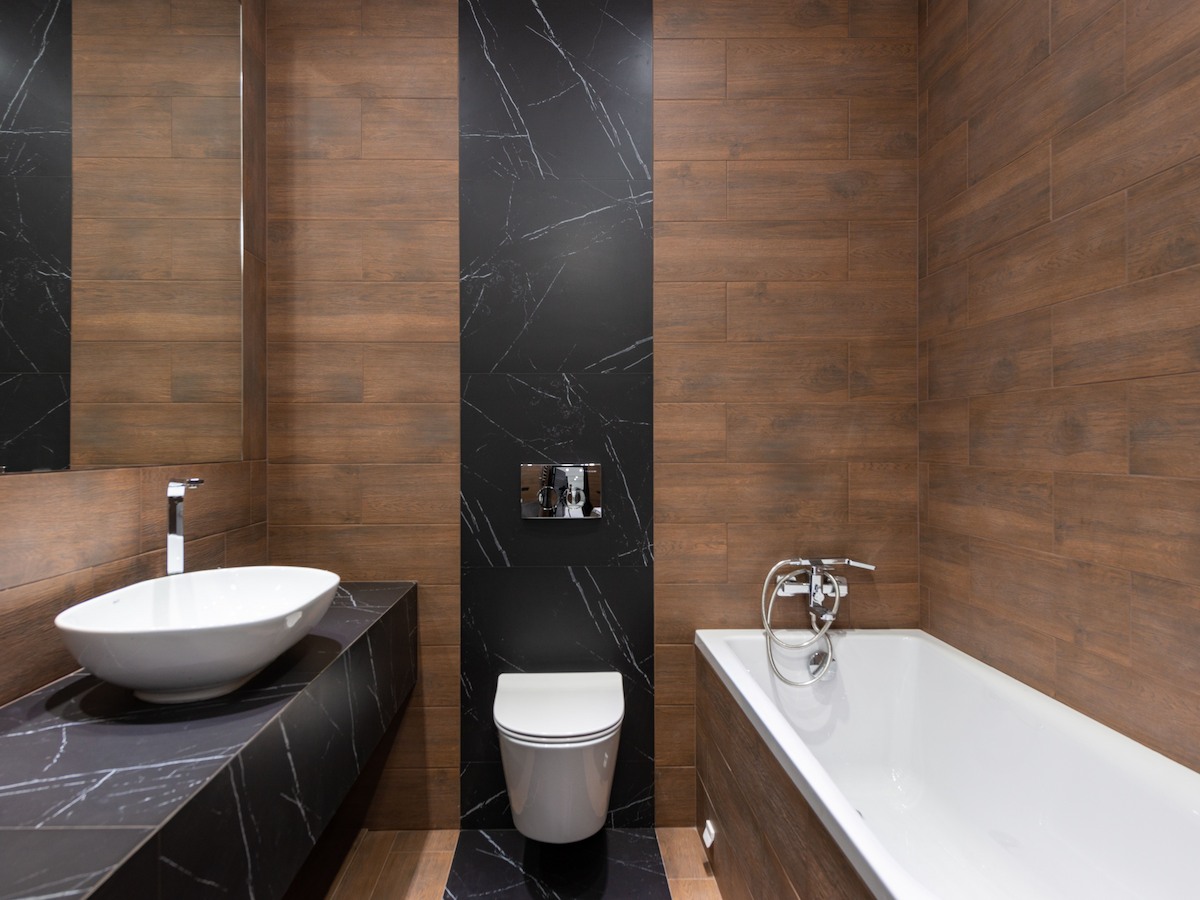
Wall-hung toilets with concealed cisterns have become standard in quality tropical villa bathrooms, and the reasons go well beyond aesthetics. Elevating the bowl off the floor eliminates the floor-to-base junction where grime, mould, and efflorescence accumulate in humid environments, and that junction is one of the most difficult areas to clean on a conventional installation and one of the most problematic once humidity is sustained year-round. The clean lines and absence of a visible cistern also make a bathroom read as larger and more considered, which matters in villas where bathroom design carries real weight in the overall aesthetic.
Specify an installation height of 42 to 45 centimetres from floor to seat, the ergonomically correct range for comfort and accessibility, which a wall-hung system lets you set precisely during installation rather than accepting whatever height the product happens to come in. The concealed cistern needs a properly detailed access panel for maintenance, and this is worth designing in deliberately so it reads as an intentional part of the bathroom rather than an afterthought bolted on once the fault-finding starts. A quality wall-hung system with concealed cistern typically costs in the region of 15,000 to 40,000 baht depending on brand and cistern mechanism, before installation.
Taps, showerheads and fittings: material and finish
This is where most tropical bathroom specifications go wrong, because the finish that looks most luxurious in a showroom is often the worst choice for Thailand’s coastal conditions. Polished chrome shows every water spot, fingerprint, and minor scratch, and in hard water areas, which covers much of Thailand’s groundwater supply, limescale deposits on polished chrome build up constantly and require aggressive cleaning to remove. That aggressive cleaning then accelerates the very surface degradation it is meant to fix, and the result is a fitting that looks tired within a few years regardless of how carefully it was maintained.
Matte and brushed finishes mask water spots, fingerprints, and minor surface wear far more effectively, and in a tropical bathroom where hard water deposits and condensation are a daily reality rather than an occasional nuisance, this is a meaningful practical advantage that shapes how the bathroom actually looks day to day, not just immediately after cleaning.
What sits beneath the finish matters just as much as the finish itself. Solid brass cores remain the benchmark for quality taps and shower mixers, offering considerably better durability and corrosion resistance than cheaper alloys or plastic-bodied alternatives. The coating over that brass is what determines salt air resistance specifically, and Physical Vapour Deposition coatings are the most durable option for coastal tropical conditions, harder than conventional electroplating, more resistant to chipping and corrosion, and available across the full range of matte and brushed finishes that perform well in Thailand’s environment. Specify lead-free brass with PVD coating for any fitting in a coastal villa, and expect to pay somewhere between 8,000 and 25,000 baht per fitting for genuine PVD-coated solid brass tapware, depending on the brand and finish.
Showerheads, mixers and the water quality question
Thailand’s water supply varies significantly between locations and sources. Properties on private wells or rainwater catchment can have high mineral content, low pH, or variable pressure, while municipal supply in some areas is chlorinated at levels that affect certain finishes over time. Specify mixers and showerheads from manufacturers who test their products against variable water chemistry rather than assuming a product designed for a temperate municipal supply will behave the same way here.
Ceramic disc cartridges inside mixers handle mineral-rich water considerably better than rubber washer alternatives, giving a longer service life and fewer drip failures over time, which matters in a villa where a maintenance callout may mean coordinating with a management company rather than fixing it yourself that afternoon. Low-flow showerheads and mixers reduce water consumption by up to 30 percent without reducing perceived pressure, through aerated streams and considered flow design, and in locations where water supply is limited or costly, which applies to many Thai coastal properties on private systems, this has a direct operational saving that compounds meaningfully over years of use.
Ventilation: the requirement that is not optional
No combination of material specification and quality fixtures compensates for inadequate bathroom ventilation in a tropical climate. Sustained humidity without adequate air movement causes mould growth on grout, wall finishes, and ceiling surfaces regardless of how well individual fixtures were chosen, which makes ventilation design as important as anything discussed so far, even though it rarely gets the same attention at the specification stage.
Passive ventilation alone is insufficient in Thailand’s humidity, so a properly sized mechanical extraction fan, running during use and for a period afterwards, is the minimum requirement. The extraction rate needs to be calculated for the actual bathroom volume rather than selected from a standard product range, since undersized extraction in a large bathroom with an open shower will not adequately control humidity no matter how good the fan’s reputation. Extraction must discharge to outside the building envelope and never into a roof cavity, because humid bathroom air discharged into an enclosed roof space causes structural moisture problems that are expensive and disruptive to remediate later. High-level openings that allow natural air movement when the mechanical extraction is not running help reduce ambient humidity between uses and are worth designing in wherever the layout allows.
What a well-specified tropical bathroom looks like in practice
The best tropical villa bathrooms bring these elements together rather than treating them as a checklist to satisfy separately. Glazed ceramic sanitaryware provides the hygienic, low-maintenance foundation. Wall-hung toilets with concealed cisterns keep the cleanable surfaces simple and the aesthetic considered. Solid brass fittings with PVD matte or brushed finishes are chosen for longevity rather than showroom appeal alone. Low-flow mixers and showerheads reduce running costs without any perceptible loss of comfort. Properly sized mechanical ventilation keeps humidity under control rather than fighting a losing battle against it. Natural stone or large-format porcelain tile, at roughly 1,200 to 3,000 baht per square metre for quality porcelain, gives floors and walls that handle humidity well and are genuinely easy to maintain, and choosing the largest practical tile format minimises the grout surface area where mould most readily establishes itself.
What to specifically avoid is polished chrome in any coastal location, porous natural stone left without proper sealing, ventilation that was sized by habit rather than calculation, and any fitting with a plastic body regardless of how convincing the surface finish looks in the showroom.
The bottom line
A luxury tropical bathroom that looks as good in five years as it does on the day of completion is the result of specification decisions made before anything is ordered, not choices corrected after the fact. The materials and finishes that perform well in Thailand’s coastal climate are not always the ones that look most impressive under showroom lighting, which is exactly why understanding the performance requirements before making selections matters more here than it would in a temperate climate. Specify for durability and maintenance practicality first, and the aesthetic quality follows from that foundation rather than competing with it.
The full build process, from land purchase through to handover and beyond, is covered in The Thailand Build Blueprint™, so sign up for early access.
If something about your own design or construction is genuinely keeping you up at night, whether that is a build issue, a contractor you are not sure you trust, or a structural concern you cannot get a straight answer on, book a Strategy Session with Nay to work through it directly.
Getting this specified and checked on site
Decisions like this one are only as good as the drawings and the site supervision behind them. If you are building on Koh Samui, Nay's full service from land assessment to handover is described at Architect Samui; for Phuket, see Architect Phuket. If you already have a builder and want an independent second opinion on a specification, book a strategy session.