

How to structure a building contract that protects you
The construction contract is the document that turns an approved design and an agreed price into a working arrangement between you and your builder. In Thailand it does less on its own than many foreign owners expect, because going to court is slow and good builders have plenty of other work if a client squeezes too hard. What a well written contract does is remove the room for misunderstanding. It fixes what is included, when money moves, how changes are handled and what happens when something goes wrong. This article explains how construction contracts work in Thailand, what the law already requires, and how to structure payments so that both you and your builder stay protected.
What Thai law already says about your contract
A building contract in Thailand is a hire of work contract under Sections 587 to 607 of the Civil and Commercial Code. Those sections set the default rules on defects, delay and payment, and they apply unless the contract says otherwise. That makes the wording of your own agreement important, because a clause you did not notice can replace the protection the Code would otherwise give you.
Contracts to build a home also fall under consumer protection rules. Since 1 January 2017, a notification of the Contract Committee under the Consumer Protection Act has controlled contracts between residential construction businesses and private clients. A compliant contract must state the price including VAT, a bill of quantities with material prices, the payment instalments, the period for obtaining the building permit, the construction period, and a warranty of five years for the structure and one year for other parts. It must give you the right to amend the plans at an agreed price, oblige the builder to follow the approved permit drawings, and set out your right to terminate or claim a penalty for delay.
The same rules ban several clauses that still appear in Thai builders’ standard forms. A contract cannot waive or limit the builder’s liability, require the builder’s permission before you inspect your own site, let the builder hand the job to someone else without your consent, or treat the work as accepted just because you did not inspect it by a set date. Non-refundable payment clauses and clauses letting the builder change the plan or price without your written consent are also prohibited. Knowing this list is useful when you review a builder’s draft, because each banned clause you find tells you something about how that builder expects the relationship to run.
Scope of work is where most disputes begin
Builders in Thailand build to what they believe was agreed. If an item is not written down, it is usually not included, and it tends to come back later as an extra. The scope should cover the structure, roofing, waterproofing, electrical and plumbing systems, air conditioning, joinery, finishes, external works and landscaping, and it should refer to the approved drawings and specification by revision number so there is no doubt which set the price is based on.
The bill of quantities belongs inside the contract, not beside it. Your architect or quantity surveyor prepares one set of quantities, every builder prices the same list, and the priced version from the builder you appoint becomes the reference for everything that follows. It shows what is firm and what is still a prime cost sum or provisional sum, and it gives you an agreed rate for pricing changes later. Our guide to custom construction for Thai villas explains why a properly detailed specification protects the design as well as the budget.
Structuring milestone payments
Payment is where most friction shows up. Builders with good crews commonly ask for a deposit of twenty to thirty percent before they commit labour and order materials, and on islands and in other places where skilled workers are scarce the request can be higher. From the builder’s side this secures the slot and covers the cost of mobilising. From yours it is the moment of greatest risk, because once a large share of the price has been paid you have very little leverage left if things go wrong early.
Refusing a deposit altogether rarely works, since the better builders will simply move on. A fairer arrangement is a smaller deposit with the balance tied to visible, checkable stages of the work: foundations complete, structure complete, roof on and watertight, first fix of services, finishes, and practical completion. Each payment should be released against an inspection by your architect or supervising engineer rather than against a calendar date. Section 602 of the Code says payment falls due on delivery of the work, or of each part where the work is delivered in parts, which is exactly what a well drafted milestone schedule does.
A retention of five to ten percent held back from each payment, or from the final one, gives you something to rely on once the builder has left site. It is released after the defects period, once the items found at handover have been put right. Section 599 of the Code also allows you to withhold payment for late or defective work unless the builder provides proper security, but a clear retention clause is far easier to use in practice than an argument about that section.
Variations and how to stop them spiralling
Something will change on every build. A material becomes unavailable, the ground turns out to be different from the soil report, or you decide to refine a detail. None of that is a problem if there is an agreed process. The contract should say that every change is recorded in writing, priced against the bill of quantities, approved by both sides and, where relevant, checked by the architect before the work is carried out. Changes agreed on site with a nod and a promise to sort it out later are the most common source of the large, unexpected bills that end up in disputes.
The consumer rules support you here, because they prohibit a builder from changing the plan or the price in a way that adds to your burden without your written consent. A variation process in the contract simply puts that principle into everyday practice, with a numbered log that anyone can check.
Timelines that reflect how Thai sites work
Set a construction period and intermediate milestones, but keep them realistic. Crews move between jobs, materials can be delayed, and heavy rain stops some work completely for days at a time. Seasonal labour is a real factor too: harvest periods can pull workers away from sites for a week or two in many regions. A penalty for delay, which the consumer rules require the contract to address, is useful as a backstop, but most projects stay on schedule because of regular communication between owner, architect and builder rather than because a penalty clause exists.
Defects, warranties and the deadline most people miss
Under Section 600 of the Code, unless the contract provides otherwise, a builder is liable for defects that appear within one year of delivery, or within five years for a structure built on land other than a wooden building. Most villas are concrete and masonry, so the five year period applies to their structure. The consumer rules require the contract warranty to match this, with five years for structure and one year for everything else.
The trap is Section 601, which says a claim must be brought within one year of the day the defect appeared. A crack that shows in the second year and is then negotiated about for eighteen months can become impossible to pursue, even though it fell within the warranty period. Acceptance matters too. If you formally accept work you know is defective without objecting, you can lose the claim, so handover should always be recorded with a written list of outstanding items. Our article on the building mistakes foreign owners make most often shows how many of these problems trace back to a rushed handover.
Language, insurance and the building permit
Many construction contracts are signed in Thai, with an English version prepared as a working translation. If the two versions differ, the Thai text will usually carry more weight, so a lawyer should take you through it before you sign, with particular care over termination, force majeure and dispute clauses. The contract should also say who arranges the contractors’ all risk insurance, the minimum sum insured, and that proof of an active policy is handed over before work starts.
Check whose name is on the building permit as well. The permit holder is the person the local authority deals with, and if the builder holds it and the relationship breaks down, replacing the builder becomes far more complicated. Where your ownership structure allows, the permit should be in the owner’s name, with a power of attorney letting the architect or builder handle filings. Our guide to building permits in Thailand explains how the permit stage works and who signs what.
Why the architect’s role continues into construction
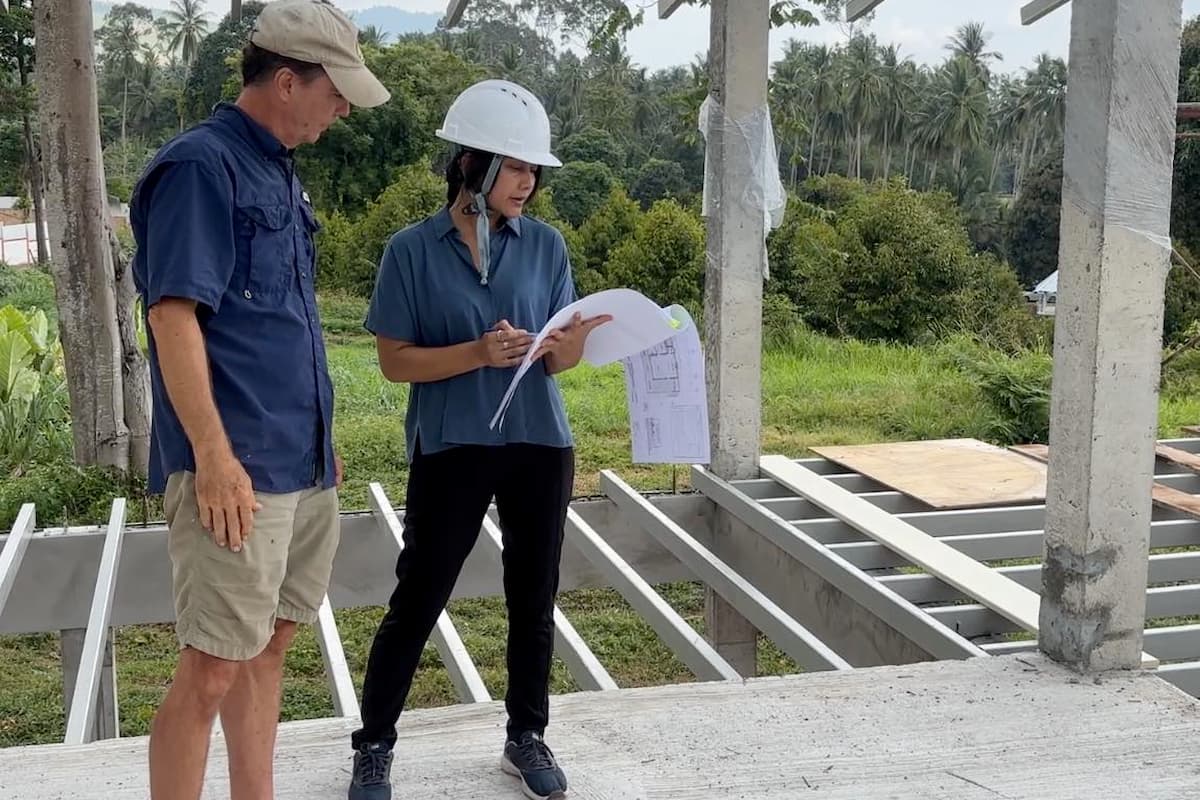
A contract gives a project structure, but it does not check the work. That is the job of an independent architect or engineer who inspects each stage before money is released, keeps the variation log accurate and records defects at handover. It is the most practical protection an owner has in Thailand, because it prevents problems while they are still cheap to fix instead of relying on a court to sort them out afterwards. Choosing the right builder, a clear contract and independent supervision work together, and a project that has all three rarely ends in a dispute.
Working with Nay on your build
Nay Sirirat takes on concept design for projects anywhere in Thailand, and visits sites further afield for paid inspections where the project justifies the travel. On Koh Samui she offers the full service through Architect Samui, from land viability to site supervision: see how a project runs from start to finish. For Phuket and Koh Phangan, see Nay Sirirat's Phuket and Phangan services. If you are further along and want an experienced second opinion on drawings, a quote or a contractor, book a strategy session.



Pingback: Building Permits in Thailand: Who Signs, How Long and What It Covers
Pingback: Architect Fees in Thailand: How Villa Design Fees Work