Choosing grass and ground cover for a garden in Thailand
A lawn is often the last thing installed on a new house and one of the first things owners notice when it goes wrong. Patchy grass under trees, brown edges near the sea, banks washing away in the first heavy rains and lawns that turn into weeds within a year are common sights around homes across Thailand. In almost every case the cause is the same: a grass chosen out of habit rather than for the conditions, laid on ground that was never prepared for it.
The better approach is to treat the garden as a set of different zones and pick the right planting for each one. A sunny family lawn, a shaded strip under trees, a beachfront garden, a steep bank and a decorative courtyard each need something different, and in some of those places the right answer is not lawn grass at all. Our guide to the ten landscaping decisions that matter explains why a lawn is one of the highest-maintenance choices in a tropical garden. This article looks at what to plant when you do want one, and what to use instead where grass will struggle.
Start with the site, not the grass
Five questions decide what will work. How many hours of direct sun does the area get? Is it close enough to the sea to take salt spray, or will it sit beside a saltwater pool? How much foot traffic will it carry, from children, dogs, guests or garden furniture? How much water is available through the dry season? And who will maintain it, and how often?
The answers usually split a garden into two or three zones. It is far easier to plan those zones on the landscape drawings, with paths and edges separating them, than to try to rescue a single grass that has been asked to grow everywhere.
Manila grass, the all-rounder
Manila grass (Zoysia matrella, sold in Thailand as nuan noi) is the most widely planted lawn grass in the country and sits firmly in the budget bracket. It forms a dense, fine-leaved, low-growing turf that feels good underfoot and stays tidy with regular mowing. It handles heat and drought well, stands up to foot traffic, and in studies of soil compaction it held up better than the other common tropical lawn grasses, which matters on ground that has been driven over by construction vehicles. It also tolerates salt reasonably well, and Australian tropical guidance recommends it for exposed seafront sites.
Its limit is shade. Research by Singapore’s national parks agency suggests that around 50 percent shade is about as much as it will take before it thins out. It is also slow growing, which keeps mowing down but means damaged patches take time to repair. For most open, sunny lawns anywhere in Thailand, Manila grass is the sensible default.
Malaysian grass for shade
Malaysian grass (Axonopus compressus, sold as ya Malaysia and known elsewhere as broadleaf carpet grass) is the budget choice for shade. Its leaves are wide and a deeper green than other lawn grasses, and it is one of very few lawn grasses that will grow under 50 percent shade or more. In tropical Australia it is the most widely used grass in shaded areas.
The trade-offs are real. It has low salt tolerance, poor drought tolerance and, because of its broad leaves, needs more water than the finer grasses. It does not cope well with heavy foot traffic and recovers slowly once worn. It grows quickly when watered and Thai guidance suggests mowing every 10 to 15 days. It should be laid before trees grow into a full canopy, as it establishes best in good light, and it spreads readily by runners, so a path or edge is needed where it meets a Manila lawn.
Bermuda grass for hard-wearing sunny lawns
Bermuda grass (Cynodon dactylon, sold as ya Bermuda) is the grass of sports fields and golf fairways. It establishes quickly, has excellent heat and drought tolerance, tolerates some salt, and is unmatched for wear and recovery, repairing itself rapidly where it has been damaged. For a lawn that will take heavy use, such as children’s play areas or a garden used for regular events, nothing else recovers as fast.
It asks a lot in return. It needs full sun, generally at least six hours of direct sunshine a day, and fails quickly in shade. It must be mown short and often and fed regularly to look good, and its runners will invade planting beds and paving joints if not edged firmly. In Thailand its turf usually sells at the top of the price range for lawn grasses, and its maintenance needs push it towards the premium end overall.
Seashore paspalum for salt and wet ground
Seashore paspalum (Paspalum vaginatum, sold as ya paspalum) is the specialist for coastal and difficult ground, and generally a mid-range option. It grows naturally along shorelines, its salt tolerance is exceptional, and University of Florida researchers have noted that it can survive irrigation with seawater. It also tolerates wet, poorly drained soil and long cloudy spells, which suits the monsoon months.
For a garden directly on the beach, or the surrounds of a saltwater pool where splashed water builds salt in the soil, it is often the only grass that stays green. Its weaknesses are poor shade tolerance, a tendency to build up thatch, and a need for frequent, careful mowing, as it is hard to cut cleanly and recovers slowly if scalped. Inland, away from the coast, salt is rarely a problem and paspalum’s main advantage largely disappears.
Velvet zoysia for feature areas
The very fine zoysia sold by many Thai nurseries, known internationally as Korean velvet grass or Mascarene grass (Zoysia tenuifolia) and sometimes called Taiwan grass, is the finest textured of all the lawn grasses. Some botanists treat it as a form of Manila grass. It grows very slowly and, left unmown, forms soft mounds and hummocks rather than a flat sheet, which is why it is often marketed as a no-mow grass.
That makes it attractive as a feature between stepping stones, in a courtyard or around a water feature, and it copes with sun, light shade, drought and coastal conditions once established. It is not suited to a main lawn: it repairs slowly, the mounding surface is uneven to walk and play on, and it does not tolerate wear well. Turf cost is broadly similar to the other zoysias, so it sits in the budget to mid-range bracket, but it is best treated as ornamental ground cover rather than lawn.
Where shade is too heavy for grass
Under dense trees, along deep overhangs or in narrow side passages, even Malaysian grass will eventually fail. Fighting that with repeated returfing costs more than accepting it, and two ground covers do far better in these places.
Mondo grass (Ophiopogon japonicus) is not a true grass but a low, grass-like plant from the lily family, native to East and Southeast Asia, that thrives in part to full shade. It forms a dense, evergreen carpet, tolerates salt and drought, needs almost no mowing and is largely free of pests. It is planted as individual clumps rather than laid as turf, and establishes slowly, so it sits at the premium end, but once settled it is one of the lowest maintenance surfaces in a tropical garden. It suits edging, shaded borders and areas that people look at more than walk on.
Pinto peanut (Arachis pintoi, known in Thailand as tua Brazil) is a low, creeping legume with small yellow flowers that is widely seen across the country. It grows in full sun to fairly heavy shade, fixes its own nitrogen so needs little or no fertiliser, tolerates poor soil, and in Thailand is typically trimmed only every few months. It is a budget option planted from cuttings and takes around six months to form a closed cover, during which weeds need pulling. It has low salt tolerance, so it is not for beachfront gardens, and it takes light foot traffic rather than a daily path. Where a path does cross a shaded area, stepping stones, gravel or decking work far better than any planting.
Slopes and banks
Lawn grass is a poor choice for stabilising a newly cut slope. Its roots are shallow, and on bare banks it can be stripped away along with the soil in the first heavy rain. On hillside sites in the south and the north alike, this is one of the most common landscape failures after construction.
Vetiver grass (Chrysopogon zizanioides, ya faek) is the established Thai answer. Promoted under the Royal Initiative and used for decades by the Department of Highways and the Land Development Department, vetiver is planted in rows across the slope, where its very deep, dense roots bind the soil and its stiff clumps slow the runoff. Highway projects in northern Thailand have combined it with pinto peanut as a ground cover between the rows. Vetiver slips are inexpensive, putting it firmly in the budget bracket, though planting it properly on a large bank is labour intensive. It does not replace engineered retaining walls where those are needed, but on most garden banks it is far more effective than turf.
Budget, mid-range and premium
The turf itself is rarely the expensive part of a lawn, and prices for turf and installation move with the season and the region, so it is more useful to think in terms of overall approach.
A budget approach uses Manila grass in the sun and Malaysian grass or pinto peanut in shade, laid on cleared and levelled existing soil with hand watering. It can look good, but results depend heavily on how well the ground was cleared and how consistently it is watered.
A mid-range approach adds proper preparation: construction debris removed, compacted ground broken up, a decent depth of imported topsoil, surface falls to drainage, and a basic sprinkler system on a timer. It also opens up the specialist grasses, such as paspalum on a coastal site or velvet zoysia as a feature, and vetiver on any banks.
A premium approach adds subsurface drainage, automatic irrigation zoned to suit each planting type, Bermuda or carefully maintained paspalum where conditions suit, mondo grass for shaded borders and edging, and a regular professional maintenance contract. The extra spend goes less on the grass than on the ground beneath it and the care it receives afterwards.
Preparing the ground matters more than the grass
Most failed lawns are not the fault of the grass. After construction, the ground around a house is often compacted fill mixed with concrete waste, sand and crushed rock, with only a thin skim of topsoil over the top. Grass laid on that base may look fine for a few months, then decline as its roots hit the compacted layer and rainwater ponds on the surface.
A lasting lawn needs debris removed, compaction broken up, a proper depth of good topsoil and falls that carry water away from the house rather than leaving it standing. Water supply matters too. Almost every lawn in Thailand needs irrigation through the dry season, and in many areas, particularly on islands and in rural locations that rely on wells or water deliveries, water can be limited or expensive at that time of year. A deep well or a grey-water system can take much of that load off the household supply. The thirstier the planting, and Malaysian grass is the thirstiest of the lawn grasses here, the more this matters. These decisions are far easier to get right while the landscape and drainage are being drawn than after the turf is down.
Matching planting to each part of the garden
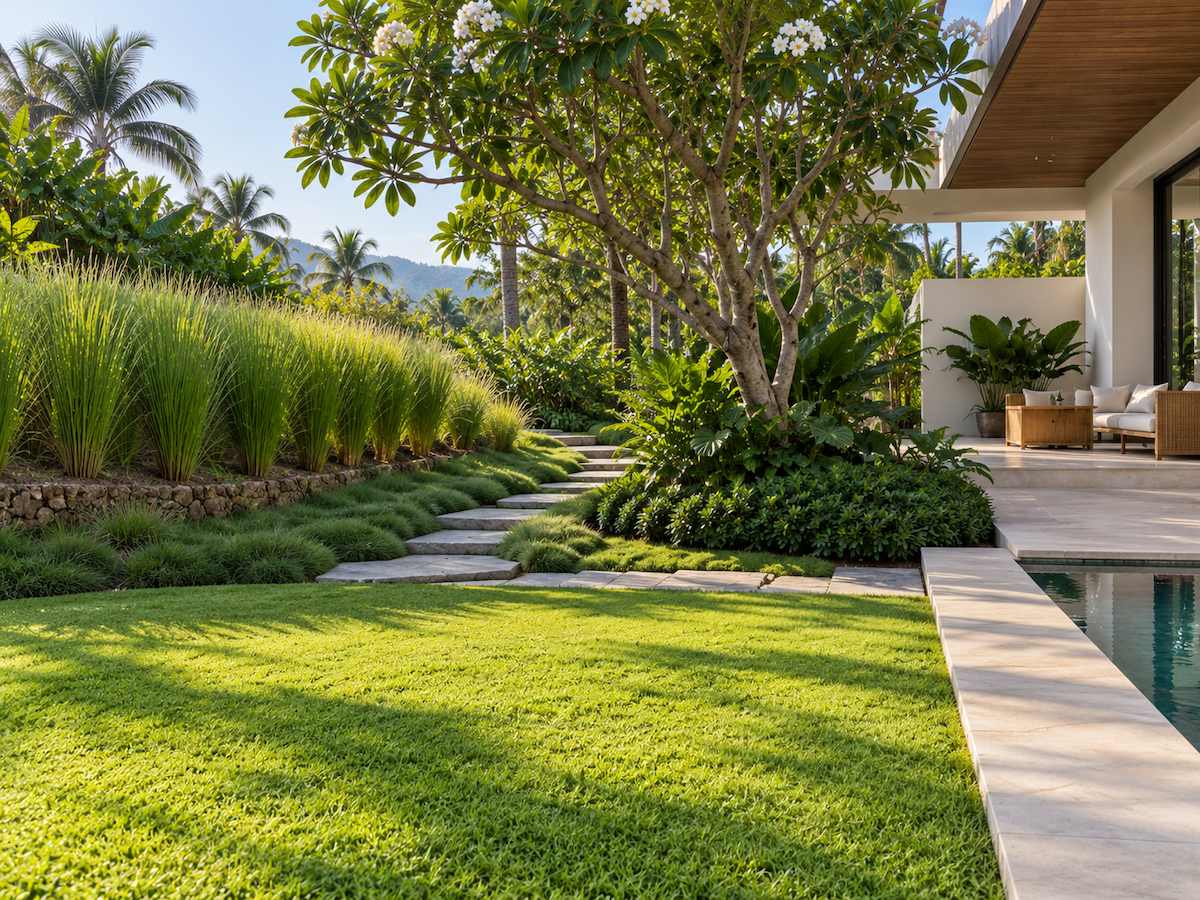
For most homes the pattern is straightforward. Open, sunny lawns suit Manila grass, or Bermuda where the lawn will take heavy use and someone will maintain it properly. Beachfront lawns and the surrounds of saltwater pools in full sun suit seashore paspalum. Areas of light to moderate shade suit Malaysian grass, kept apart from the main lawn by a path or edge. Deep shade suits mondo grass or pinto peanut rather than any lawn grass, and banks and slopes need vetiver rather than turf. Small courtyards and decorative spaces that nobody walks across suit velvet zoysia.
Chosen this way, each part of the garden is planted with something that wants to grow there, and the whole landscape costs less in water, fertiliser and replacement turf over the years than a single grass forced to grow everywhere.
For those of you doing a full build, from land purchase through to handover and beyond, you can find everything you will need in The Thailand Build Blueprint™, so sign up for early access.
If something about your own build or garden is keeping you up at night, whether that is a drainage problem, a contractor you are not sure you trust, or a structural concern you cannot get a straight answer on, book a Strategy Session with Nay to work through it directly.
Working with Nay on your build
If you are planning a build on Koh Samui, the six-step process from land viability to site supervision is set out at Architect Samui; for Phuket, start with Architect Phuket. If you are further along and want an experienced second opinion on drawings, a quote or a contractor, book a strategy session.