Change of use to hotel, explained for villa owners
Thousands of villas across Thailand were built and permitted as private houses, then rented to guests by the night or the week. For a single villa this is often manageable. For a group of villas on one site, or a small resort that has grown building by building, it usually is not. Under Thai law, a property that takes paying guests for short stays is in the hotel business, and the building approval that came with a house permit does not cover it. This article explains how the rules work, what an owner should expect when converting houses to hotel use, and why the building work matters as much as the paperwork.
When rental villas become a hotel
The Hotel Act B.E. 2547 (2004) treats any place that provides temporary accommodation to travellers for payment as a hotel. A ministerial regulation that came into force on 29 October 2023 raised the threshold for small properties. Accommodation with no more than 8 rooms and no more than 30 guests in total, counted across all buildings together, can be notified to the district registrar as non-hotel accommodation instead of applying for a full hotel licence. Once the registrar accepts the notification, the acknowledgement is valid for five years.
Above that threshold, the property needs a hotel licence. A site with ten villas and fifteen bedrooms, for example, is clearly a hotel in the eyes of the law, even if each villa was built for a different owner. Hotels of up to 50 rooms offering rooms only are classed as Type 1. A property with more than 50 rooms, or one that also runs a restaurant or kitchen for guests, falls into Type 2 or above, with more demanding requirements. Operating without the right licence carries penalties under Section 59 of the Act, including fines and a continuing daily fine while the breach continues.
Why a house permit is not enough
A building permit approves a building for a stated use. Most villas were approved as residential buildings. A hotel is a controlled use under the Building Control Act, so before a hotel licence can be issued, the local authority must approve the buildings for hotel use. In practice this means applying to the municipality or Tambon office for a change of use permit, known in Thai as plian kan chai akhan.
This is where many owners are surprised. The authority does not simply update a record. It checks each building again against the rules for hotels, which are stricter than the rules for houses in several ways. Hotel buildings have their own ministerial regulation covering structure, fire protection, escape routes and building management. Stairs in hotels of two storeys or more need landings at regular intervals, corridors must meet minimum widths, open space around the buildings is checked, and fire safety systems are expected throughout. The structure itself may need to be checked by an engineer, because the loads and safety standards for a hotel differ from those assumed for a family home.
What the authority will usually ask for
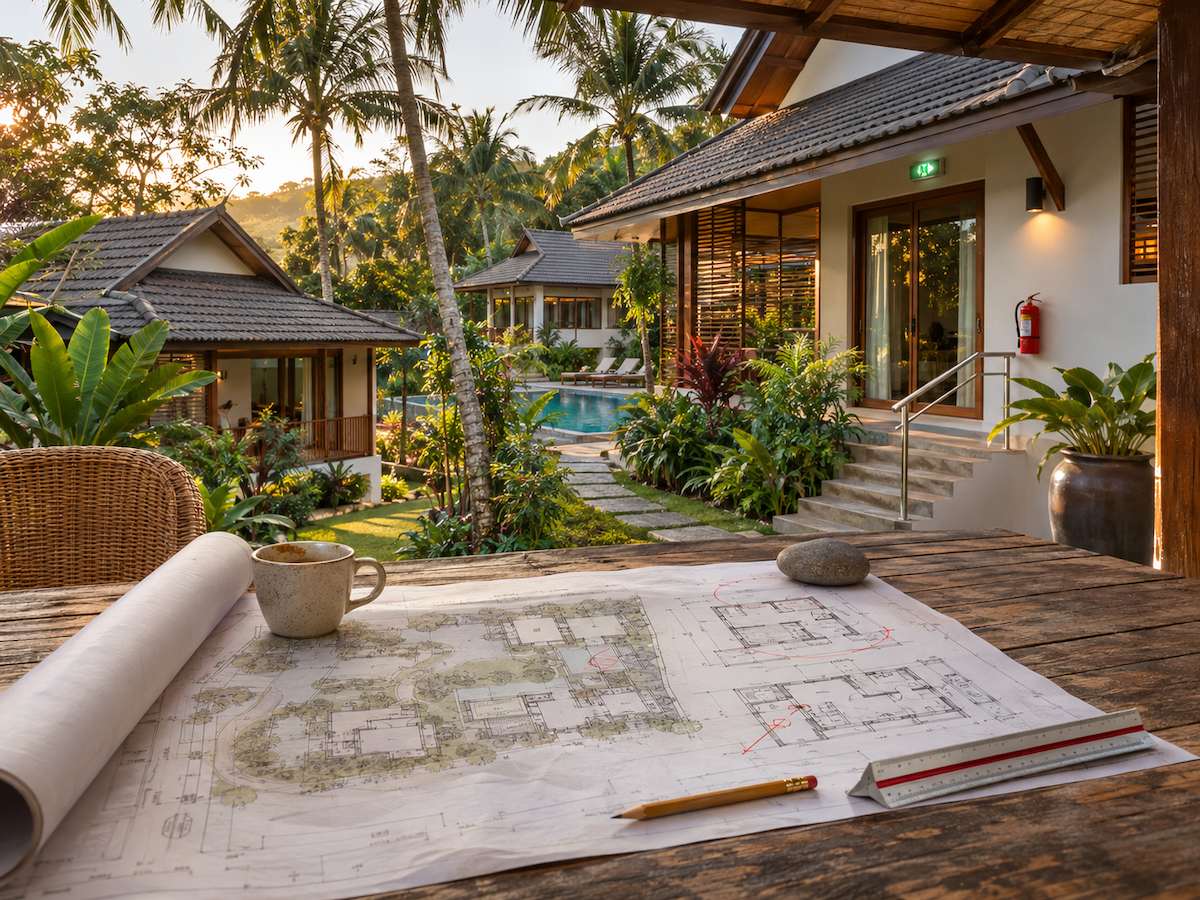
Every local office works slightly differently, but owners should expect the application to be based on a new set of drawings for each building, signed by a licensed architect and licensed engineers. The original approved plans are a useful starting point, yet they show a house rather than a hotel, they are signed by someone else, and in many cases the building on site no longer matches them exactly. Older permit files can also be hard to find, so the plans and permits the owners kept themselves are often the most reliable record.
Alongside the building drawings comes a site plan for the whole property. This shows the access road and the route a fire engine would take, parking, open and green space, drainage and the wastewater system. For a hotel, wastewater treatment is assessed against the standard for the number of guests rather than a single family, and a septic tank sized for a house may not be enough. Our guide to greywater and septic systems for Thai villas explains why these systems are so often undersized.
The paperwork side is just as important. The change of use is applied for by the building owner with the consent of the land owner, and on multi-owner sites each company or individual must sign. Registered leases on the land title also matter, which is why the title deeds and every page of their registration records should be checked at the start. If you are unsure how to read a title, our article on Thai land title deeds is a good place to begin.
The building work that often follows
Once the requirements are clear, most conversions involve some construction. The common items are fire alarm and smoke detection, emergency lighting and exit signs, extinguishers, and safer escape routes, which can mean rebuilding stairs, adding landings and handrails or widening a corridor. Parking may need to be marked out or extended, and the wastewater system upgraded. None of this is unusual, but it has to be designed properly, built to the approved drawings and inspected, because the authority checks the finished buildings before it issues the certificate for hotel use.
This is the part that is easiest to underestimate. A lawyer can prepare the hotel licence application and the owner agreements, but the drawings, engineering certificates and construction changes need an architect and engineers who are licensed to sign them and who understand what the local authority will accept.
Older buildings and special rules
The government has issued special regulations in recent years to help existing small hotels enter the licensing system. One of them relaxes some requirements, such as open space, corridor and stair widths and building setbacks, for buildings that already existed before 19 August 2016, provided they are structurally sound and meet the fire safety conditions. Its future has been under review, so anyone hoping to rely on it should confirm with the local authority that it still applies before planning around it. Location rules matter too. Many coastal and island areas have environmental protection measures that limit what can be built or used on high or steep land, and these sit on top of the building rules.
How to approach a conversion
The sensible first step is a review before anyone commits to drawings. Gather the building permits and approved plans for each building, any digital drawings or surveys, the title deeds with their registration pages, and a clear count of buildings, bedrooms and guests. An architect can then check the buildings on site, confirm the requirements with the local authority and tell you which buildings can be converted, what work is needed and what the next stage will cost. It is the same principle as a land assessment before buying a plot: a modest cost at the start avoids a much larger one later.
Ownership and business structure deserve the same attention. Running a hotel is a regulated business, and for foreign owners it raises separate questions under the Foreign Business Act. Our overview of how foreigners can legally hold property in Thailand covers the options, and a lawyer should advise on the right structure for your situation.
For owners on Koh Samui, Nay Sirirat offers a complete hotel licence service, from the first document review through drawings, engineers and construction alterations to the licence itself, with a free review of your documents to start.
Before you commit to land
The legal structure and the land itself are two different questions, and both need checking before a design begins. For Koh Samui, read four ways to acquire a home on Koh Samui; for Phuket, foreign ownership in Phuket and buying land in Phuket as a foreigner. Nay is an architect, not a lawyer: for the land viability side, talk to Nay directly.