The infrastructure most buyers do not think about until it fails
Mains sewerage connection is available in parts of Thailand’s major urban areas but not so much in other areas. Coastal plots, hillside sites, and island locations (the land categories most foreign buyers are purchasing) manage wastewater on-site. How that management is designed and built determines whether the system is invisible and functional for the life of the property, or a source of odour, cost, and recurring maintenance that no amount of remediation fully resolves.
The two systems are distinct in function and should be treated separately at the design stage. A septic system handles blackwater, like toilet waste, containing pathogens that require treatment before safe disposal. A greywater system handles the comparatively clean wastewater from showers, basins, and laundry which, with minimal treatment, can be recycled for garden irrigation and significantly reduce the villa’s fresh water demand. Combining both streams into a single system is common practice on budget builds and consistently produces the worst outcome of both.
Septic systems: what correct specification requires
A septic tank receives toilet waste, separates solids from liquid through settlement and anaerobic digestion, and discharges the clarified effluent to a drainage field or soakaway where soil filtration provides final treatment. The system works reliably when it is correctly sized for the peak occupancy it must handle, connected to a drainage field with adequate soil permeability, and maintained at appropriate intervals.
The sizing mistake that produces most septic system failures in Thai villa construction is designing for average occupancy rather than peak occupancy. A four-bedroom villa occupied by two people most of the year but rented at full capacity for significant periods requires a tank sized for full rental occupancy, not for the owner’s household. An undersized tank fills faster than the digestion process can manage, solids carry over into the drainage field, and the field blocks. The result is effluent backing up toward the building, persistent odour, and a drainage field that requires excavation and replacement, which is a significant cost on any site.
Soil permeability determines whether a conventional soakaway drainage field is viable for the site. Clay soils with low permeability cannot absorb effluent at the rate a drainage field discharges it; in these conditions the field saturates, fails, and produces surface ponding of partially treated effluent. A percolation test conducted during site investigation establishes the soil’s absorption rate and determines whether a conventional drainage field is appropriate or whether an alternative disposal method is required. On sites with poor permeability, mound systems that raise the drainage field above the natural soil level or aerobic treatment units that produce a higher quality effluent suitable for drip irrigation are the design responses.
Aerobic treatment units represent a step up from conventional septic systems in both treatment quality and maintenance requirement. Where a conventional septic tank requires pumping every three to five years and little else, an aerobic unit involves an air pump, regular servicing, and monitoring of the treatment process. The trade-off is justified on sites where soil conditions make conventional disposal impractical, on plots close to watercourses or the sea where treatment quality is a legal and environmental requirement, and on island locations where the consequences of system failure are contained and visible in ways they are not on larger landmasses.
Permits for septic systems in Thailand are required under the Building Control Act. The local authority specifies setback distances from property boundaries, watercourses, and wells, and the system design must comply with these requirements to receive approval. Building without the correct permits creates legal exposure and can complicate future sale of the property.
Greywater recycling: what it achieves and what it requires
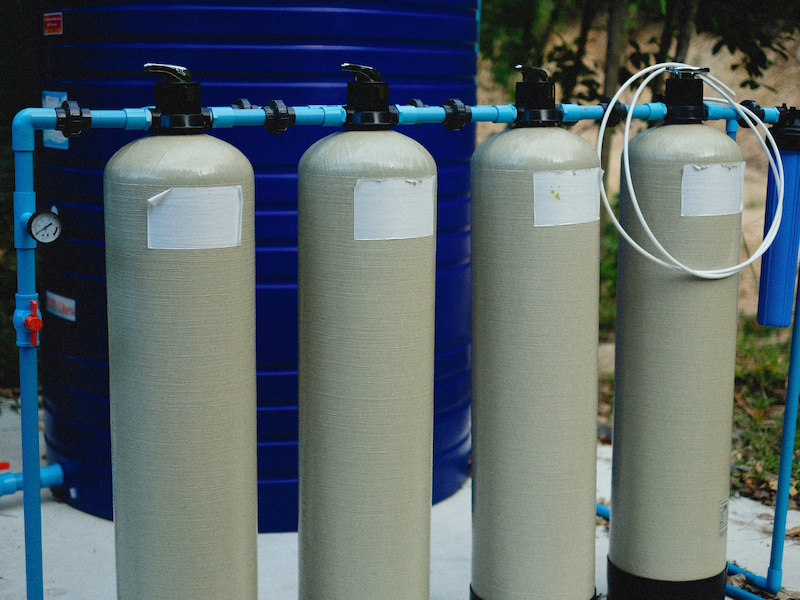
The basic greywater system collects wastewater from showers, basins, and laundry outlets separately from toilet waste, passes it through a simple filter to remove hair and particulate, treats it with a small dosing pump and UV or chemical disinfection, and distributes it to a subsurface drip irrigation network in the garden. The separation of greywater from blackwater must be designed into the drainage layout during construction.
What greywater recycling does not do is eliminate the need for a septic system. Toilet waste requires separate treatment regardless of what happens to the greywater stream. The system value is in reducing irrigation water demand and fresh water consumption, not in replacing wastewater treatment.
The maintenance requirement for a greywater system is modest but not zero. Filters require cleaning at regular intervals, UV lamps require replacement annually, and the drip irrigation network requires periodic flushing. A greywater system in a rental villa without consistent maintenance develops odour from organic accumulation in filters and pipes. The system design should account for how maintenance will actually be conducted.
Kitchen sink waste should not enter a greywater recycling system. The oils, food particles, and detergent concentrations from kitchen drainage accelerate organic accumulation and odour in the system significantly. Kitchen waste goes to the septic system.
The design stage decisions that matter
Two decisions made at the design stage determine whether both systems function correctly for the life of the property.
The first is pipe separation. Blackwater from toilets and greywater from showers, basins, and laundry must run in separate drainage lines from the point of origin to their respective treatment systems. On most villa footprints this is straightforward to detail during design and adds little cost. Detailing it after construction is complete means opening floors and walls.
The second is system sizing for peak occupancy. Both the septic tank and the greywater system should be sized for the maximum number of people the villa will accommodate simultaneously, not the number of people who live there most of the time. The cost difference between a system sized for peak occupancy and one sized for average occupancy is modest at construction stage. The cost of the failure that undersizing produces is not.
The bottom line
On most Thai villa sites, wastewater management is the owner’s responsibility and the consequences of doing it poorly are operational, financial, and environmental. A correctly sized septic system on appropriate soil, a greywater recycling system where fresh water demand and supply conditions make it worthwhile, and the pipe separation designed in from the start produce infrastructure that is invisible in normal operation and requires only routine maintenance for the life of the property.
The alternative of a system sized for convenience, combined streams, and no percolation testing, is visible, odorous, and expensive to correct from the wrong side of handover.
For structured guidance on every stage of a villa build in Thailand — from land purchase through to handover — see The Thailand Build Blueprint™ at thetropicalarchitect.com/the-blueprint
For guidance on your specific project, book a strategy session with Architect Nay at thetropicalarchitect.com/consultations
Getting this specified and checked on site
Decisions like this one are only as good as the drawings and the site supervision behind them. If you are building on Koh Samui, Nay's full service from land assessment to handover is described at licensed Koh Samui architect; for Phuket, see licensed Phuket architect. If you already have a builder and want an independent second opinion on a specification, get a second opinion.