A door system worth considering carefully before specifying
Automatic sliding doors appear frequently in contemporary tropical villa design and for good reason in the right applications. The hands-free operation, seamless indoor-outdoor transition, and ventilation benefits are genuine advantages in a villa context where carrying items between spaces and welcoming guests are daily activities.
They also fail more often than most door systems in Thailand’s tropical conditions, cost significantly more than manual alternatives, and depend on reliable power and consistent maintenance to function correctly. Whether automatic sliding doors are the right specification for a particular application depends on understanding both sides of this clearly.
The genuine advantages in a tropical villa context
Hands-free operation through infrared or motion sensor activation is practically useful in a villa: when carrying groceries from car to kitchen, moving between pool and living areas with wet hands, or welcoming guests without interrupting a conversation. The convenience benefit is real and daily rather than occasional.
The natural ventilation contribution is behavioural as much as mechanical. A door that opens automatically as occupants approach and closes after they pass encourages villa inhabitants to use outdoor spaces more freely, which increases natural ventilation use and reduces air conditioning dependence in transitional spaces. Over time this changes how the villa is occupied in ways that a manual door does not.
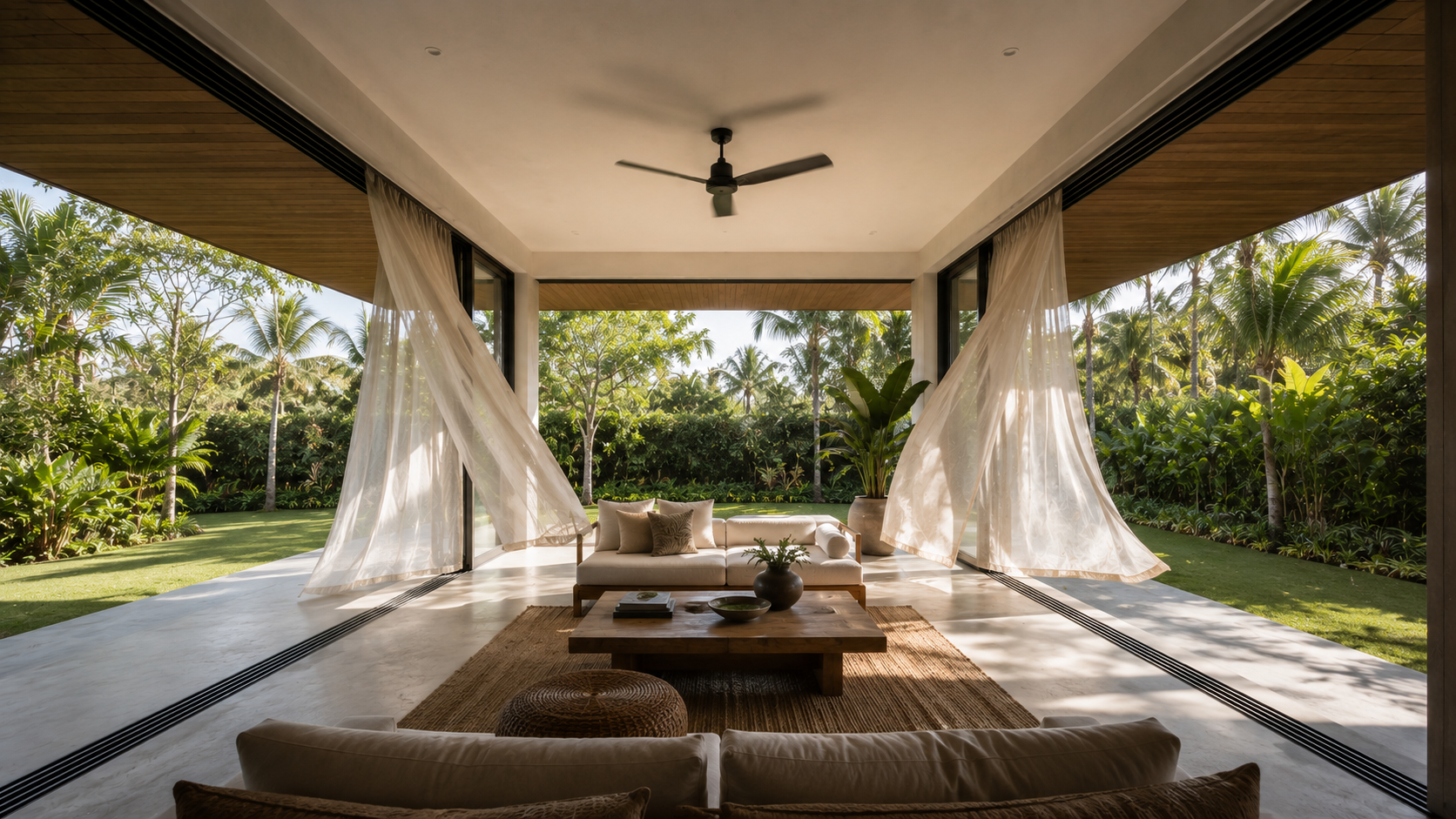
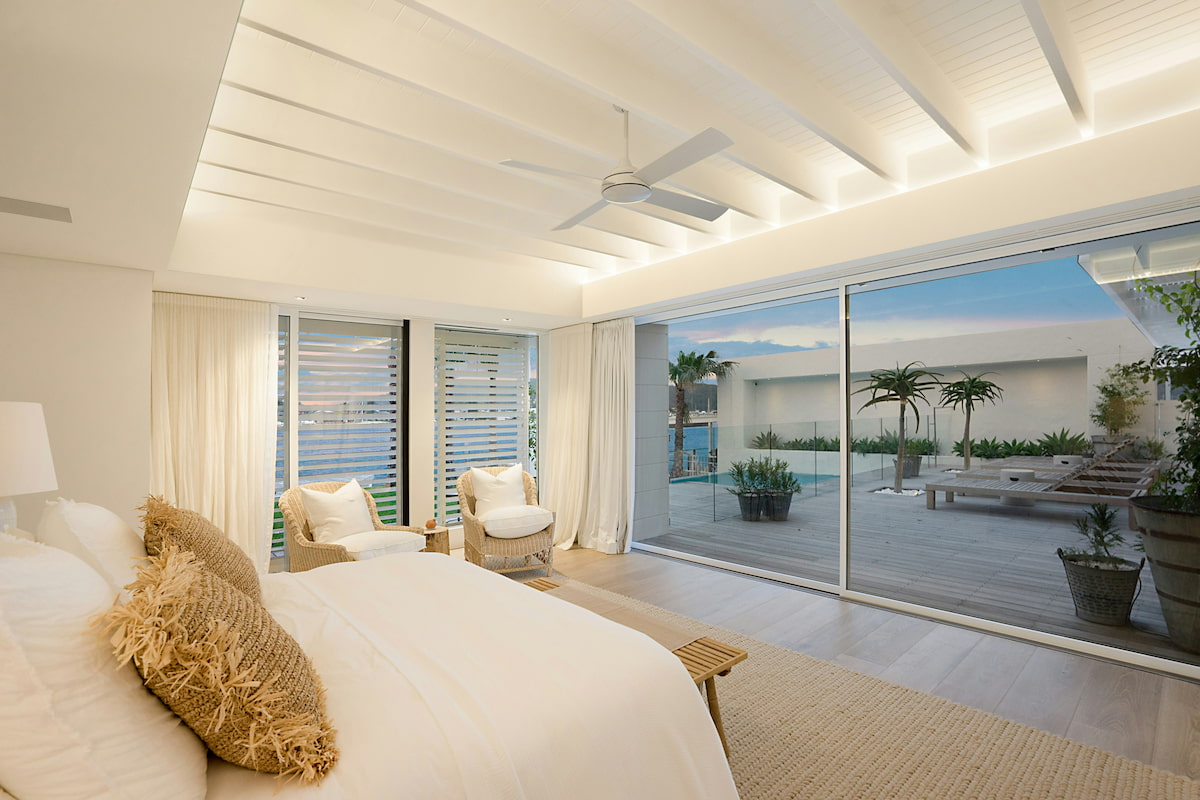
The aesthetic and spatial quality contribution is the third advantage. Automatic sliding doors eliminate the door swing that manual hinged doors require and the manual effort that manual sliding doors involve. In open-plan villas designed for seamless indoor-outdoor flow, this contributes to the spatial quality of the design and the transition between inside and outside feels genuinely effortless rather than requiring conscious action.
For glazing specification on these systems, 8 to 12 millimetre tempered safety glass meeting ANSI Z97.1 or equivalent standards handles the impact and pressure loads that tropical storms generate on large glazed openings. Tempered glass shatters into small rounded fragments rather than large dangerous shards and is the correct safety specification for any large glazed door panel.
Where Thailand’s climate creates specific challenges
The electronic components that automate sliding door operation, drive motors, sensor arrays, and control boards, are vulnerable to the sustained high humidity and salt air that Thailand’s coastal villa conditions produce. Budget automatic door systems use electronics specified for controlled indoor environments in temperate climates. In Thailand’s conditions these components corrode and fail, typically within two to three years of installation. Specify automatic door systems from manufacturers who document tropical or marine environment performance specifically. The price difference between budget and specification-grade systems is significant, but the cost of replacing failed components in a door that is integral to the villa’s daily circulation is higher than the premium avoided at the specification stage.
Power dependency is the second challenge. Automatic doors depend on electrical power to function. In Thailand’s monsoon season, power outages occur, sometimes briefly, sometimes for extended periods during severe weather. An automatic door that cannot be operated during a power outage creates an access problem in exactly the conditions when reliable access matters most. Battery backup systems that maintain operation during outages are available and worth specifying for any automatic door that is a primary access point. Manual override mechanisms that allow the door to be moved manually without power are a minimum requirement regardless of backup power provision.
Track and sensor maintenance is the third challenge and the most consistently underestimated. Sliding door tracks accumulate dust, sand, and organic debris in Thailand’s tropical environment. Contaminated tracks cause misalignment, jamming, and sensor activation failures. The door either fails to open when it should or fails to close completely, which creates both security and weather protection problems. Tracks in coastal locations also accumulate salt deposits that corrode the track surface and roller mechanism if not regularly cleaned. Maintenance schedules that work for automatic doors in temperate climates are inadequate for Thailand’s coastal conditions. Weekly track cleaning and monthly sensor inspection is realistic for primary access doors in coastal locations.
Frame and track specification
Marine-grade aluminium is the correct frame specification for automatic sliding doors in Thai coastal villa locations. The same specification principles that apply to window and door frames throughout the villa apply here: 6063 alloy, marine-grade powder coating or anodising, and grade 316 stainless steel fixings. The automatic mechanism does not change the material requirements of the frame.
Track specification matters more on automatic systems than manual ones. Heavy-duty track systems must be rated for the door panel weight plus a safety margin, because automatic sliding door panels are typically heavier than manual ones and the drive mechanism is designed for a specific load range. Under-specification of the track or over-specification of the panel weight causes drive motor overload and premature failure. Grade 316 stainless steel track is essential in coastal locations. Standard stainless track corrodes in salt air, the corrosion creates surface roughness that increases rolling resistance, and the increased resistance accelerates motor wear in a compounding cycle.
Bottom track drainage prevents water pooling that corrodes track components and allows ingress under the door panel. Perimeter sealing manages wind-driven rain during monsoon conditions. Automatic sliding doors in exposed positions require the same weather tightness detailing as any other large glazed opening.
A minimum two metre opening width is required for smooth automatic operation. Narrower openings create awkward proportions for the automatic activation zone and restrict the ventilation benefit that is part of the case for automatic doors in the first place.
Mosquito screen integration
In any tropical villa position near vegetation, water features, or garden areas, mosquito screens are not optional. They are the detail that determines whether the door can actually be used with the glass open for extended periods.
Automatic sliding doors with integrated screen systems, where a separate screen panel slides independently of the glass panel, allow the door to be held in the open position with insect protection in place. Without this the door is either fully open (ventilated but unprotected from insects) or fully closed (protected but not ventilated), neither of which delivers the integrated indoor-outdoor experience the door was specified for.
Specify the screen system at the door design stage rather than adding it retrospectively. Integrated systems that share the same track architecture as the door panel work more reliably than bolt-on additions and look like part of the original specification rather than an afterthought.
When manual sliding doors are the better specification
The case for manual sliding doors over automatic in many villa applications is straightforward and worth making clearly.
Manual sliding door systems cost a fraction of equivalent automatic systems. The aesthetic result, large glazed panels creating seamless indoor-outdoor transition, is essentially identical. For villa owners where the hands-free convenience of automation is not a priority, the cost saving is substantial with no meaningful performance trade-off.
Manual sliding doors have no electronic components to fail. In Thailand’s conditions where electronic component reliability is a genuine concern, a door that works through physical operation alone has a maintenance profile that automatic systems cannot match: no battery backup required, no sensor calibration, no motor replacement cycles.
Manual doors work during power outages without any special provision. In a villa where power reliability during monsoon weather is uncertain, this is a meaningful practical advantage rather than a theoretical one.
Manual sliding doors can be fitted with multi-point locking systems that automatic doors cannot easily accommodate. For high-security areas of a villa, primary access points, and ground floor openings in unoccupied properties, manual doors with quality locking hardware provide better security than automatic doors where the lock mechanism is integrated with the drive system.
The decision between automatic and manual is not a quality hierarchy. It is a use-case decision. Automatic doors justify their cost and complexity in specific applications where the convenience benefit is genuinely valued and the maintenance commitment can be met. Manual doors are the correct specification for applications where neither condition applies.
Where automatic doors do justify the specification
The primary entrance to the villa is the most consistent justifiable application, where the convenience of hands-free entry is genuinely used multiple times daily and the villa has reliable power or battery backup provision.
Kitchen to terrace connections also justify automation, where food and drink are regularly carried between indoor and outdoor spaces and hands-free operation has daily practical value rather than occasional novelty.
Pool hall or entertainment space connections in larger villas, where the door separates a substantial indoor entertaining space from an equally substantial outdoor area and is used frequently enough to justify the maintenance commitment, are also appropriate applications.
For owners or regular guests with limited mobility, automatic operation transforms access quality in a way that manual doors cannot replicate. This is the application where the specification is most clearly justified by genuine functional requirement rather than convenience preference.
The bottom line
Automatic sliding doors are a genuinely useful specification in the right applications: where hands-free convenience is valued daily, where power reliability and maintenance commitment can be sustained, and where the cost premium over manual alternatives is justified by the use case.
They are frequently over-specified in Thai villa construction and installed because they look impressive in a showroom or on a specification sheet rather than because the application genuinely requires automation. In those cases manual sliding doors deliver the same aesthetic result with lower cost, better reliability, and less ongoing maintenance demand.
The specification decision is straightforward when the question is asked directly: does this particular door, in this particular position, in this particular villa, benefit enough from automation to justify the cost and maintenance commitment over a manual alternative? Often the answer is yes for one or two doors in a villa and no for the rest.
For structured guidance on every stage of a villa build in Thailand — from land purchase through to handover — sign up for the forthcoming Thailand Build Blueprint™ at thetropicalarchitect.com/the-blueprint
For guidance on door system specification for your specific project, book a strategy session at thetropicalarchitect.com/consultations
Getting this specified and checked on site
Decisions like this one are only as good as the drawings and the site supervision behind them. If you are building on Koh Samui, Nay's full service from land assessment to handover is described at licensed Koh Samui architect; for Phuket, see licensed Phuket architect. If you already have a builder and want an independent second opinion on a specification, get a second opinion.