The safety specification that gets removed when budgets tighten
Fire-resistant doors do not appear on mood boards. They are not mentioned in design magazines. They do not feature in the early conversations about materials, finishes, and views that dominate villa design discussions. They appear, if at all, as a line item in a specification document that gets questioned when budgets are reviewed and removed when a cheaper alternative is found or the reasoning is not clearly understood.
This is precisely why fires in Thai villas cause more damage and more casualties than equivalent fires in better-regulated building environments. The passive fire protection that fire-rated doors provide is containing fire and smoke long enough for occupants to escape and emergency services to respond. They are cheap to build in and can be expensive in regrets.
Thailand’s villa construction context makes the case more rather than less compelling. Hillside plots with limited vehicle access delay fire service response significantly. Forest-edge developments create external fire risk from vegetation fires during dry season. Island locations compound the response time problem further still. The self-reliance that makes building in these locations appealing applies to fire safety as much as to water and power infrastructure.
What a fire-resistant door actually does
A fire-rated door is not simply a thicker or heavier door. It is an engineered assembly (door leaf, frame, seals, and hardware) tested as a complete system to maintain a barrier against fire and smoke for a defined period. The key word is assembly: a correctly rated door leaf in an unrated frame with standard hardware provides no rated protection. Every component of the assembly must meet the specification.
The two standard residential ratings are FD30 and FD60. FD30 provides 30 minutes of fire resistance, which should be sufficient time for occupants to evacuate and for a contained fire not to spread rapidly through the building. This is the minimum appropriate rating for most residential applications. FD60 provides 60 minutes and is the appropriate specification for higher-risk positions: between floors in multi-storey villas, at stairwell enclosures, and between the main dwelling and any attached garage or utility space with significant fire load.
A fire-rated door resists two distinct hazards, and both matter. Flame resistance prevents fire penetrating from one side of the door to the other for the rated period. This is achieved through steel cores, fire-treated timber, and composite infill panels depending on the door construction. Smoke resistance is provided by intumescent seals around the door perimeter, which expand when exposed to heat and seal the gap between door and frame, and by cold smoke seals which operate at normal temperatures to address smoke movement before the intumescent seals activate. Both seal types are required for complete protection. Smoke is the primary cause of fire casualties, not flame. A door that prevents flame passage but allows smoke to travel freely through gaps is providing incomplete protection in the dimension that matters most.
Where fire-resistant doors belong in a Thai tropical villa
Thai building regulations specify minimum fire door requirements, but compliance with minimum regulations is not the same as appropriate protection for a specific villa configuration. The positions where fire-rated doors provide meaningful protection are determined by the specific risks of the building and its location.
The kitchen is the most common fire origin point in residential buildings as cooking equipment, electrical appliances, and combustible materials in close proximity create the conditions for ignition. A fire-rated door between the kitchen and the main living and circulation areas contains a kitchen fire long enough for occupants to evacuate through other routes. This is the single most important fire door position in most residential villas regardless of size or location.
In multi-storey villas without stairwell enclosure, fire and smoke travel vertically through the building via the stairwell and this is the same route that occupants need to use to escape downward. A fire-rated door at the stairwell entrance on each floor maintains the stairwell as a protected escape route. This is essential in hillside villas where the stairwell may be the only practical means of escape from upper floors, and where the combination of timber construction elements and natural updraft creates rapid vertical fire spread conditions.
Attached garages, generator rooms, fuel storage, and utility spaces with significant electrical load represent fire risks that are physically connected to the main dwelling but originate in a different use. A fire-rated door at the junction between these spaces and the main building provides separation that limits the spread of a fire originating outside the occupied areas. For villas with solar battery storage systems (increasingly common in Thai villa construction) a fire-rated enclosure or fire-rated access door at the battery and inverter installation is worth including in the specification from the outset.
In villas where all bedrooms are on upper floors accessible by a single staircase, fire-rated doors at bedroom entrances provide a measure of last-resort protection. If the staircase becomes inaccessible during a fire, a fire-rated bedroom door gives occupants a safe refuge and buys time for rescue or suppression.
Material specification for Thailand’s conditions
Fire-rated doors for Thai tropical villa use must meet two requirements simultaneously: achieving the fire resistance rating under test conditions, and performing reliably in Thailand’s humidity, salt air, and temperature cycling over the building’s life. Standard fire doors specified for temperate climates address the first requirement without regard for the second.
The door leaf in steel-core construction requires tropical-grade surface finishes like powder-coated or factory-applied paint systems with documented humidity and salt air resistance. The steel core provides fire resistance; the surface finish determines whether the door maintains structural integrity and appearance in Thai conditions across its service life. Composite fire doors with fire-treated timber cores and steel or aluminium facing are available in contemporary styling that integrates more naturally with tropical villa aesthetics than industrial steel door construction. For positions where the fire door is visible and design quality matters, composite construction offers both rating compliance and aesthetic integration.
The frame is the component most commonly underspecified on non-specialist sites. A correctly specified door in an inadequate frame provides no rated protection. The frame is a critical part of the assembly. Specify galvanised steel or stainless steel frames for tropical conditions; standard steel frames corrode in Thailand’s humidity, compromising both the frame integrity and the door-to-frame seal that fire resistance depends on. The junction between frame and surrounding wall structure should be sealed with fire-rated intumescent mastic rather than standard construction sealant. This gap is a potential fire and smoke passage point that standard sealants do not address.
Hardware specification follows the same logic as all other hardware in Thai coastal villa construction. Fire-rated hinges, typically three per door leaf for FD60 rated assemblies, are non-negotiable as standard hinges have no fire rating and should not be used on rated assemblies. Self-closing mechanisms are equally essential: a fire-rated door held open by a wedge or hook provides no protection when a fire starts. For doors that need to stand open during normal use, electromagnetic hold-open devices connected to the fire alarm system are the correct solution, so the electromagnet releases and the door closes automatically when the alarm activates. All hardware should be grade 316 stainless steel in coastal locations.
Installation is where fire protection is realised or lost
A fire-rated door correctly specified and incorrectly installed provides no rated protection. The installation requirements are specific and the details that matter are the ones most often missed on non-specialist construction sites.
The frame must be mechanically fixed into the surrounding wall structure at specified centres, not simply set in place and grouted around. Movement of the frame under fire conditions (as the surrounding structure is stressed by heat) compromises the door-to-frame seal. Consistent gaps between door leaf and frame, typically two to four millimetres at head and jambs and three to eight millimetres at the threshold, are required for the intumescent seals to function correctly. Gaps outside this range either prevent the door from closing completely or cause the seals to activate prematurely under normal use conditions.
The self-closer must close and latch the door fully from any open position, including the maximum open position. A self-closer that closes the door from 45 degrees but fails from 90 degrees is failing its primary function. This is a simple check to perform after installation and before the building is occupied, and it is consistently overlooked on sites where the fire door specification was not supervised adequately.
Integration with tropical villa design
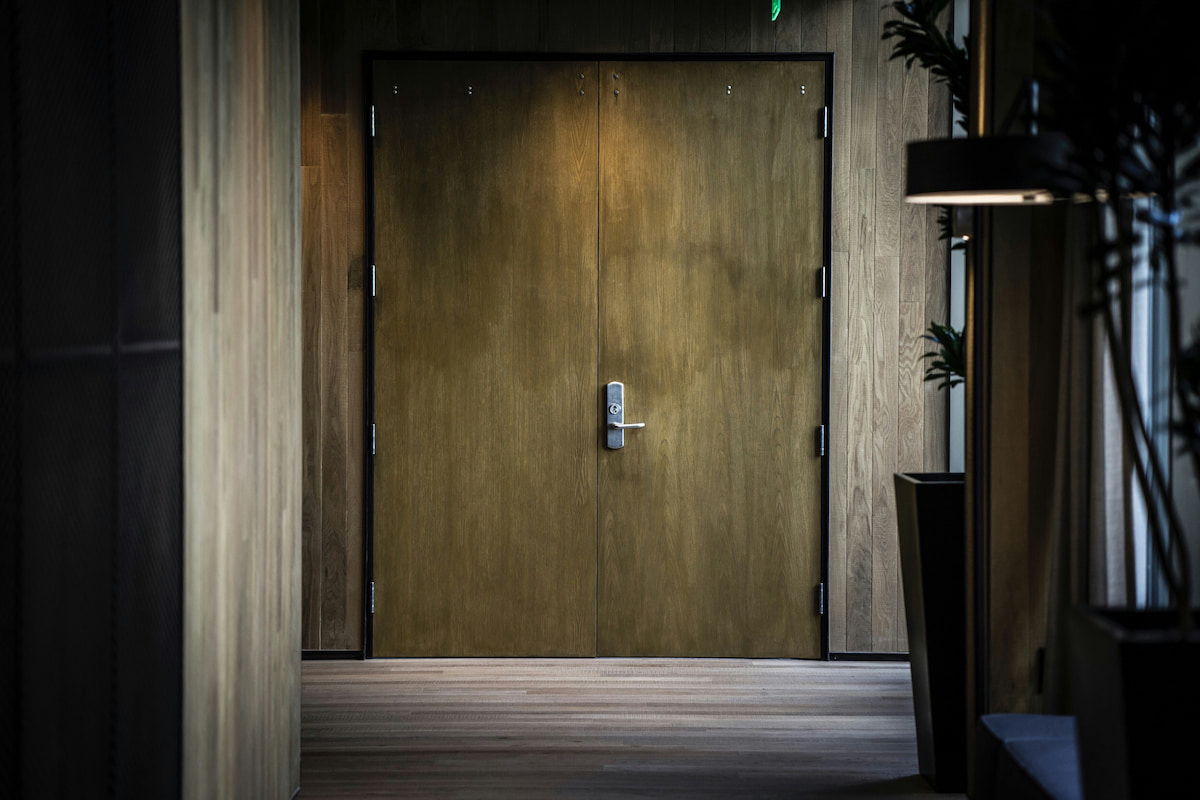
The perception that fire-rated doors are visually incompatible with contemporary tropical villa design reflects the limited range available a decade ago rather than the current market. Composite fire doors in timber veneer, painted panel, and louvred designs are available in finishes that integrate naturally with the interior palettes common in Thai tropical villa construction.
The practical integration requirements are straightforward. Door swings and clearances need to be designed into the spatial layout as fire-rated doors are typically heavier than standard doors and the self-closer mechanism requires adequate clearance for the door to open fully. Thresholds need to accommodate the door bottom seal without creating a trip hazard; recessed threshold details are achievable in new construction and more demanding to retrofit. The self-closer mechanism is visible and should be either accepted as a designed element or specified in a concealed overhead closer format that integrates more cleanly with the door face.
The bottom line
Fire-resistant doors in Thai tropical villas are a safety specification that protects lives in the specific conditions that characterise many Thai villa builds, such as remote locations, delayed emergency response, hillside fire spread risk, and single-staircase escape routes. The cost of correct specification relative to total villa construction cost is modest. The protection provided in a fire event is not.
Specify the correct fire resistance rating for each position, frame and hardware rated as part of the complete assembly, tropical-grade materials for Thailand’s conditions, and professional installation with verified alignment and self-closer function. These decisions are the difference between a fire door that performs when it is needed and one that provides the appearance of protection without the substance.
For structured guidance on every stage of a villa build in Thailand, from land purchase through to handover, see The Thailand Build Blueprint.
For guidance on any problems relating to your building systems or projects, book a strategy session with Nay.
Working with Nay on your build
If you are planning a build on Koh Samui, the six-step process from land viability to site supervision is set out at how the build process runs; for Phuket, start with licensed Phuket architect. If you are further along and want an experienced second opinion on drawings, a quote or a contractor, get a second opinion.