The decisions that compound over decades
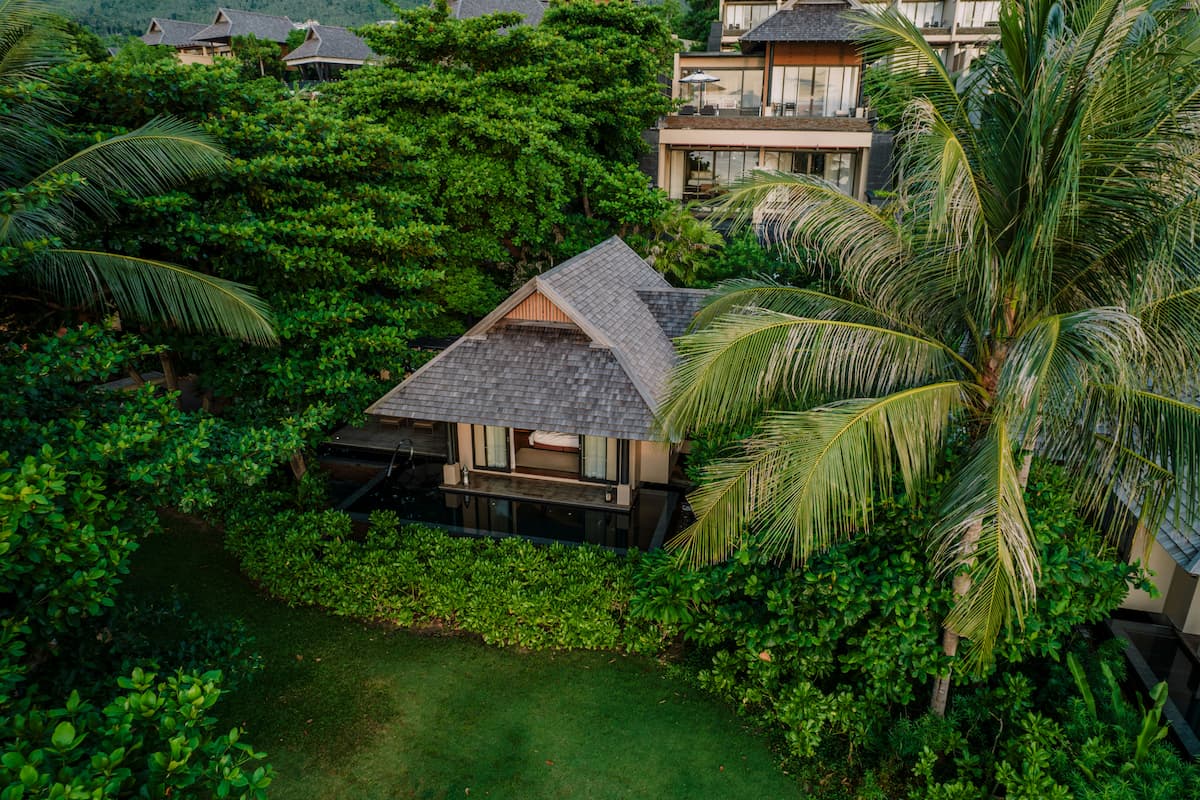
A tropical villa in Thailand looks roughly the same at one year old regardless of whether it was built well or built adequately. The differences begin to appear at three to five years and show up in surface finishes, in how materials are ageing, and in whether water management details are holding up or quietly creating problems. By ten years, the gap between a villa built for longevity and one built to a budget is usually significant and increasingly expensive to close.
The decisions that determine which category a villa falls into are made almost entirely in the design and specification phase, before construction begins. They are rarely dramatic decisions. They are the accumulated effect of dozens of specification choices, each individually modest and collectively determining how the building performs for the next twenty or thirty years.
Thailand’s tropical coastal climate creates four distinct stress conditions that compound rather than operate independently. Sustained high humidity sits above 70 percent for most of the year and above 80 percent during the wet season. Materials that absorb moisture deteriorate progressively, often internally before the damage becomes visible, which means the problem is further advanced than it appears when it first surfaces. Intense UV radiation, with an index regularly reaching 10 to 12, degrades surface finishes, coatings, and polymer materials that are not specifically UV-stabilised. The degradation is irreversible. UV damage cannot be repaired, only refinished. In coastal locations, airborne salt deposits on all surfaces and penetrates building materials through ventilation and moisture movement, accelerating corrosion and degrading surface coatings at distances from the sea that most owners underestimate. And monsoon rainfall arrives in intense bursts rather than steady rain, creating drainage volumes and pressures at joints and penetrations that are categorically different from the conditions that European building details were designed to handle.
A specification decision that addresses one of these conditions without considering the others often produces a different failure mode rather than solving the underlying problem.
The roof is where most long-term problems originate
The roof is the primary defence against Thailand’s climate and the building element where specification decisions have the most significant long-term consequences. Most serious moisture problems in Thai villas trace back to roofing decisions, whether the material choice, the detailing, the drainage capacity, or maintenance neglect.
Metal roofing in aluminium or zinc-aluminium coated steel provides durability and light weight suited to the structural spans common in contemporary Thai villa design. Bare galvanised steel is not the right specification. Galvanised coatings degrade in Thailand’s acid rain conditions faster than the base material rates would suggest in neutral conditions. Clay and concrete tiles provide thermal mass that moderates roof space temperature, which matters for naturally ventilated villas where the roof space temperature affects the ceiling below it. Whatever the material, specify corrosion-resistant fixings throughout. Standard steel fixings corrode and fail before the tiles themselves, requiring costly re-fixing work on an otherwise sound roof.
A ventilated air gap between the roof covering and the insulation or ceiling below dramatically reduces the heat load transferred into the building interior. In Thailand’s direct sun, an unventilated metal roof surface reaches temperatures above 70 degrees Celsius. A ventilated cavity allows this heat to dissipate rather than conducting directly into the building, reducing the ceiling surface temperature by 15 to 20 degrees compared to an unventilated equivalent.
Roof gutters and downpipes sized for average rainfall are inadequate for monsoon intensity. A roof that drains adequately in normal rain overflows at gutter junctions and downpipe entry points during heavy monsoon downpours, and the overflow has to go somewhere. Size drainage for 100mm per hour rainfall intensity as a minimum, and include overflow provisions as secondary drainage paths that activate when primary drainage reaches capacity. Every penetration through the roof membrane, pipe outlets, ventilation terminals, skylights and structural fixings, is a potential water entry point. Detail these with upstands, flashings, and sealants specified for tropical conditions. The penetration details that hold up for years in temperate climates fail faster in Thailand’s UV exposure and thermal cycling.
Wall assemblies and moisture from outside to inside
External render on masonry walls is the standard external wall finish in Thai villa construction. Its longevity depends on the render mix specification, crack control detailing, and the coating system applied over it. Crack control reinforcement mesh at movement-prone junctions, window and door frames, structural beam-to-column junctions, and changes in substrate material, prevents the cracking that allows water ingress. Skipping the mesh to save cost produces cracking within a few years that requires ongoing repair. Specify elastomeric acrylic paint over exterior render rather than standard emulsion. The additional flexibility accommodates the thermal movement that standard paint films crack through, and the extended recoating interval of seven to twelve years versus three to five reduces the lifecycle maintenance cost significantly.
In air-conditioned spaces, the temperature differential between cool interior and humid exterior drives moisture vapour movement through wall assemblies. In the wrong direction, from outside to inside through the wall, this creates condensation within the wall construction that is invisible and causes progressive deterioration. Wall assembly design for air-conditioned spaces needs to consider vapour diffusion direction and manage it through appropriate barrier placement, not simply insulate for thermal performance without considering the moisture consequence.
Foundations and water management
Building floor levels above the surrounding ground, even in locations without obvious flood risk, provides protection against the groundwater level rises that accompany Thailand’s monsoon season. A floor level 500mm above natural ground is a modest structural cost at the construction stage and a significant protection against the damp-related problems that affect buildings constructed at or near ground level.
Surface water drainage around the building perimeter must direct monsoon rainfall away from the building rather than allowing it to pond against foundation walls, and it must be designed for peak monsoon flow rates rather than average conditions. Below-ground structure in coastal Thailand is subject to groundwater with varying salinity. Waterproofing membranes on below-ground walls and slabs protect against both moisture ingress and the progressive reinforcement corrosion that salt-contaminated groundwater causes in unprotected concrete.
Material selection and the questions that matter
The framework for making sound material decisions in Thailand’s climate reduces to three questions that should be applied to every specification choice. Can it handle sustained moisture without deteriorating? Does it resist UV degradation, documented as a specification requirement rather than an assumed characteristic? And how demanding is the maintenance requirement, and will it actually be done? Some materials perform excellently with consistent maintenance and poorly without it. The honest question for any material specification is whether that maintenance will actually happen, particularly for villas that are remotely managed, intermittently occupied, or likely to change ownership. Specifying maintenance-intensive materials in situations where maintenance consistency cannot be relied upon produces predictable outcomes.
The maintenance discipline that protects the investment
The most common cause of accelerated deterioration in Thai villas is not incorrect specification. It is correct specification that is not maintained. A well-built villa with an inadequate maintenance regime deteriorates faster than a modestly specified villa that is consistently looked after.
After the monsoon season, typically October to November in most Thai villa locations, inspect the roof surface for coating degradation, loose fixings, or debris at drainage points. Check gutter and downpipe connections for separation or blockage. Examine all external sealant joints for cracking or adhesion loss at window and door perimeters. Look at the external paint and render surface for cracking, chalking, or biological growth, and check all metal elements for early corrosion signs, particularly fixings, frames, railings, and screen elements.
The value of this inspection is only realised if findings are acted on promptly. Minor sealant cracking sealed immediately costs almost nothing. The same cracking left through another monsoon season allows water ingress that damages adjacent finishes and structure, and the remediation cost is a multiple of the preventive repair cost. Maintain records of material specifications, product names, coating systems, and installation dates. When maintenance or repair is required, matching existing materials is straightforward with documentation and difficult without it.
A Thai tropical villa built to last is not the product of any single correct decision. It is the accumulated effect of consistently applying the right criteria across every specification and detailing choice from foundation to roof. The climate conditions are demanding and consistent, and the building’s response to those conditions needs to be equally consistent. The investment in getting these decisions right at the design and construction stage is modest relative to the total project cost. The cumulative cost of addressing the consequences of getting them wrong, in remediation, replacement, and maintenance, over a twenty-year ownership period is not modest at all.
For guidance on specification and design for your specific project, book a Strategy Session with Architect Nay at thetropicalarchitect.com/consultations
The full build process — from land purchase through to handover — is covered in The Thailand Build Blueprint™ at thetropicalarchitect.com/the-blueprint
Working with Nay on your build
If you are planning a build on Koh Samui, the six-step process from land viability to site supervision is set out at the six-step process; for Phuket, start with our Phuket practice. If you are further along and want an experienced second opinion on drawings, a quote or a contractor, talk to Nay directly.