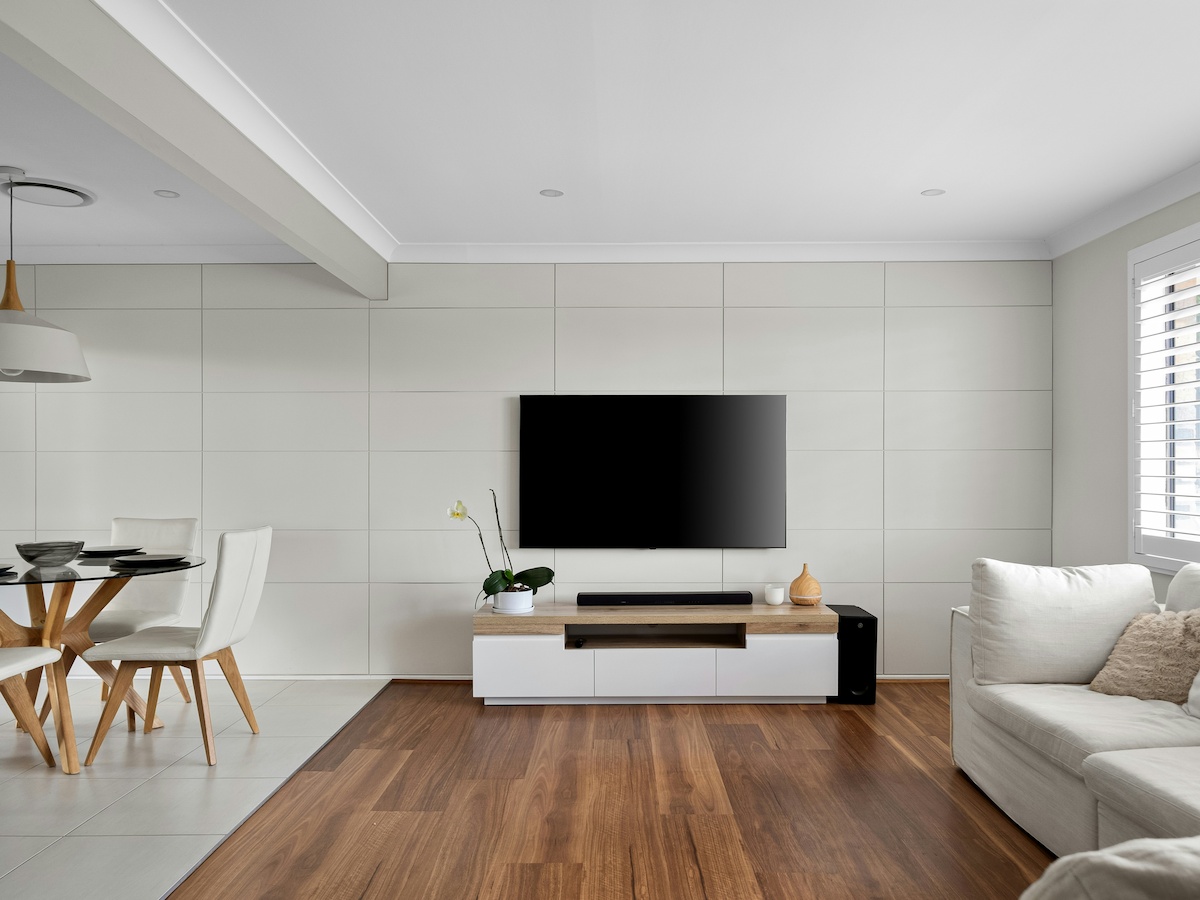
The case for vinyl flooring in tropical villas
Vinyl flooring spent decades being dismissed as the budget option, the material you specified when you could not afford anything better. That reputation is now outdated. Modern vinyl flooring is a capable material that handles tropical conditions well, and in specific applications within a Thai villa it is often the most practical choice available.
This is not an argument for using vinyl everywhere. It is an argument for understanding where it performs well, where it does not, and how it compares to the alternatives competing for the same spaces. The first half of this guide stays at that decision level. The second half covers the technical specification, construction type, wear layer thickness, subfloor moisture testing and expansion gaps among them, that decides whether the floor performs for a decade or fails within a few years.
Why tropical conditions suit vinyl better than most materials
Thailand’s combination of high humidity and temperatures consistently between 28 and 32 degrees Celsius creates a specific problem for flooring nationwide, one that intensifies further with salt-laden air in coastal locations: moisture. Materials that absorb moisture swell, warp, and delaminate. Materials that cannot breathe trap moisture beneath them, causing adhesive failure and odour. Materials with joints and grout lines accumulate mould.
Modern vinyl addresses these problems directly. Waterproof construction with cushioned cores engineered for dimensional stability means it does not swell or shrink as humidity fluctuates, a common failure mode for timber and standard laminate in Thai conditions wherever in the country they are installed. Where sheet vinyl is used the surface is seamless, reducing the mould accumulation that grout lines in tiled surfaces demand constant maintenance to prevent. For wet and moisture-prone areas, bathrooms, kitchens, laundry rooms, and utility spaces, vinyl’s performance characteristics are well matched to what the environment demands, coastal or inland.
How it compares to the alternatives
Teak and tropical hardwoods offer the highest aesthetic quality available for villa flooring, but in Thailand’s humidity, more so with salt air at the coast, timber demands regular sealing and treatment against termites and UV degradation. That ongoing maintenance commitment is real and should not be underestimated. It is the right choice where natural warmth and authenticity are the priority and the maintenance will be kept up, and the wrong choice for rental properties or high-moisture areas where it will not.
Ceramic and porcelain tiles are durable, water resistant, and well suited to wet areas, though comfort underfoot is a real limitation, since tiles feel cold and hard in living spaces, and grout maintenance in humid conditions lets mould establish quickly in porous grout lines. They excel in bathrooms and kitchens and are less appropriate for bedrooms and living areas where comfort matters more.
Natural stone offers exceptional durability and a luxurious aesthetic, but it requires sealing that needs to be properly maintained, its slip resistance varies significantly between stone types, critical in wet areas, and it is heavy enough to affect structural loading. It remains the right choice for feature areas where budget allows and the maintenance will actually be kept up over time.
Laminate flooring is generally unsuitable for Thai tropical conditions nationwide, since standard laminate swells and delaminates in sustained humidity. Tropical-grade laminate performs better but sits at a price point where vinyl becomes the more competitive option, which is why laminate is not generally a recommended specification for Thai villa builds.
Vinyl, against all of these, is the most practical specification for high-moisture interior zones. It is not the highest aesthetic ceiling available, but it offers the best combination of moisture performance, durability, maintenance simplicity, and cost for bathrooms, kitchens, and utility areas anywhere in the country.
Where vinyl works and where it does not
Vinyl earns its place in bathrooms and wet rooms, kitchens and utility areas, staff quarters and service areas, and generally any interior space where moisture management is the primary flooring concern rather than aesthetic prestige.
Consider alternatives instead for main living areas and bedrooms where aesthetic quality is the priority, since timber or stone deliver better results where conditions allow the maintenance they require. Outdoor and semi-outdoor spaces are also a poor fit, since vinyl is not designed for direct sun and rain exposure, and feature areas where the flooring itself is a significant design element deserve the real material, since vinyl’s aesthetic, however improved in recent years, still does not match the genuine thing up close.
Design options
Modern vinyl is available in a wide range of finishes, realistic timber and stone textures, contemporary patterns, and solid colours, and replication quality has improved significantly. At normal viewing distances the better products are convincing.
The honest position is that vinyl still looks like vinyl on close examination. It does not fully replicate the depth, variation, and tactile quality of real timber or stone. For utility areas and wet rooms this does not matter in the slightest. For the main living areas of a high-specification villa, it might matter more than the budget saving justifies.
Specifying it properly
Vinyl flooring is often treated as a straightforward specification: choose a colour, order the product, have it installed. In Thailand’s tropical climate the reality is more demanding. The wrong wear layer specification, inadequate subfloor preparation, incorrect adhesive, or missing expansion allowances produce failures that require complete replacement rather than repair.
Everything above covers where vinyl is the right choice for a Thai tropical villa and where alternatives perform better. The sections that follow assume the decision to use vinyl has been made and address the technical specification decisions that determine whether it performs well for a decade or more, or begins failing within a few years.
Construction type
Vinyl flooring comes in two main construction types with meaningfully different performance characteristics.
Rigid core vinyl, also known as RCV or SPC for stone plastic composite, combines limestone powder and PVC to create dimensional stability that standard vinyl does not achieve. It resists denting under heavy furniture, does not flex or telegraph subfloor imperfections, and handles the temperature cycling in Thai villa conditions without the expansion and contraction that affects standard flexible vinyl. This is the correct specification for most Thai tropical villa applications.
Flexible vinyl, often described as luxury vinyl tile or plank, is standard flexible vinyl construction. Its performance is adequate in stable, climate-controlled interiors but it is more susceptible to temperature-related expansion and more likely to telegraph subfloor imperfections than rigid core alternatives. It is still used in many applications but rigid core is the better default specification for Thai conditions.
Wear layer thickness
The wear layer is the transparent protective surface over the decorative layer. Its thickness determines how long the floor retains its appearance under use and how resistant it is to the abrasive wear that coastal villa living produces, including sand, grit, and the high foot traffic of rental properties.
Wear layer thickness is measured in mil, thousandths of an inch, or in millimetres. A 12 mil layer, equivalent to 0.3 millimetres, is rated for light residential use only and is not appropriate for Thai villa applications where rental turnover, pets, or significant foot traffic is expected. A 20 mil layer at 0.5 millimetres is the standard residential specification and is the minimum appropriate for villa bedrooms and low-traffic areas. A 28 mil layer at 0.7 millimetres is rated for heavy residential and light commercial use, and is the correct specification for entrance areas, living rooms, and any high-traffic zone in a Thai villa. Rental properties should specify at this level throughout. A 40 mil layer or above is commercial grade and is worth considering for high-turnover rental properties where the floor will receive intensive use between regular maintenance cycles.
Specifying 20 mil throughout a villa and applying it to the entrance hall and main living area, which receive the highest wear, produces premature surface degradation in exactly the positions where the floor is most visible.
Total plank thickness
Total plank thickness affects both underfoot feel and dimensional stability. Specify a minimum 5 millimetres total thickness for Thai villa applications. Thinner planks flex more under foot traffic, feel less substantial underfoot, and are more susceptible to telegraphing subfloor imperfections. A 6 to 8 millimetre total thickness is worth specifying for principal living areas where underfoot quality is a design consideration.
UV resistance
Vinyl flooring in positions that receive significant natural light, near large glazed openings or in rooms without adequate shading, requires documented UV resistance specification. The decorative layer beneath the wear layer can fade under Thailand’s UV intensity if the wear layer does not provide adequate UV protection.
Request UV resistance test data from suppliers for any vinyl specified in naturally lit spaces. Fading is irreversible. Once the decorative layer discolours the floor requires replacement.
VOC certification and recycled content
In enclosed air-conditioned rooms, which describes most villa bedrooms and living areas, off-gassing from flooring materials accumulates rather than dispersing. Specify low-VOC certified vinyl with emissions below 0.5 milligrams per square metre per hour for all interior applications. The certification should reference a recognised standard such as GREENGUARD Gold rather than an unverified manufacturer claim.
Cheaper vinyl products, particularly some imported from sources without rigorous environmental standards, can off-gas significantly in the heat of a Thai villa during initial installation and in enclosed spaces thereafter. This is a health consideration as much as a performance one and both matter.
Sustainable vinyl options incorporating up to 50 percent recycled content are available from quality manufacturers. The environmental credentials of recycled-content vinyl are meaningfully better than virgin PVC production without compromising performance, and worth specifying where environmental credentials are part of the brief.
Subfloor preparation
Vinyl flooring fails more often from inadequate subfloor preparation than from product quality problems. A correctly specified product installed over an inadequate subfloor fails. An adequate subfloor makes the specification work as intended.
Concrete slabs in Thailand retain moisture for longer than in temperate climates. A slab that appears dry may still be releasing moisture at a rate that causes adhesive failure and edge lifting in vinyl flooring installed over it. Test slab moisture content before installation using a calibrated hygrometer. Acceptable levels are relative humidity at the slab surface below 75 percent for rigid core vinyl and below 65 percent for flexible vinyl. If moisture levels exceed these thresholds, wait. Installing vinyl over a wet slab is one of the most reliable ways to produce a failed installation. The adhesive bond fails as moisture migrates upward, the floor begins to lift at edges and joints, and the only remedy is complete removal and reinstallation. In coastal Thailand where groundwater levels are high and vary seasonally, slabs that test adequately dry in the dry season may release more moisture during the wet season. A vapour barrier over the slab provides protection against this seasonal variation regardless of the moisture test result at installation time.
Levelness tolerance matters more than most installers communicate to clients. Rigid core vinyl requires a subfloor level to within 3 millimetres across any 1.8 metre span. Flexible vinyl requires 3 millimetres across any 600 millimetre span, a more demanding requirement that reflects its greater susceptibility to telegraphing surface irregularities. High points in the subfloor cause localised stress under foot traffic that cracks planks. Low points create unsupported spans that deflect under load and develop the hollow sound underfoot that indicates inadequate subfloor contact. Level the subfloor with appropriate self-levelling compound before installation. The compound must be fully cured before vinyl is laid over it, and in Thailand’s humidity the curing time may be longer than the manufacturer’s temperate-climate guidance suggests.
The subfloor surface must be clean and free from dust, adhesive residue, paint, and contamination. Adhesive bond to a contaminated surface fails regardless of product quality. Grinding and vacuuming the slab surface before installation is standard practice, not an optional quality step.
Adhesive selection
Use adhesives formulated for tropical high-humidity conditions throughout. Standard contact adhesives can soften in sustained heat, losing bond strength and allowing the floor to shift and lift. Pressure-sensitive adhesives designed for vinyl flooring provide better performance in Thai conditions because they maintain bond strength across the temperature range the floor will experience and allow limited repositioning during installation.
For rigid core vinyl installed as a floating floor, which is the most common installation method, adhesive is not required for the field area. Perimeter adhesive or skirting retention is still needed to prevent edge lifting.
Expansion gaps
Vinyl expands with temperature. In Thailand’s climate where floor surface temperatures in sunny rooms reach significantly higher levels than in temperate conditions, the thermal movement across a large floor area is substantial.
Maintain expansion gaps of 5 millimetres minimum at all walls, fixed cabinetry, door frames, columns, and any fixed element the floor meets. Floor areas exceeding 10 metres in any single direction require additional intermediate expansion joints. These gaps must be maintained throughout the installation and not filled with adhesive or caulk during finishing. Cover them with appropriate skirting, threshold, or trim profiles that allow the floor to move freely beneath them.
Skipping expansion gaps or reducing them to save time produces floors that buckle and lift as the material expands. In Thailand’s climate the temperature differential between installation conditions and summer floor surface temperatures can be significant, and the expansion this produces in a large floor area without adequate gaps is substantial.
Direction and layout
Plan the installation layout before starting. Run planks parallel to the longest wall in rectangular rooms because this produces the most visually coherent result. Avoid very narrow cut planks at room perimeters by planning the layout so perimeter cuts are at least half a plank width.
In open-plan spaces that connect multiple rooms, run planks consistently across the entire area rather than changing direction at room boundaries. Direction changes in continuous open-plan spaces read as an installation decision rather than a design decision.
Threshold details
Transitions between vinyl and other floor materials such as tile, stone, or timber require threshold profiles that accommodate the height difference and allow independent movement of both materials. The threshold must not create a trip hazard and must allow the vinyl to expand without being constrained by the adjacent material.
In wet zone boundary positions, the transition between a tiled bathroom and a vinyl-floored bedroom for example, the threshold must also provide a water barrier that prevents bathroom water migrating under the vinyl edge.
Ongoing maintenance
One of vinyl’s real advantages in a tropical villa is maintenance simplicity. Unlike timber it needs no sanding, sealing, or polishing. Unlike natural stone it needs no periodic resealing. Unlike tiled surfaces its seamless construction removes the grout maintenance that humid conditions make particularly demanding.
Routine maintenance is pH-neutral cleaning and regular dust removal, with an annual check of edges and seams for early lifting, since caught early this is a simple repair and left alone it becomes a considerably larger one. Expected lifespan with correct installation and routine maintenance runs 10 to 15 years in tropical conditions, good value against the materials it competes with in the same applications.
Use pH-neutral cleaning products only. Acidic cleaners, including many common household cleaning products, attack the wear layer surface over time, reducing gloss and eventually compromising the UV protection that the wear layer provides. Alkaline cleaners can affect adhesive bond at edges. Damp mop with minimal water. Standing water at joints and edges migrates into the core regardless of waterproof construction claims because the waterproofing is of the plank surface, not of the installed floor system at joints.
Felt pads under all furniture legs are essential. Hard furniture contact points under load create indentations in the wear layer over time, particularly with rigid furniture on small-diameter feet. In Thailand’s climate where furniture is moved frequently for cleaning and air circulation, furniture scratch damage at contact points is a common maintenance issue.
Inspect edge and joint conditions annually, particularly after the monsoon season when humidity cycling has been most significant. Edge lifting and joint separation caught early can be reseated with appropriate adhesive. Left untreated, they allow moisture ingress that cannot be remedied without plank replacement.
Check expansion gaps annually for any filling. Skirting boards or trim profiles that have settled against the floor surface and constrained expansion movement is more common than most people expect and produces buckling at the constrained positions during the following hot season.
The bottom line
Vinyl flooring correctly specified for Thai tropical conditions performs reliably for ten to fifteen years with minimal maintenance. The specification decisions that determine this outcome, rigid core construction, adequate wear layer for the use intensity, documented UV and VOC performance, moisture-tested and level subfloor, tropical-grade adhesive, and correct expansion allowances, are not complicated. They are simply the details that need to be confirmed before ordering and before installation begins rather than assumed.
The cost of correct specification over incorrect specification is negligible. The cost of replacing a failed vinyl floor installation, including the disruption to finished spaces, is not.
Used strategically alongside premium materials in living and entertaining areas, vinyl is a sensible part of a well-considered material palette, not a compromise. Once you know where it belongs in your villa, the specification guide covers exactly how to get the technical details right.
For structured guidance on every stage of a villa build in Thailand (from land purchase through to handover) see The Thailand Build Blueprint™ at thetropicalarchitect.com/the-blueprint
For guidance on tropical specification or help with your specific project, book a strategy session wih Nay at thetropicalarchitect.com/consultations
If sustainability credentials matter as much as performance, see our environmental case for ceramic tiles, a traditional material that holds up well against newer synthetic flooring options.
Getting this specified and checked on site
Decisions like this one are only as good as the drawings and the site supervision behind them. If you are building on Koh Samui, Nay's full service from land assessment to handover is described at Architect Samui; for Phuket, see Architect Phuket. If you already have a builder and want an independent second opinion on a specification, book a strategy session.