The question that matters more than it used to
Power outages in Thailand are a routine rather than exceptional event, particularly in coastal and island locations served by overhead distribution lines that monsoon storms damage with regularity. A villa without backup power loses air conditioning, refrigeration, pool filtration, security systems, and water pressure simultaneously, and at the times when monsoon conditions make the loss most uncomfortable.
For most of the history of Thai villa construction, the answer to this problem was straightforward: install a diesel generator sized for the building’s essential loads and run it when the grid fails. The answer remains valid. It is no longer the only answer, and for many villa owners and developers it is no longer the best one.
Solar photovoltaic systems with battery storage have reached a level of cost and reliability that makes them a genuine alternative to diesel backup in Thailand’s conditions. It is not simply an environmental preference but a practical and increasingly economic choice. Understanding the specific characteristics of each approach, and the hybrid configurations that combine both, is the basis for making the decision that suits the specific villa and its use pattern.
What diesel generators actually provide
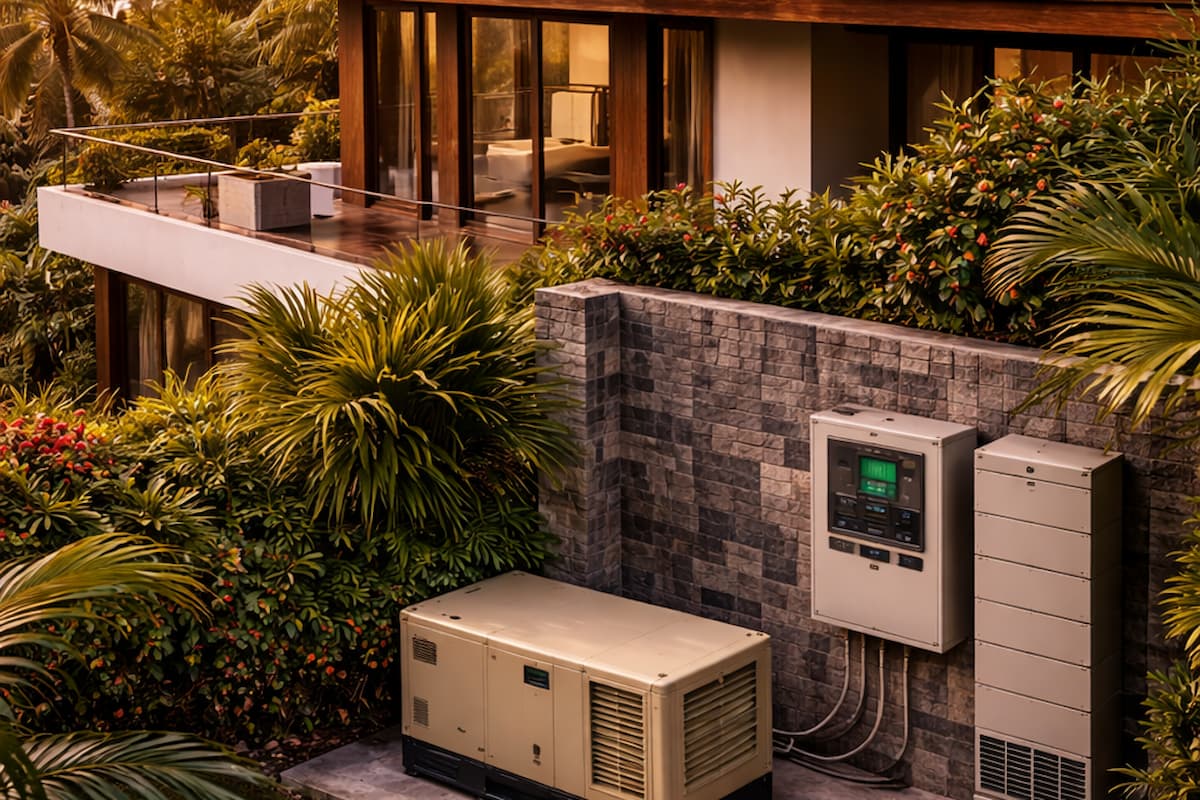
A diesel generator is a self-contained power source that operates independently of sunlight, battery state of charge, and weather conditions. It produces reliable AC power at the rated output for as long as fuel is supplied. These characteristics make diesel generation simple to understand and simple to rely on: when the grid fails, the generator starts and the villa runs.
The practical performance of a diesel system depends on decisions made at specification stage. Generator sizing is the first. A generator sized for the villa’s peak simultaneous load runs at low load factor during normal backup operation, which is inefficient because diesel generators operate most efficiently at 70 to 80 percent of rated capacity. So, a significantly oversized generator running at 20 percent load consumes disproportionate fuel and accumulates engine hours faster relative to useful output. Correct sizing requires a load calculation that identifies the essential loads the generator must serve and the realistic simultaneous demand those loads create, which is typically lower than the sum of individual nameplate ratings.
Automatic transfer switches allow a generator to start and take over supply within seconds of a grid outage without requiring manual intervention. For a rental villa where no owner or caretaker may be present, automatic transfer is the difference between a system that operates correctly when needed and one that requires someone to start it manually at the moment the outage occurs.
Fuel storage and supply are the practical constraints that determine how long a diesel system can sustain backup operation. A 10 kVA generator running at moderate load consumes approximately two to three litres of diesel per hour. On a remote site during an extended outage following a major storm (the scenario where backup power matters most) fuel supply logistics become a genuine operational consideration. Specifying adequate on-site fuel storage for the expected outage duration is part of the system design.
The ongoing costs of diesel generation include fuel, regular servicing (oil, filters, and coolant at intervals determined by engine hours), and eventual engine overhaul or replacement. These costs are predictable and manageable but not negligible over the life of the system. A generator that runs for two hundred hours per year, which is reasonable for a villa in a location with frequent outages, accumulates service requirements on a schedule that requires budgeting and management.
Noise is the other operational reality. A diesel generator at normal operating load produces 65 to 75 dB at one metre (comparable to a running dishwasher at close range), and significantly more disruptive than that figure suggests when it is running at night in an otherwise quiet environment. Acoustic enclosures reduce this to 55 to 65 dB, which is manageable but remains audible. Generator placement relative to sleeping areas and the neighbour’s property line is a design consideration that is easier to resolve during planning than after the generator is installed.
What solar with battery storage actually provides
A solar photovoltaic system with battery storage generates power from sunlight during the day, stores surplus generation in batteries, and draws from storage when generation is insufficient or absent — at night, during overcast periods, and during grid outages. In Thailand’s solar resource, which averages four to five peak sun hours per day across most of the country with higher values in the dry season and lower in the wet season, a correctly sized solar and battery system can meet a significant proportion of a villa’s total energy demand from generation alone.
The distinction that matters for backup power discussion is between a solar system that operates in isolation from the grid and one that operates in parallel with it. A standard grid-tied solar system without battery storage produces power during daylight and exports any surplus to the grid, but shuts down automatically when the grid fails. This is a safety requirement that prevents the system from energising lines that utility workers may be working on. It provides no backup capability despite generating power.
A hybrid solar system combines grid connection, solar generation, and battery storage with an inverter that manages the relationship between all three. During normal grid operation, solar generation reduces import from the grid and charges the battery; surplus beyond battery capacity can be exported. When the grid fails, the hybrid inverter isolates from the grid, draws on battery storage, and continues to use solar generation if sunlight is available, providing backup power without diesel, noise, or fuel consumption for as long as the battery and solar resource sustain it.
Battery capacity is the limiting factor in solar backup performance. A lithium iron phosphate battery bank sized for the villa’s essential overnight loads provides backup through a normal evening and night outage with comfortable margin. An extended outage that persists beyond the battery’s capacity and occurs during overcast conditions (the worst-case scenario) requires either solar generation resuming as conditions improve or an alternative source. This is where the hybrid approach that combines solar storage with a diesel generator provides a more complete solution than either alone.
The capital cost of a correctly sized solar and battery system is substantially higher than a diesel generator providing equivalent backup capacity. The ongoing cost profile is inverted: fuel and servicing costs for diesel are replaced by minimal maintenance requirements for solar panels and periodic battery replacement at eight to fifteen years depending on the battery chemistry and depth of discharge management. For a villa in year-round use or with high electricity consumption from air conditioning, the economics of solar storage improve significantly compared to a villa used only seasonally.
The hybrid configuration that most villa projects should consider
For most Thai villas where reliable backup power is a genuine operational requirement rather than an occasional convenience, the most robust solution combines solar generation and battery storage with a diesel generator as the system’s backup for extended outages and overcast periods.
In this configuration, the solar and battery system handles the majority of outage events, which are typically short in duration and occur in conditions where solar generation resumes within hours. The diesel generator starts automatically only when the battery state of charge falls below a defined threshold, recharges the battery bank, and shuts down when the battery is sufficiently charged. The generator runs at high load factor for relatively short periods rather than running continuously at low load throughout an outage, improving fuel efficiency and reducing engine hours relative to a diesel-only system serving the same backup requirement.
The practical effect is a system that operates silently on solar and battery storage for the majority of outages, falls back to diesel only for extended events, and maintains utility power import for normal operation when the grid is available. Running costs are substantially lower than diesel-only backup because the generator operates far fewer hours per year. The capital cost is higher than either system alone but lower than sizing either independently to the same level of resilience.
For villa developers and owners considering the off-grid case — sites where grid connection is not available or not practical — the hybrid approach with appropriately larger solar and battery capacity and a diesel generator for the dry season or extended overcast periods is the standard solution for reliable power. Fully off-grid operation on solar and battery alone is achievable in Thailand’s solar resource for short outage periods but requires battery sizing that becomes prohibitively expensive for continuous reliable supply through extended overcast wet-season periods without a diesel supplement.
Sizing decisions that determine system performance
Neither a diesel generator nor a solar and battery system performs correctly if it is incorrectly sized for the loads it must serve. The sizing decisions are distinct for each component.
The diesel generator is sized for the peak simultaneous load of the essential circuits it must power during an outage. Air conditioning typically dominates this calculation and a single inverter split unit draws two to three kilowatts at startup and one to two kilowatts running, and a villa with four or five units running simultaneously on generator power requires a generator sized accordingly, with margin for other simultaneous loads. The correct sizing is the result of a load calculation, not a rule of thumb.
The solar array is sized for the daily energy demand it must offset, given the solar resource available and the losses in the system — inverter efficiency, cable losses, and the effect of panel temperature on output. In Thailand’s climate, panel temperature derating is significant as panels operate at ambient temperature plus 20 to 30 degrees in direct sun, and power output decreases approximately 0.4 percent per degree above 25 degrees Celsius. A correctly sized array accounts for this rather than rating the system at standard test conditions that do not reflect actual tropical performance.
Battery capacity is sized for the essential load duration the system must sustain without solar generation or grid input — typically overnight plus a buffer for the following morning before solar generation resumes. For a hybrid system with diesel backup, the battery can be sized for overnight essential loads with the generator providing backup for extended events, which allows a more economical battery specification than a fully off-grid system would require.
Installation and integration requirements
Both diesel generators and solar hybrid systems require installation by qualified electrical contractors with specific experience in the system type. A diesel generator incorrectly connected without an automatic transfer switch that properly isolates the generator from the grid creates a genuine electrocution risk for utility workers. A solar hybrid system incorrectly configured with inadequate battery management can damage batteries, reduce system life significantly, and in extreme cases create fire risk.
The distribution board design discussed in the electrical systems article in this series is directly relevant here: a board designed with the generator and solar connections in mind from the outset is substantially easier to integrate correctly than one that was designed without backup power provision and then retrofitted. The cost of designing for backup power at the electrical specification stage is modest. The cost of retrofitting is not.
In locations where the villa is to be rented, the backup power system should be designed to operate without owner or caretaker intervention. Automatic transfer switches, automatic generator start on low battery or grid failure, and remote monitoring that allows the owner to assess system status from elsewhere are all standard capabilities in current generation equipment and should be specified as standard rather than optional.
The bottom line
Diesel generation and solar hybrid backup are not competing philosophies and are merely tools with different performance profiles suited to different priorities. A diesel generator is simpler, lower in capital cost, and reliable in any weather condition. A solar hybrid system has lower running costs, operates silently, reduces grid import throughout the year, and provides backup without fuel logistics for the majority of outage events.
For Thai villas needing reliable power, a hybrid solar-battery and diesel system is well worth considering. Solar and batteries handle daily needs and short outages, while diesel provides backup for longer blackouts. Over ten years, this combined approach performs better and may result in no extra cost than using diesel alone.
Size both systems correctly. Install both correctly. Design the distribution board for both from the outset. The result is a villa that operates reliably regardless of what the grid is doing.
For structured guidance on every stage of a villa build in Thailand — from land purchase through to handover — see The Thailand Build Blueprint™ at thetropicalarchitect.com/the-blueprint
For guidance on your specific project, book a strategy session with Architect Nay at thetropicalarchitect.com/consultations
Getting this specified and checked on site
Decisions like this one are only as good as the drawings and the site supervision behind them. If you are building on Koh Samui, Nay's full service from land assessment to handover is described at our Samui practice; for Phuket, see our Phuket practice. If you already have a builder and want an independent second opinion on a specification, talk to Nay directly.