The principle that runs through every other decision
Ventilation appears throughout villa design in Thailand not because it is a single system to be specified and forgotten, but because it is a principle that affects almost every other decision: how the building is oriented, how the roof is detailed, what materials the walls are built from, where windows are positioned, how the roof space is managed, and how the indoor and outdoor environments relate to each other.
A Thai villa that is designed for ventilation from the outset is fundamentally different from one that was designed without it and then had air conditioning applied as the solution to discomfort. The first is comfortable with moderate mechanical cooling as a supplement to passive performance. The second is dependent on continuous air conditioning to remain habitable, with correspondingly high running costs and the discomfort that follows any failure of that system.
The ten strategies below are the basis of a ventilation approach for Thai villa design. They are not alternatives to be selected between but rather a framework to be applied in combination, with the specific emphasis determined by the site conditions, the building form, and the owner’s priorities.
1. Orient the building for prevailing wind
Every site in Thailand has a dominant wind direction from which useful cooling breezes arrive for the majority of the year. In Thailand this is typically from the southwest during the wet season and the northeast during the dry season, though the specific pattern varies with geography and topography. Identifying the prevailing wind direction for a specific site and orienting the building to receive it is the single most effective passive ventilation decision available, and it is the one that must be made first because it cannot be corrected after construction.
A building oriented with its long facade perpendicular to the prevailing wind and with openings positioned to receive and channel that flow captures natural ventilation effectively. A building rotated to optimise the view at the cost of wind orientation may look identical on plan but perform significantly worse in practice. Where the view and the wind direction conflict, the resolution is a design problem that experienced tropical architects solve through plan configuration and section design rather than by defaulting to the view and accepting the ventilation loss.
2. Design for cross ventilation through the plan
Cross ventilation is the movement of air through a building from one side to the other, driven by pressure differential between the windward and leeward faces of the building. It is the most effective form of natural ventilation available in residential design and the one most consistently compromised by plan configurations that prioritise other considerations.
For cross ventilation to work, openings must exist on both the windward and leeward sides of every space that is to be ventilated. A room with windows on one face only receives air that enters and has nowhere to exit and the pressure differential that drives airflow does not exist. The plan configuration that prevents cross ventilation is a series of enclosed rooms accessible from a central corridor, where the corridor separates the windward and leeward openings. The plan configuration that enables it is one where spaces extend from one face of the building to the other, or where the plan is open enough for air to move laterally between facades.
The depth of the building perpendicular to the prevailing wind direction affects cross ventilation performance significantly. Plans that are narrow in the wind direction ventilate effectively; plans that are deep require either operable internal partitions that allow airflow, a plan layout that creates ventilation pathways through the section, or acceptance that the central zones of the plan will require mechanical assistance.
3. Use the stack effect for vertical airflow
The stack effect describes the movement of air driven by temperature differential rather than by wind pressure. Warm air rises. In a building with openings at low and high levels, warm air exits at the top and draws cooler replacement air in at the bottom continuously, without any wind to drive it. In Thailand’s climate, where the temperature differential between roof space and ground level can be twenty degrees or more, the stack effect is a powerful and reliable airflow driver.
The design response is to provide both low-level inlet openings and high-level outlet openings in the spaces where stack effect ventilation is intended. Louvred panels at low level on the cooler shaded faces, combined with high-level louvres, ridge vents, or operable clerestory windows near the roof apex, creates the vertical airflow path that the stack effect drives. The greater the height difference between inlet and outlet, the stronger the driving force and the greater the airflow volume produced.
Stack effect ventilation is particularly effective in double-height living spaces, stair voids, and any volume with significant vertical dimension. It operates during the hottest parts of the day when wind-driven cross ventilation may be least reliable, making it a valuable supplement to the horizontal ventilation strategies that dominate at other times.
4. Extend roof overhangs to protect openings and walls
Roof overhangs are simultaneously a shading strategy, a moisture protection strategy, and a ventilation enabler. The connection to ventilation is that openings on walls without adequate overhang protection cannot remain open during rain. In Thailand’s climate, openings that must be closed during rain events are openings that cannot contribute to ventilation during or after those events, which may be a significant portion of the wet season.
Deep roof overhangs extending one to two metres or more beyond the wall face allow windows and louvres on the protected walls to remain open during all but the most extreme horizontal monsoon rain. They also shade the wall face from direct sun, reducing the solar heat gain through the wall and glazing that drives interior temperature up and increases cooling demand. An overhang that allows an opening to remain open during rain while also shading the wall and glazing behind it is performing three functions simultaneously.
The appropriate overhang depth varies with the pitch of the roof, the height of the wall, and the prevailing rain direction for the specific site. On north and south facing walls in Thailand, overhangs are primarily managing direct overhead sun. On east and west facing walls, lower-angle morning and afternoon sun requires either deeper overhangs or supplementary shading devices such as external louvres or brise soleil.
5. Specify louvres and operable openings strategically
Fixed glazing provides daylighting and view but no ventilation. The proportion of any facade that can be opened to allow airflow determines the ventilation capacity available to the occupant. In many Thai villa designs this proportion is frequently too low, because glazing systems are selected for appearance or cost rather than for their ventilation performance.
Louvres and jalousie systems provide high ventilation area relative to their opening size and can remain partially open during rain when protected by an adequate overhang. They are the appropriate specification for openings whose primary function is ventilation rather than view. Sliding doors and bifold systems provide large openings when fully open but require occupant intervention to operate and cannot remain open during rain without protection. Fixed louvres above doors and windows provide permanent uncontrolled ventilation that operates without occupant intervention, useful for maintaining airflow through spaces that are not regularly occupied or monitored.
The positioning of operable openings within the wall height matters as much as their total area. Low-level inlets allow cool air to enter at floor level where occupants benefit from it most. High-level outlets allow hot air that has risen to exit without mixing back into the occupied zone. Openings positioned at mid-height on both windward and leeward walls provide cross ventilation but do not take advantage of the vertical temperature stratification that exists in any occupied space.
6. Ventilate the roof space actively
The roof space in an unventilated Thai villa accumulates heat to temperatures that radiate downward through the ceiling and into the living space below throughout the day and into the evening. This is covered in detail in the roof underlayment and ventilation article in this series, but its importance to the overall ventilation strategy warrants emphasis here.
Roof space ventilation is a distinct system from the habitable space ventilation strategies described elsewhere in this article. Its function is to remove the superheated air that accumulates beneath the roof covering before it can transfer heat into the ceiling assembly and living spaces below. The mechanism is eave-to-ridge airflow: cool air entering through eave vents at the base of the roof slope, travelling upward as it heats, and exiting through ridge venting at the apex. On complex roof forms where continuous eave-to-ridge flow is not achievable, turbine ventilators provide mechanically assisted extraction from the roof space.
A well-ventilated roof space that is maintained at close to ambient temperature rather than at the extreme temperatures an unventilated space reaches reduces the heat load on the ceiling insulation and the cooling system beneath it substantially. It is not a small supplementary strategy and should be considered a foundational requirement for comfortable performance in Thailand’s climate.
7. Separate wet and dry zones to protect ventilation paths
Bathrooms and kitchens in Thai villa design generate moisture, cooking odours, and heat that, if allowed to migrate into the main living spaces, drive up humidity and temperature in the areas where ventilation is most important. The design strategy is to treat wet and service zones as separately ventilated compartments rather than as integrated parts of the open plan.
Bathrooms should have dedicated extract ventilation that removes humid air directly to the exterior rather than allowing it to exhaust into corridors or living spaces. In a naturally ventilated villa without mechanical extract, this requires positioning bathrooms on the leeward face of the building with operable openings that the natural pressure differential draws humid air through. Mechanical extract fans provide a reliable alternative where natural positioning is not possible.
Kitchens with active cooking generate both moisture and heat that a range hood exhausting to the exterior manages effectively. A range hood that recirculates air through a filter rather than exhausting it removes cooking particulate but returns heat and moisture to the kitchen and that can defeat the ventilation purpose. In Thailand’s climate, genuine external exhaust from kitchen cooking areas is the appropriate specification.
8. Use indoor-outdoor design to extend the ventilated zone
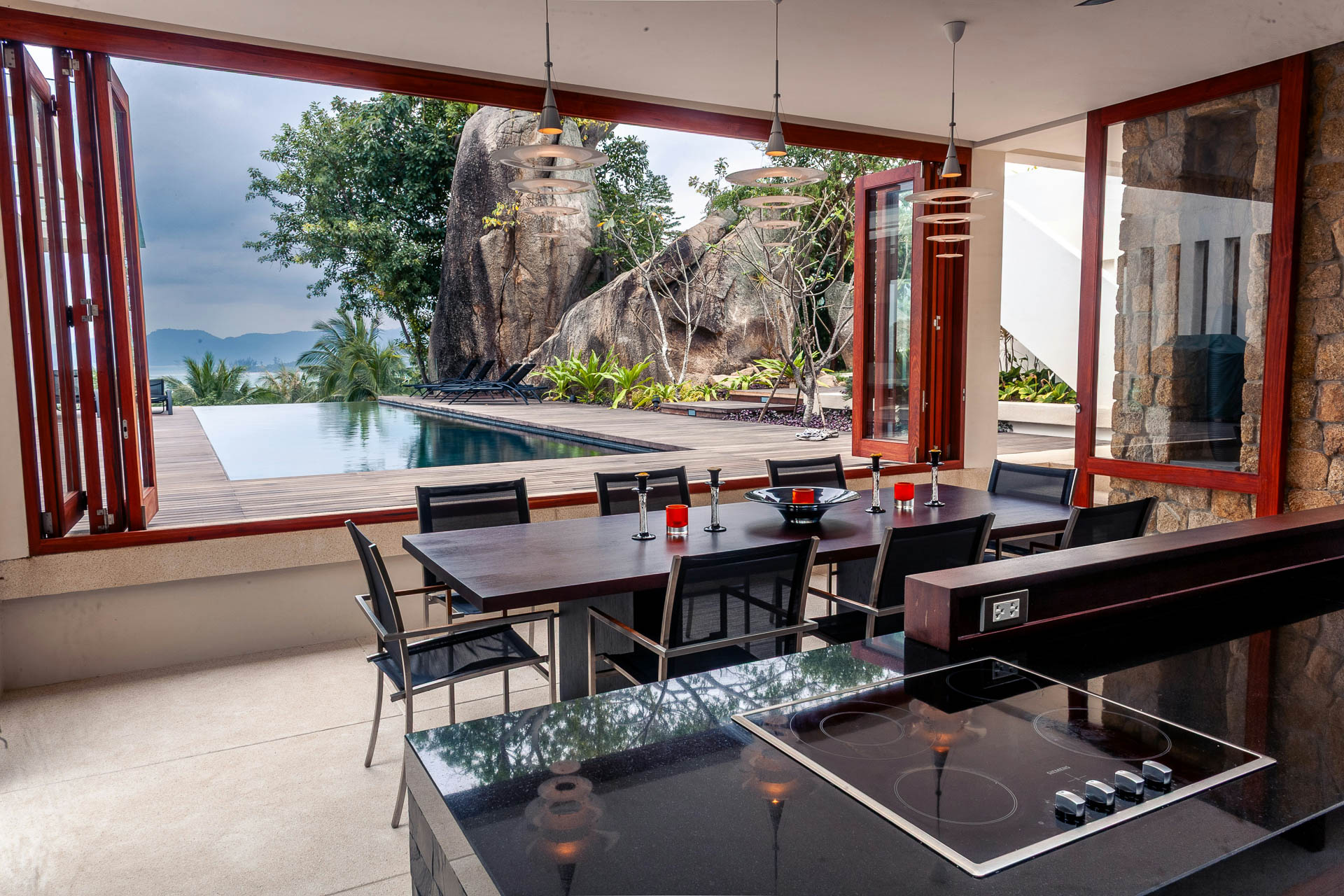
The relationship between indoor and outdoor space in Thai tropical villa design is not simply an aesthetic preference. A design that integrates indoor and outdoor zones through large operable openings, covered terraces that transition between the two, and spatial planning that treats the garden as an extension of the living area creates a ventilated zone that is larger and more effectively cooled than the sealed interior of a villa designed as a contained air-conditioned box.
A living area that opens fully onto a covered terrace, with the terrace positioned to receive prevailing breeze and shaded to remain comfortable during the hottest parts of the day, extends the usable comfortable space of the villa significantly. The covered terrace also provides the protected outdoor zone that allows windows and openings on the interior face to remain open during rain, maintaining airflow through the interior even when conditions outside are wet.
The design discipline is providing shade for the outdoor zone. An unshaded terrace in Thailand’s sun is unusable for most of the day and contributes nothing to the villa’s comfortable living area. A terrace shaded by deep overhangs, a pergola structure, or integrated landscaping is a usable extension of the villa that enhances both ventilation and the quality of the living environment.
9. Manage solar gain to reduce the ventilation load
Ventilation strategies manage the heat that has already entered the building. Solar shading strategies reduce the heat entering in the first place and the two work in combination. A building with high solar gain through unshaded west-facing glazing requires both significant ventilation and significant mechanical cooling to remain comfortable; a building with shaded openings on all facades requires less of both.
External shading is more effective than internal shading at every stage. An external louvre or overhang that prevents solar radiation from reaching the glazing surface prevents that energy from entering the building at all. An internal blind that intercepts the same radiation after it has passed through the glass converts it to heat within the room, where it must be removed by ventilation or air conditioning. The practical consequence is that external shading reduces the heat load on the ventilation system while internal shading does not.
The facades requiring the most attention in Thailand are the west and east faces, which receive low-angle direct sun in the late afternoon and early morning respectively, and the roof, which receives direct overhead sun for the majority of the day. Shading strategies for these surfaces that reduce solar heat gain are the most direct means of reducing the demand on ventilation and cooling systems throughout the building.
10. Design the mechanical system to supplement passive performance
Mechanical ventilation and air conditioning in a Thai villa perform best as a supplement to a building that already performs well passively, not as a replacement for passive design that was not attempted. A villa with good orientation, cross ventilation, stack effect provisions, deep overhangs, and a ventilated roof space requires significantly less mechanical cooling to remain comfortable than one without these characteristics. The air conditioning system is smaller, runs less frequently, and costs less to operate.
The specific mechanical system decisions that affect the relationship with passive ventilation: air conditioning units positioned to circulate air effectively through the space they serve rather than simply cooling the air near the unit; ceiling fans that extend the comfort range of the occupants and allow the air conditioning set point to be raised without reducing comfort; and mechanical extract from bathrooms and kitchens that prevents moisture from migrating into the main living areas.
Ceiling fans in particular are significantly underspecified in Thai villa design relative to their contribution to occupant comfort. A ceiling fan that creates a breeze across the occupant’s skin raises the effective comfort temperature by two to three degrees, allowing the air conditioning set point to be raised by the same amount. Across a rental season or a year of owner occupation, that difference in set point has a measurable effect on energy costs.
The bottom line
Ventilation in Thai villa design is not a system specification it is very much a design philosophy applied across orientation, plan, section, roof, openings, shading, and mechanical systems simultaneously. The strategies in this article are interdependent: cross ventilation works better with good orientation; the stack effect works better with roof ventilation; indoor-outdoor design works better with deep overhangs; and all of them reduce the load on the mechanical system that supplements the whole.
A villa designed with this framework from the outset is a fundamentally different building from one that was not. The difference is apparent every day of the year in comfort, in running costs, and in the quality of the environment it provides.
For structured guidance on every stage of a villa build in Thailand — from land purchase through to handover — see The Thailand Build Blueprint™ at thetropicalarchitect.com/the-blueprint
For guidance on ventilation strategy for your specific project, book a strategy session with Architect Nay at thetropicalarchitect.com/consultations
Designing for the climate from day one
Most comfort problems are decided at the design stage, not fixed afterwards. Nay designs and supervises villas on Koh Samui through Architect Samui and in Phuket through Architect Phuket; the Koh Samui overview and the Phuket build cost guide are useful starting points. For a second opinion on an existing design, book a strategy session.