A different discipline from interior lighting
Garden and landscape lighting in a Thai villa is not interior lighting moved outdoors. The operating environment is categorically different: sustained UV exposure, monsoon rainfall, standing water around fittings, soil contact, salt air in coastal locations, insects and biological growth in and around every enclosure, and the thermal cycling between daytime heat and cooled evening air. Fittings, drivers, cabling, and control systems that perform reliably indoors fail in this environment when they are not specified for it.
The design discipline is also distinct. Interior lighting works within a controlled envelope where the designer determines every surface the light touches. Garden lighting works in an environment where the sky, the vegetation, the pool water, and the surrounding darkness are all part of the composition. The best garden lighting schemes in Thai villas are ones the designer has thought through from a seated position at the main outdoor living area at night, not ones assembled from a catalogue of individual products.
IP rating: the specification that determines whether fittings survive
Every outdoor fitting in a Thai villa installation requires an ingress protection rating appropriate for its specific position. The IP rating system uses two digits: the first indicates solid particle protection, the second liquid ingress protection. For garden and landscape lighting in Thailand, the liquid ingress rating is the critical number.
IP44 is the minimum appropriate rating for fittings in covered outdoor positions that are not subject to direct rain. IP65 is the minimum for any fitting exposed to direct rainfall or hosing during cleaning. IP67 is required for fittings installed at or below ground level where temporary immersion in standing water is possible during monsoon rain events. IP68 is required for fittings fully submerged in pool or water feature applications.
These are minimum thresholds, not targets. In coastal locations with salt air, the mechanical quality of the gaskets and seals that achieve the IP rating matters as much as the rating itself. A fitting that achieves IP65 with gaskets that degrade in salt air will progressively lose its ingress protection as the gaskets deteriorate. Specifying marine-grade fittings with UV-stable seals in coastal locations is the appropriate response, not simply specifying the minimum IP rating.
Material specification for Thailand’s outdoor environment
The material from which a fitting is made determines its service life in Thailand’s outdoor conditions more than any other single factor.
Stainless steel is the appropriate specification for most structural fitting components in outdoor positions. Grade 304 stainless steel performs adequately in most inland locations. Grade 316 stainless is required in coastal salt air environments where 304 corrodes at fixings and exposed edges within a few years of installation. The grade distinction is not visible from the fitting’s appearance and is not always documented in standard product literature. Ask specifically and verify.
Aluminium fittings with marine-grade powder coating or anodising provide good corrosion resistance at lower cost than stainless steel in most applications. The coating integrity determines the performance: powder coating that is chipped or scratched during installation exposes bare aluminium that corrodes in salt air environments. Handle and install aluminium fittings with the same care as the final surface they are intended to produce.
Brass and copper develop a patina in outdoor conditions that many designers consider aesthetically appropriate for garden settings. Both materials perform adequately in non-coastal locations. In salt air environments, the patination accelerates and the rate of material loss beneath it increases, which a consideration for fittings with thin walls or fine detail.
Plastic and resin fittings degrade under Thailand’s UV intensity regardless of the UV stabilisers incorporated in the material. Products specified for outdoor use in temperate climates have typically been tested at UV levels substantially lower than Thailand experiences. The practical consequence is a shorter service life than the product’s outdoor rating suggests, with surface chalking, colour change, and eventual embrittlement appearing within a few years rather than the decade or more that temperate climate testing implies.
Cabling and driver specification
The cabling and drivers that power outdoor fittings are the components most consistently underspecified in Thai villa garden lighting installations, and the ones whose failure produces the most disruptive remediation.
Direct burial cable installed underground must be rated for direct burial applications, with insulation and sheathing materials appropriate for soil contact and moisture exposure. Standard electrical cable without direct burial rating is not appropriate for underground installation regardless of how it is protected during installation. In Thailand’s wet season, soil moisture levels around underground cables are sustained for months at a time.
Conduit for underground cable runs is a specification decision that determines whether future repair or replacement is achievable without excavation. Cable installed in conduit can be withdrawn and replaced if it fails. Cable installed without conduit in direct contact with soil requires excavation for any repair. The cost of conduit at installation stage is modest relative to the excavation cost of repairing uncondited cable runs in an established garden.
LED drivers for outdoor fittings must be housed in enclosures with IP ratings appropriate for their installation position. A driver housed in a waterproof enclosure positioned above ground level in a ventilated location performs differently from the same driver installed in a below-grade enclosure subject to flooding. Driver overheating in Thailand’s ambient temperatures is a genuine failure mode for drivers positioned in enclosed, unventilated locations. Specify driver enclosures with ventilation provision and position them accessibly for servicing.
Low-voltage LED systems operating at 12V or 24V are appropriate for path lighting, underwater pool lighting, and in-ground uplighting where the safety risk of line voltage in wet conditions is unacceptable. Transformer sizing for low-voltage systems must account for cable run length, as voltage drop over long cable runs reduces the illuminance at the fitting end of the circuit below the design target.
Design principles for Thai garden lighting
The design quality of a garden lighting scheme is determined by what is illuminated and from where, not by the number of fittings installed or their individual brightness.
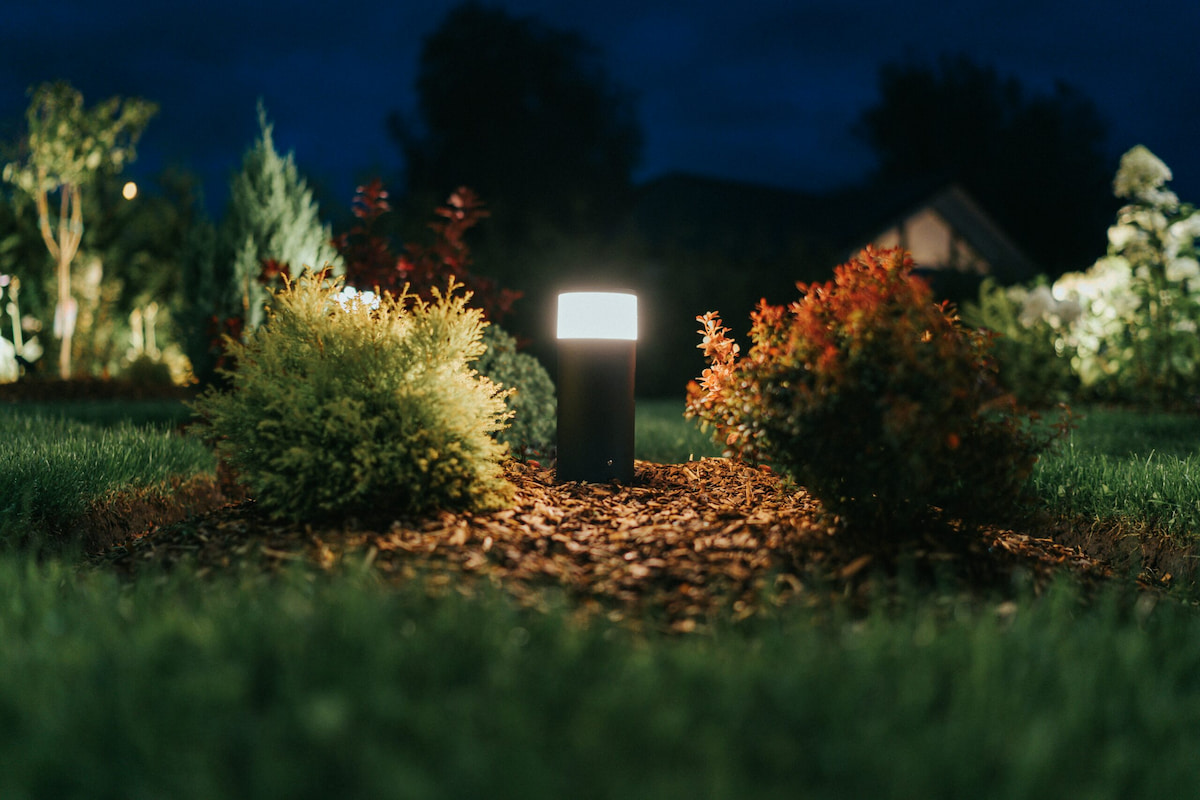
Path and step lighting should provide adequate visibility for safe movement at night without spilling upward light that washes out the wider garden scheme. In-grade or step-mounted fittings that direct light across the walking surface rather than upward provide safety illumination without light pollution. Steps in particular require consistent illumination at the tread edge — not at the face of the riser, which illuminates the structure but not the surface the foot lands on.
Tree uplighting produces the garden lighting effect with the highest impact relative to the number of fittings involved. A single well-positioned uplight at the base of a significant tree illuminates the canopy from below, creates moving shadow as leaves move in the breeze, and contributes to the overall garden composition from every viewpoint. The positioning and beam angle of tree uplights relative to the viewer determines whether the result is dramatic and intentional or harsh and unconsidered. Aim uplights away from primary viewing positions, not toward them.
Pool and water feature lighting requires fittings rated for submersion at the operating depth, colour temperature consistency across all underwater fittings in the same water body, and a transformer housed in a dry, accessible location away from the pool equipment pit. Underwater lighting on separate switching from the pool pump circuit allows the visual effect to be managed independently of filtration operation.
Insect attraction is a practical design consideration that is absent from most garden lighting guidance. Standard white LED light at 4000K and above attracts significantly more insects than warm white LED at 2700K or below. Amber LED, which sits outside the spectrum that most insects can perceive, attracts minimal insect activity and is appropriate for fittings near outdoor dining and seating areas where insect accumulation is a comfort and hygiene consideration.
Control systems for outdoor lighting
Outdoor garden lighting in a rental villa benefits from control systems that allow scheduled operation and remote management without requiring guest interaction. A system that illuminates pathways, pool surrounds, and perimeter areas automatically from dusk to a defined time, and allows the owner to monitor and adjust remotely, reduces both the management burden and the risk of the lighting system being left on or off in ways the guest did not intend.
Photocell and timer control for perimeter and safety lighting operates independently of guest interaction and ensures consistent operation. Dimming capability for decorative garden features allows the lighting atmosphere to be adjusted for different occasions without changing fittings or lamp specification. Integration with the villa’s broader smart home system, if one is installed, allows garden lighting to be managed as part of a unified interface rather than as a separate system requiring separate management.
The bottom line
Garden lighting in Thailand fails faster and costs more to maintain than interior lighting in every case where the specification was carried across from an interior application without adjustment for the outdoor environment. The correct specification starts with IP ratings appropriate to each fitting’s position, continues through material selection for the corrosion conditions of the specific site, and extends to cabling and drivers that are rated for the moisture and heat conditions they will operate in.
Design quality follows from understanding what to illuminate and why. The schemes that work are restrained, purposeful, and thought through from the viewing positions that matter. The schemes that do not work are ones assembled from the available product range without considering what each fitting is intended to achieve in the composition as a whole.
For structured guidance on every stage of a villa build in Thailand — from land purchase through to handover — see The Thailand Build Blueprint™ at thetropicalarchitect.com/the-blueprint
For guidance on your specific project, book a strategy session with Architect Nay at thetropicalarchitect.com/consultations
Working with Nay on your build
If you are planning a build on Koh Samui, the six-step process from land viability to site supervision is set out at Architect Samui; for Phuket, start with Architect Phuket. If you are further along and want an experienced second opinion on drawings, a quote or a contractor, book a strategy session.