The feature that rewards correct decisions and punishes poor ones
A swimming pool is the most consistently desired feature in a Thai villa and among the most frequently regretted. Owners who commission pools without adequate thought about size, specification, site, and ongoing cost discover the problems within two or three years, by which point the pool is built, the problems are structural or systemic, and the cost of correction is significant.
The decisions that determine whether a pool becomes a genuine asset or a persistent operational problem are almost all made before construction begins. Understanding where those decisions go wrong is more useful than any amount of post-construction remediation.
The size and type decision
Many owners go for the largest or most visually striking pool available without thinking through the daily reality of owning and maintaining it in Thailand’s conditions. An oversized pool costs more to fill, more to keep chemically balanced, and more to run filtration on than a correctly proportioned one, and the ongoing cost differential over a decade of ownership is substantial.
Depth is a related decision that receives less attention than it should. Pools deeper than 1.5 to 1.8 metres are rarely used by most swimmers and significantly increase water volume, chemical demand, and energy consumption for filtration. The depth adds cost without adding utility for the majority of villa use cases.
Infinity edge and vanishing edge pools on hillside sites are a specific category requiring more careful consideration than developer marketing materials suggest. The visual effect is genuine and compelling. The structural engineering requirement is also genuine: hillside soil conditions in Thailand, particularly during monsoon season when water tables rise and ground saturation changes the loading on retaining structures, demand detailed geotechnical assessment and engineering that not all pool contractors provide. An infinity edge pool built without adequate structural engineering for the specific site becomes a liability rather than an asset when the ground moves beneath it.
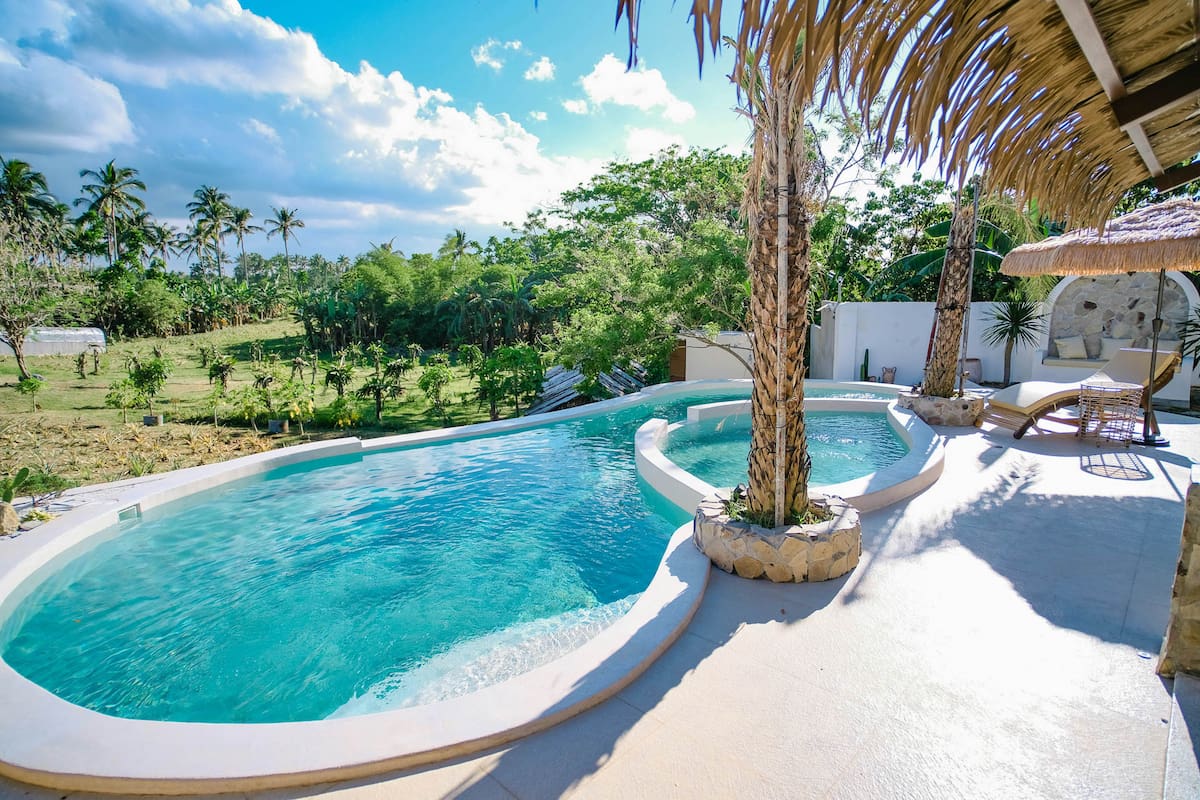
A practical size range for a family villa pool in Thailand is 8 by 4 metres to 12 by 5 metres. A shallow tanning ledge at 30 to 50 centimetres depth extends the usable area of a smaller pool meaningfully. A longer, narrower lap pool is often more usable in Thailand’s heat than a large free-form pool that looks impressive on plan but is rarely swum across.
The specification decision
Cheap pool packages from general builders produce cheap pool outcomes. This is the most expensive mistake in the category because the consequences are structural and the remediation costs are high: leaks that require draining and recoating, cracking that requires structural repair, filtration that cannot maintain water quality, and equipment that fails under sustained use in Thailand’s heat.
The elements most commonly compromised on low-cost pool quotations are the waterproofing membrane, the pump and filtration sizing, the concrete shell thickness, and the steel reinforcement specification. Each of these compromises is invisible at handover and apparent within a few wet seasons.
In Thailand’s clay soils and coastal sand conditions, the ground beneath a pool moves. Seasonal water table variation, expansive clay soils that swell with moisture and contract in dry periods, and the loading effects of monsoon rain on sloped sites all apply forces to a pool shell that inadequate structural design cannot accommodate. A geotechnical assessment before excavation is not an optional extra for a pool project in Thailand. It is the document that determines whether the structural design is adequate for the actual ground conditions or is simply adequate for assumed conditions that may not exist on the specific site.
Pool construction in Thailand should be handled by a specialist pool contractor rather than a general building contractor who includes pools in their scope. The structural detailing, waterproofing systems, and equipment specification of a pool are a distinct discipline, and the consequences of inadequate specialist knowledge are structural problems that a general contractor is not equipped to resolve.
The maintenance and running cost decision
Thailand’s climate is demanding on pool water. Sustained heat, intense UV, high ambient humidity, and monsoon debris loading all accelerate the conditions that affect water quality and equipment load. Algae grows fast in Thailand’s temperatures and will establish itself quickly in any pool where chemical balance lapses. During the wet season, rainfall, organic debris, and runoff from surrounding areas increase the maintenance burden substantially.
Electricity for pumps and filtration represents a meaningful ongoing cost that should be calculated at the design stage, not discovered after the pool is running. Variable-speed pumps consume significantly less energy than single-speed equivalents running at full capacity and are worth specifying in any pool designed to be economical to run. Oversized filtration reduces the frequency at which the system is running at maximum capacity and extends the period between chemical interventions.
Automation for pH and chlorine control reduces the daily management burden significantly, which matters particularly for rental villa pools where no owner is present to monitor water quality between guests. Salt chlorination systems are popular in Thailand and reduce the demand for manual dosing, but they still require monitoring and do not eliminate the need for regular water testing.
Pool finishes affect maintenance load as much as they affect appearance. High-quality ceramic or glass mosaic tile provides a surface that is durable under Thailand’s UV intensity, easy to clean, and resistant to the biological growth that softer or more porous finishes accumulate. Pool paint and cheaper coatings require reapplication on a cycle that makes them more expensive over a ten-year period than a correctly specified tile finish installed once.
The site and orientation decision
Where a pool sits on a site, and how it relates to the building and the path of the sun, determines its usability and its impact on the villa’s performance as a whole.
A pool positioned too close to the building creates ongoing humidity loading on the adjacent walls, splashing onto wall surfaces, and potential waterproofing complications at the junction between pool deck and building. A minimum separation of 1.5 to 2 metres from the building structure is the practical baseline. More is better where the site permits.
A pool oriented to receive full afternoon western sun becomes uncomfortably hot to use during the hours when it would otherwise be most appealing. Positioning that provides morning sun for warming the water and afternoon shade from building overhangs or landscaping produces a pool that is usable throughout the day rather than unusable in the hottest afternoon hours.
Deck drainage is a site design issue that receives insufficient attention. Pool decks that do not drain adequately during monsoon rain create standing water, slip hazards, and loading on waterproofing systems that were not designed for ponding. Deck falls need to be designed into the construction rather than achieved through surface gradient alone, and anti-slip tile surfaces for wet deck conditions are a safety requirement rather than a finishing choice.
Prevailing wind direction affects pool maintenance. A pool positioned in the path of winds carrying leaf litter, dust, or salt spray from coastal locations accumulates debris and contamination that increases filtration loading. Positioning or screening that reduces this exposure reduces maintenance demand over the life of the pool.
The safety, permits, and durability decision
Pool construction in Thailand requires building permits, and pools in villas intended for rental use are subject to specific safety requirements including fencing and barrier specifications that local authorities may inspect and enforce. Building without the correct permits creates legal exposure that is both a risk to the owner and a potential complication for rental operations.
Electrical safety around pool equipment is a non-negotiable specification requirement. All pool equipment must be correctly bonded and earthed, with RCD protection on every electrical circuit serving the pool. Water and inadequate earthing is a lethal combination. The standards that apply to electrical installations in the main villa apply with greater urgency in the pool equipment environment, where the fault risk and the consequence of failure are both higher.
UV resistance of pool finishes and equipment matters more in Thailand’s solar intensity than many specifications account for. Cheap liner materials and fibreglass shells degrade under sustained UV exposure and require replacement on timescales that make their initial cost advantage disappear. Specify materials with documented UV resistance ratings appropriate for continuous outdoor exposure in a tropical climate.
Equipment placement affects the entire operational life of the pool. Pumps, filters, and valves that are installed in positions that are difficult to access require significantly more labour time for routine maintenance and make emergency repairs complicated and expensive. Design the plant room for access, not just for concealment.
The bottom line
A well-specified, correctly engineered pool in Thailand is a straightforward asset that should be usable, maintainable, and durable under conditions that are genuinely demanding on both the structure and the equipment. The decisions that make it straightforward are all made before excavation begins: appropriate size for the actual use case, structural engineering based on geotechnical assessment, specialist contractor, correctly specified equipment, and site placement that works with the sun and the building rather than against them.
The alternative is not a cheaper pool. It is the same pool with problems that compound over time and are expensive to resolve from the wrong side of handover.
For structured guidance on every stage of a villa build in Thailand — from land purchase through to handover — see The Thailand Build Blueprint™ at thetropicalarchitect.com/the-blueprint
For guidance on ventilation strategy for your specific project, book a strategy session with Architect Nay at thetropicalarchitect.com/consultations
Working with Nay on your build
If you are planning a build on Koh Samui, the six-step process from land viability to site supervision is set out at Architect Samui; for Phuket, start with Architect Phuket. If you are further along and want an experienced second opinion on drawings, a quote or a contractor, book a strategy session.