Make sure you understand Thai land titles
Before location, before price, before views or plot size, the single most important question when buying land in Thailand is: what title deed does this land carry?
The answer determines what rights you are actually purchasing, what you can legally do with the land, how secure your ownership is, and whether the land can be sold, leased, mortgaged, or developed. Two plots can look identical, be priced similarly, and occupy adjacent positions but carry title deeds that represent fundamentally different levels of security and utility.
Thailand’s land title system evolved over decades from informal agricultural claims to GPS-surveyed registered ownership. Understanding where a specific title sits in that progression tells you almost everything you need to know about whether a plot is worth buying.
How the system came to exist
Thailand had no formal land ownership records for much of its history. Land was used, farmed, planted, grazed, without any official registration of who owned what. When the government began requiring land to be formally claimed and registered, the process started with a document called the Sor Kor 1, a claim based on demonstrated productive use. That began a progression toward full registered ownership that culminates in the Chanote, Thailand’s gold standard title, based on GPS survey and official registration.
The progression matters because many plots in Thailand sit somewhere along this continuum rather than at the end of it. Where a specific title sits determines how secure the ownership is, which transactions are permitted, and what risks a buyer is taking on.
One practical observation worth noting: coconut palms, rubber trees, and fruit trees on a hillside plot are often a sign that someone historically claimed the land under the Sor Kor 1 system. It is not a guarantee of any particular title, but their presence suggests the land has been in productive use and may have a title history worth investigating.
The title deeds and what each one means
The Sor Kor 1 is the starting point of the system and entirely irrelevant to foreign buyers. It is an early-stage claim to land that cannot be sold, leased, or mortgaged, and it grants no meaningful ownership rights that a foreign buyer could rely on. Thai nationals have sometimes been able to upgrade Sor Kor 1 land through a legally complex process. For a foreign buyer this title has no practical value and should not be considered.
The Nor Sor 2 is one step above the Sor Kor 1 but still not relevant to foreign buyers. It grants temporary land use rights without the security of full ownership. No selling, no long-term security, no confident pathway to development.
The Nor Sor 3 does grant ownership rights, a meaningful distinction from the first two, but the land has not been fully surveyed. Boundaries are approximate rather than precisely defined, which creates genuine potential for disputes with neighbouring landowners. Thai nationals dealing with other Thai nationals sometimes accept this title when they have established relationships with neighbours and existing confidence about boundaries. For a foreign buyer without that local knowledge, the boundary uncertainty creates risks that are difficult to quantify and potentially costly to resolve.
The Nor Sor 3 Khor is similar to the Nor Sor 3 but with some additional rights. Selling and leasing are permitted, and the land survey, while still manual rather than GPS-based, provides slightly more reliable boundary definition. The fundamental limitation remains: this is a provisional title pending full registration, and boundary disputes remain possible. Some experienced developers and investors with local knowledge and legal support consider Nor Sor 3 Khor land, typically because it is priced below Chanote land and they have confidence in the upgrade pathway. For first-time buyers or anyone without extensive Thailand property experience and strong legal support, this is not the title to start with.
The Nor Sor 3 Gor is a meaningfully stronger title. The land has been aerially surveyed, which produces more reliable boundary definition and significantly reduces the dispute risk that manual surveys carry. Transactions including selling, leasing, and mortgaging are all permitted. The technical distinction from a full Chanote is that the land remains formally under government ownership pending final registration. In practice Nor Sor 3 Gor land is generally considered secure and the upgrade pathway to Chanote, while subject to bureaucratic processing time, is well-established. For buyers who find a plot with the right location and price but Nor Sor 3 Gor rather than Chanote title, this is a title worth serious consideration with appropriate legal due diligence, not an automatic disqualifier.
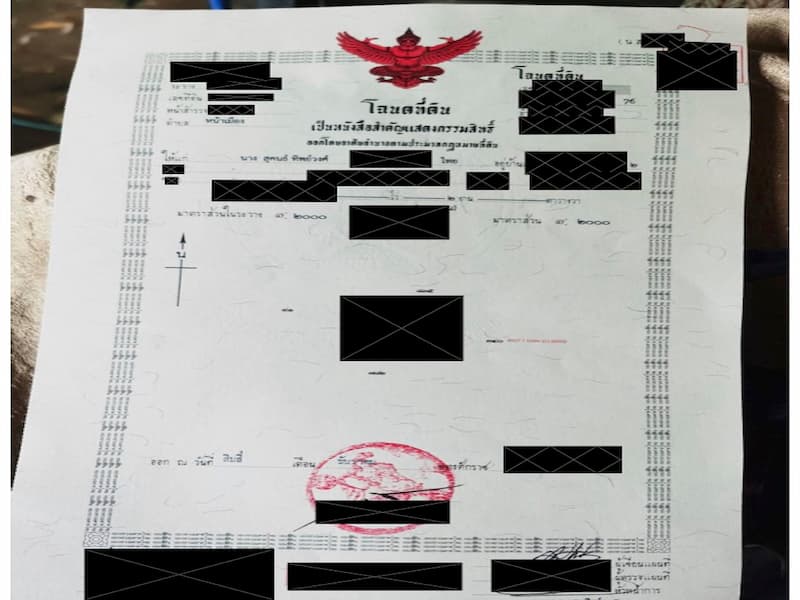
The Chanote, formally the Nor Sor 4 Jor, is the title every foreign buyer should be targeting. It is Thailand’s full registered title deed, GPS surveyed, with boundary posts physically placed on the land and the title officially registered in the Land Department. There are virtually no restrictions on what the holder can do with the land, subject to applicable zoning and building regulations. The Chanote provides precisely defined boundaries with GPS coordinates, full legal ownership rights, and the ability to sell, lease, mortgage, or subdivide without complications. The price premium over lesser titles reflects this and it is a premium worth paying.
In practical terms for a foreign buyer: the Chanote is the title to pursue with confidence. The Nor Sor 3 Gor is an acceptable alternative with strong legal support and appropriate due diligence. Everything below those two titles carries risks that most foreign buyers are not equipped to manage and should be avoided unless there is a compelling reason and expert guidance in place.
What a title deed does not tell you
The title deed is the starting point for land purchase due diligence, not the complete picture. There are additional questions that every foreign buyer needs to address before committing to a purchase: how a foreigner can legally hold or control land in Thailand, the distinction between owning land and owning a structure built on it, how leases, usufructs, and company structures function as ownership vehicles, and what a proper title search at the Land Department actually involves. These are questions where professional legal advice is not optional. They are where the difference between a secure investment and an expensive mistake is made.
Regardless of which title a plot carries, a reputable Thai property lawyer should conduct due diligence before any agreement is signed or funds transferred. That process should include a title search at the Land Department, boundary verification against what is being represented, confirmation that no encumbrances, mortgages, or disputes are registered against the title, and a review of any sale agreement before signing. The cost of professional legal due diligence on a land purchase in Thailand is modest relative to the purchase price. The cost of proceeding without it when something is wrong is not.
Thailand’s land title system rewards buyers who understand it and creates expensive problems for those who do not. The Chanote is the title to target. The Nor Sor 3 Gor is the acceptable alternative with appropriate due diligence. Everything below those two titles carries risks that most foreign buyers are not equipped to manage. Know what title you are buying before you negotiate price, before you instruct a lawyer, and before the view makes the decision for you.
For structured guidance on every stage of a villa build in Thailand — from land purchase through to handover — see The Thailand Build Blueprint™ at thetropicalarchitect.com/the-blueprint
For guidance on your specific project, book a strategy session with Architect Nay at thetropicalarchitect.com/consultations
- This article is for information purposes and you should consult a lawyer for professional legal advice.
Before you commit to land
The legal structure and the land itself are two different questions, and both need checking before a design begins. For Koh Samui, read four ways to acquire a home on Koh Samui; for Phuket, foreign ownership in Phuket and buying land in Phuket as a foreigner. Nay is an architect, not a lawyer: for the land viability side, get a second opinion.