Paradise does not automatically produce productivity
The appeal of working from a tropical villa in Thailand is obvious. The reality of doing it comfortably requires more thought than most people give it before they arrive.
Thailand’s temperatures of 30 to 35 degrees Celsius and humidity regularly above 80 percent create a working environment that rewards careful design and punishes neglect. A home office that works well in these conditions is not simply a desk near a window with a good view. It is a considered space that manages heat, humidity, airflow, and materials with the same intentionality as any other part of a well-designed tropical villa.
This is increasingly relevant. Remote work has made the question of how to create a genuinely productive workspace in a tropical villa a practical one rather than a theoretical one, particularly for villa owners, long-stay renters, and digital nomads who spend months rather than days working from these spaces.
Positioning is the decision that determines everything else
Where the office sits within the villa is more important than what goes in it. Get the positioning right and the space works with the climate. Get it wrong and no amount of equipment or furniture compensates.
Cross-ventilation is the primary positioning criterion. Position the workspace to benefit from natural cross-breezes, with openings on two sides of the space that allow air to move through rather than accumulate. In Thailand’s heat, a workspace with good natural ventilation is comfortable to work in for extended periods. A workspace in a humid corner with stagnant air is not, regardless of air conditioning. Avoid corners, internal rooms, and any position where airflow is blocked by adjacent structure or vegetation. The best home office positions in a tropical villa are often the least obvious ones architecturally because functional air movement matters more than the most dramatic view.
Daylight without direct sun is the second positioning criterion. Natural light supports productivity and reduces dependence on artificial lighting. Direct tropical sun on a workspace creates heat, glare on screens, and UV damage to materials and equipment. Position the desk to receive diffused or indirect natural light, preferably north-facing in Thailand, or shaded by adequate roof overhangs on other orientations. Shaded windows that admit light without direct sun are the ideal specification. A deep roof overhang that shades the window while allowing sky light in is the architectural detail that makes this work passively rather than requiring constant blind adjustment.
Separation from living spaces is the third consideration. For anyone working seriously from home, acoustic and visual separation from the rest of the villa makes a meaningful difference to concentration. A dedicated room or a clearly defined zone with visual privacy from circulation areas performs better than a desk positioned in a corner of the living room.
Climate control
A well-positioned office with good cross-ventilation can be comfortable to work in without air conditioning during the cooler parts of the day and in the dry season. During Thailand’s hottest months and in the humidity of the wet season, air conditioning is generally necessary for sustained productive work. The most practical approach for most villa home offices is both, with natural ventilation as the primary strategy and air conditioning available for the conditions that require it. Designing the space to work well naturally ventilated reduces air conditioning running hours and the energy cost that accompanies them.
A dedicated split unit for the office rather than relying on a system that serves multiple spaces provides better temperature control and more efficient operation. Size the unit for the room volume and heat load, recognising that screens, computers, and printers generate heat that adds to the cooling requirement beyond what an empty room calculation would suggest. Position the indoor unit so the airflow does not blow directly onto the desk. This is a common installation that creates uncomfortable draughts on the occupant while leaving other parts of the room inadequately cooled.
In an air-conditioned office, humidity is managed as a byproduct of cooling. In a naturally ventilated office in Thailand’s wet season, ambient humidity above 80 percent is normal and affects both occupant comfort and equipment longevity. A small dehumidifier running during high-humidity periods is worth considering for spaces that are primarily naturally ventilated.
Materials that survive the conditions
Equipment and furniture that perform well in temperate offices deteriorate in Thailand’s humidity and salt air if the wrong materials are specified.
Steel-framed desks with powder-coated finishes and rust-proof hardware perform well in tropical conditions, with a lifespan of 15 to 20 years even in partially open or semi-outdoor spaces. Standard steel without protective coating corrodes in coastal salt air within a few years. Tropical hardwood desktops such as teak and acacia are the practical timber choices because they resist swelling, cracking, and mould better than softer timbers. They develop a patina over time that improves rather than degrades their appearance. Pine and MDF desktop surfaces are inadequate specifications for Thai humidity because they will swell, warp, and delaminate predictably.
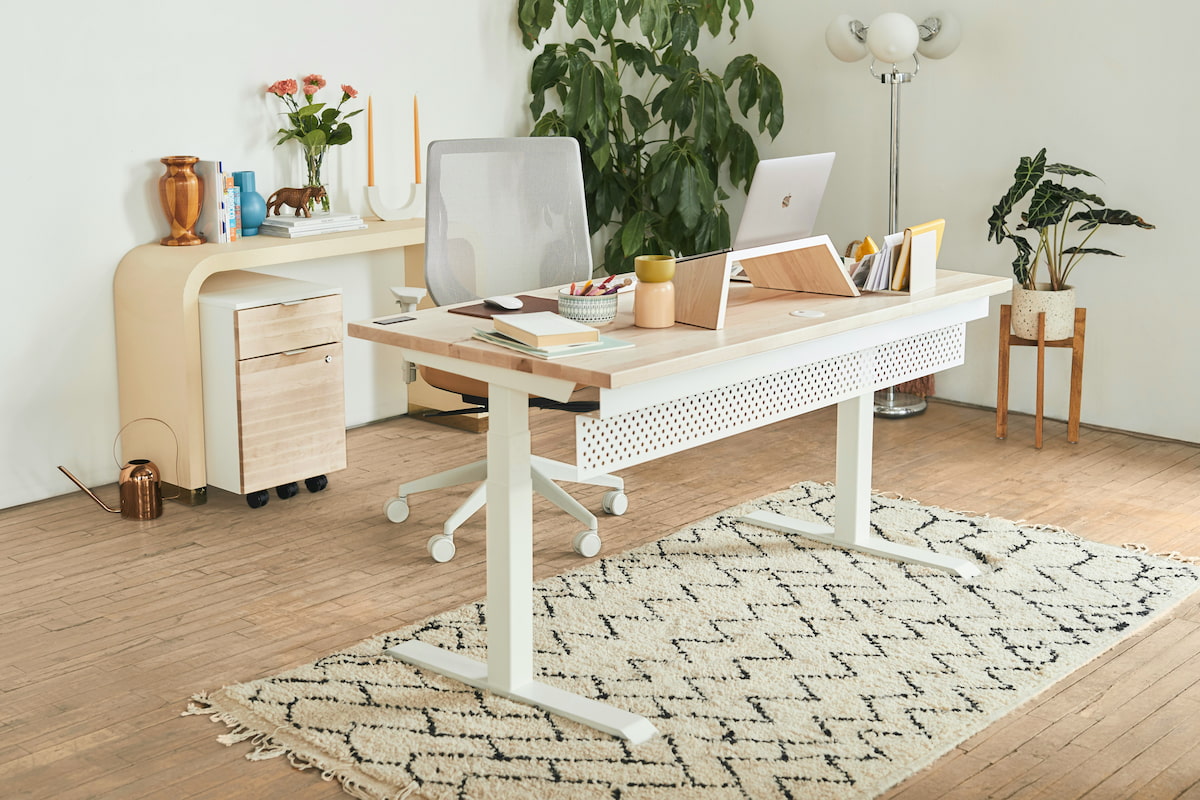
Adjustable height desks ranging from 70 to 120 centimetres allow alternating between sitting and standing during long work sessions. In a tropical villa where occupants may work extended hours, the circulation benefit of height adjustment has genuine productivity implications. Low-energy motors with adequate ventilation around the mechanism perform reliably in tropical conditions. Poorly ventilated desk bases are the most common cause of electric desk failure. Fixed-height desks remain practical where adjustability is not a priority but require pairing with quality ergonomic chairs that maintain correct posture without the compensation that height adjustment provides.
Mesh back chairs outperform upholstered alternatives in tropical conditions because the breathable surface prevents the sweating that upholstered chairs cause in sustained heat. Fabric and foam upholstery absorbs moisture, retains it, and eventually develops mould in sustained high-humidity conditions regardless of air conditioning use. Specify powder-coated aluminium or steel frames on chairs. Plastic components, particularly at adjustment mechanisms, degrade under sustained UV if the chair is used near windows or in semi-outdoor spaces.
Closed storage performs better than open shelving in humid tropical conditions. Books, documents, and equipment stored on open shelves accumulate moisture and develop mould in sustained humidity. Sealed cabinets with occasional ventilation openings protect contents better. Bamboo and rattan for accent pieces and non-load-bearing storage handle tropical humidity well and contribute to the material palette without the maintenance demands of tropical hardwood.
Technology and connectivity
Computers and screens generate heat that compounds the office temperature challenge. Ensure adequate space around equipment for air circulation. Dense cable management that traps equipment in enclosed spaces creates heat problems that reduce performance and lifespan. Laptops on solid desk surfaces overheat faster than on ventilated stands. A simple riser with ventilation clearance beneath extends equipment life and reduces thermal throttling during intensive work.
Cable organisation reduces dust accumulation and keeps cords off floors, which can be important in spaces with ceiling fans or open windows where airflow is continuous. Floor-level cables in a tropical villa collect dust and organic matter that accelerates degradation of cable insulation in humid conditions. Built-in cable management with sealed entry points into desk surfaces also reduces the entry points for insects, which is a practical consideration in tropical villa offices that is rarely mentioned in conventional office design guidance.
Stable internet connectivity is the non-negotiable requirement for a productive remote workspace. Plan the network infrastructure at the villa design stage rather than retrofitting. Wi-Fi access point position, cable routes for wired connections, and UPS provision for power stability during monsoon weather all perform better when designed in from the beginning. A UPS (uninterruptible power supply) for critical equipment is worth including. Thailand’s power supply is reliable in most areas but monsoon weather causes brief outages and voltage fluctuations that can damage equipment without surge and outage protection.
The finishing touches that make the space work
Video calls require adequate acoustic conditions, and a workspace with hard surfaces throughout produces reverberant sound that makes calls less pleasing. Simple textile additions such as a rug, acoustic panels, or soft furnishings reduce reverberation meaningfully without compromising the clean tropical aesthetic.
Supplement natural light with quality artificial lighting at the desk level rather than just overhead ceiling lighting, which creates shadows on work surfaces. A desk lamp with colour temperature around 4000K, neutral white, provides the alert, productive light quality that warm ambient lighting does not.
Matte finishes throughout improve the working environment. Glossy surfaces in a bright tropical workspace create visual fatigue through reflections and glare. Matte desk surfaces, matte wall finishes, and non-reflective flooring produce a calmer visual environment that is easier to work in for extended periods.
The bottom line
A home office in a tropical Thai villa works well when it is designed with the same climate awareness as the rest of the building. Positioning for natural ventilation, materials specified for humidity and salt air, equipment cooling addressed, and connectivity infrastructure planned from the start produce a workspace that is genuinely productive.
A desk near a window with a view is a starting point. A properly designed tropical home office is the thing that makes long-term remote work in Thailand sustainable rather than a constant battle against the conditions.
For structured guidance on every stage of a villa build in Thailand, from land purchase through to handover, see The Thailand Build Blueprint™ at thetropicalarchitect.com/the-blueprint
For guidance on your specific project, book a strategy session with Nay at thetropicalarchitect.com/consultations
Working with Nay on your build
If you are planning a build on Koh Samui, the six-step process from land viability to site supervision is set out at how the build process runs; for Phuket, start with licensed Phuket architect. If you are further along and want an experienced second opinion on drawings, a quote or a contractor, get a second opinion.