The insulation that happens inside the walls and ceiling
Most insulation conversations in tropical villa construction focus on the building envelope: roof spaces, external walls, and floors. The insulation that wraps the mechanical systems inside the building receives far less attention and causes a disproportionate share of the energy efficiency and moisture problems that villa owners encounter after construction is complete.
In Thailand’s tropical climate, uninsulated air conditioning ducts lose a significant proportion of their cooling capacity to the surrounding warm air before it reaches the rooms it is meant to cool. Uninsulated cold water pipes produce condensation that drips onto ceilings, promotes mould growth, and eventually causes water damage to finishes and structure. Both problems are straightforward to prevent with correct specification during construction and expensive to address after the building is finished and the systems are concealed.
Why duct insulation matters more in Thailand than temperate climates
An air conditioning duct carrying air cooled to 14 degrees Celsius runs through a ceiling void where the ambient temperature may be 45 degrees or higher in direct sun conditions. The 31-degree temperature differential across the duct wall drives heat transfer into the duct continuously. Every metre of uninsulated duct loses cooling capacity that the air conditioning system compensates for by running longer and working harder.
The energy cost compounds over the life of the system. An air conditioning unit working 20 percent harder than a well-insulated equivalent to deliver the same cooling effect at the outlet uses 20 percent more electricity for every hour it runs. In a Thai villa that is a significant number of hours per year and a significant electricity cost over a decade of ownership.
Condensation is the second problem. Where a cold duct surface contacts warm humid air at any gap, joint, or inadequately insulated section, condensation forms on the outer duct surface. In a ceiling void this condensation drips onto the ceiling lining, causes staining and eventually structural moisture damage, and creates the sustained damp conditions that support mould growth in the ceiling space. The staining pattern follows the duct run precisely and is one of the more diagnostic ceiling problems in Thai villa construction: a line of moisture damage that maps directly to uninsulated ductwork above.
EPDM foam: the correct specification for tropical conditions
EPDM foam, ethylene propylene diene monomer, is the standard insulation material for HVAC ducts and cold pipes in tropical conditions. Its performance characteristics are well matched to the application.
The closed-cell structure of EPDM foam means it does not absorb moisture. In Thailand’s humidity this is the critical characteristic: open-cell foam alternatives absorb condensation and eventually become saturated, losing insulation value and promoting biological growth in the ceiling void. EPDM’s flexibility allows it to wrap around pipes and irregular duct shapes without gaps or compression. Gaps in insulation coverage are precisely where condensation forms, because the thermal bridge at any uninsulated section produces a cold outer surface that draws moisture from the surrounding air.
EPDM also resists mould growth through its closed-cell structure and chemical composition, which matters in the humid ceiling voids where these materials spend their entire service life. For any exposed pipe runs in semi-outdoor areas or plantrooms with natural light exposure, EPDM maintains its properties under UV exposure where some alternative foam insulations degrade and become brittle.
The correct thickness specification for Thai villa conditions is a minimum of 25 millimetres for all HVAC duct insulation and a minimum of 13 millimetres for cold water pipes in air-conditioned spaces, increasing to 19 millimetres for pipes in unconditioned spaces or ceiling voids with high ambient temperatures. All joints and seams must be sealed with foil tape rated for tropical conditions. Unsealed joints are the primary failure point in any duct and pipe insulation system.
Cold water pipe condensation: the problem most villa owners discover too late
Cold water pipes in Thailand’s humid conditions produce condensation on their outer surface regardless of air conditioning, because the pipe surface temperature falls below the dew point of the surrounding air for much of the year. This is not a seasonal problem. It is a year-round condition in coastal and lowland locations.
Uninsulated cold water pipes in ceiling voids drip condensation continuously during humid periods. The drip pattern follows the pipe run and produces ceiling staining in a line directly below the pipe, which is the diagnostic pattern that identifies uninsulated cold pipes as the source when it appears on a finished ceiling. The moisture also wets adjacent timber framing, insulation, and ceiling board, creating conditions for mould and in timber-framed construction progressive deterioration of structural members.
The positions where this most commonly causes problems are cold water supply pipes running through unconditioned ceiling voids between floors, chilled water pipes for fan coil unit systems running through ceiling spaces, cold water pipes running through external wall cavities where they contact warm humid air, and any cold pipe run in a space where the ambient temperature significantly exceeds the pipe surface temperature.
EPDM foam correctly installed, with continuous coverage, sealed joints, and no gaps at fittings and valves, prevents condensation formation by maintaining the outer insulation surface above the dew point of the surrounding air.
The installation failures that produce the problems
The specification of correct materials is necessary but not sufficient. The installation failures that produce condensation damage and energy waste in Thai villa mechanical systems are specific and consistent.
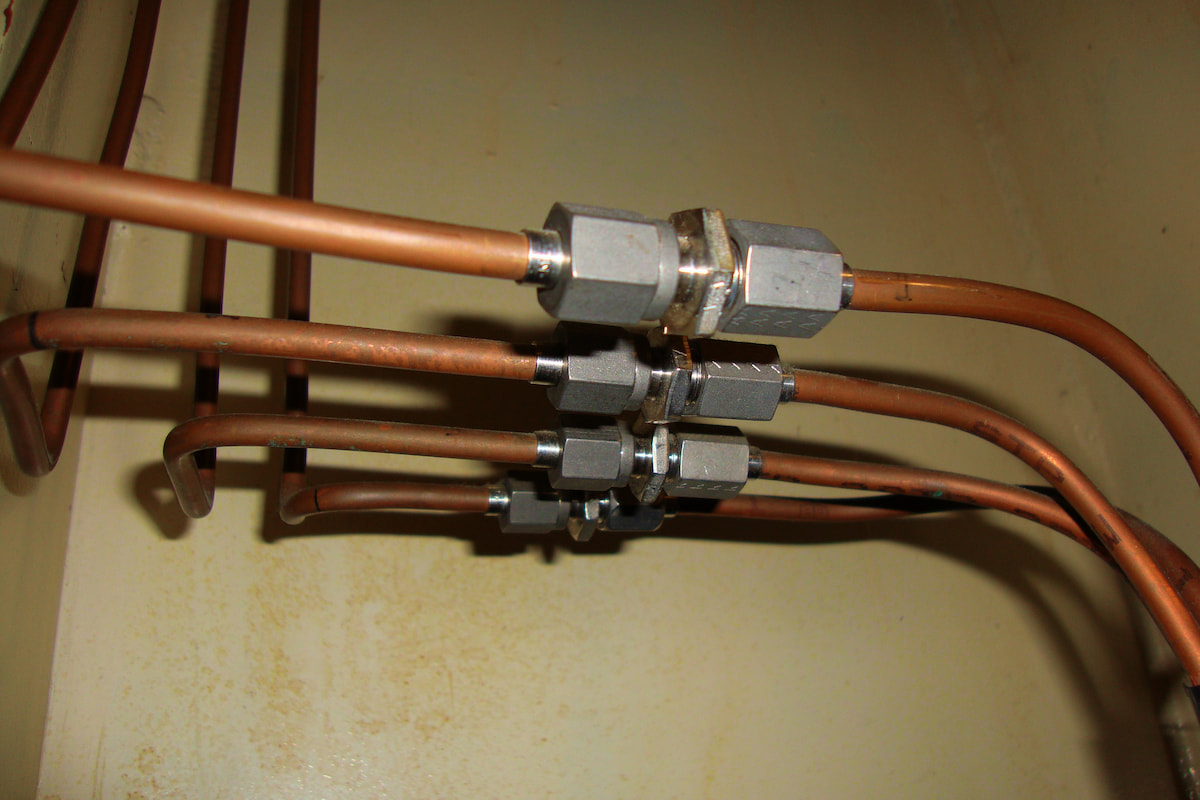
Pipe fittings including elbows, tees, reducers, and valve bodies are routinely left uninsulated because they are awkward to wrap. Each uninsulated fitting is a condensation point that drips onto the ceiling below it. Pre-formed EPDM fitting covers are available for standard fittings and should be specified and used rather than leaving fittings bare as a labour saving.
Pipe hangers and duct supports that compress the insulation to zero thickness at the contact point create thermal bridges where the insulation value is effectively zero and condensation forms. Insulated pipe support shoes that maintain the insulation thickness at support points are the correct specification and should be included in the mechanical specification document rather than left to the installer’s discretion.
EPDM foam tubes split longitudinally for installation over existing pipes, and the resulting seam must be sealed with appropriate adhesive and foil tape. Unsealed seams open progressively in Thailand’s thermal cycling, creating gaps that produce condensation lines along the seam position. This failure is visible on the finished ceiling as a line of moisture staining that follows the pipe run but appears offset to one side.
Installers sometimes reduce insulation thickness from the specified value to save material cost. At 13 millimetres instead of 25 millimetres on a duct run the thermal resistance is approximately half the specified value, and condensation risk and heat gain both increase proportionally. Verify insulation thickness during installation before the ceiling is closed, because the verification is not possible afterwards without opening the ceiling.
Standard adhesive tapes lose adhesion in sustained heat and humidity. The conditions in a Thai ceiling void in direct sun can exceed 70 degrees Celsius. Specify foil tape rated for sustained temperatures above 80 degrees Celsius with documented humidity resistance. Standard tapes fail on a timeline measured in months in these conditions.
Retrofit versus new construction
In new construction, duct and pipe insulation is specified before the systems are installed and the ceiling is closed. Access is straightforward and the cost per linear metre is modest relative to the total mechanical installation cost.
Retrofitting insulation to existing uninsulated duct and pipe runs requires opening ceiling linings to access the systems. This is a significant disruption and cost in a finished villa, and in many cases the disruption to finishes makes retrofit insulation uneconomical for the energy saving alone. Condensation damage repair often forces the work anyway, adding the cost of ceiling reinstatement to the cost of the insulation that should have been installed during construction.
This is one of the clearest cases in Thai villa construction for getting the specification right from the outset. The cost of EPDM foam and labour at the installation stage is a small fraction of the cost of opening and reinstating finished ceilings to retrofit insulation, and a smaller fraction again of the cost of remediating moisture damage from years of condensation dripping onto finished surfaces.
The bottom line
Duct and pipe insulation in Thai tropical villas is a modest cost at the construction stage that prevents significant ongoing energy waste and moisture damage. EPDM foam at correct thickness, with sealed joints and insulated fittings, handles Thailand’s climate reliably for the life of the mechanical systems it protects.
The specification takes ten minutes to add to a construction document. The consequences of omitting it appear on finished ceilings within the first monsoon season and continue until the insulation is retrofitted or the damage is repaired.
For structured guidance on every stage of a villa build in Thailand — from land purchase through to handover — see The Thailand Build Blueprint™ at thetropicalarchitect.com/the-blueprint
For guidance on your specific project, book a strategy session with Architect Nay at thetropicalarchitect.com/consultations
Designing for the climate from day one
Most comfort problems are decided at the design stage, not fixed afterwards. Nay designs and supervises villas on Koh Samui through licensed Koh Samui architect and in Phuket through licensed Phuket architect; the Koh Samui overview and the Phuket build cost guide are useful starting points. For a second opinion on an existing design, get a second opinion.