More than a finishing touch
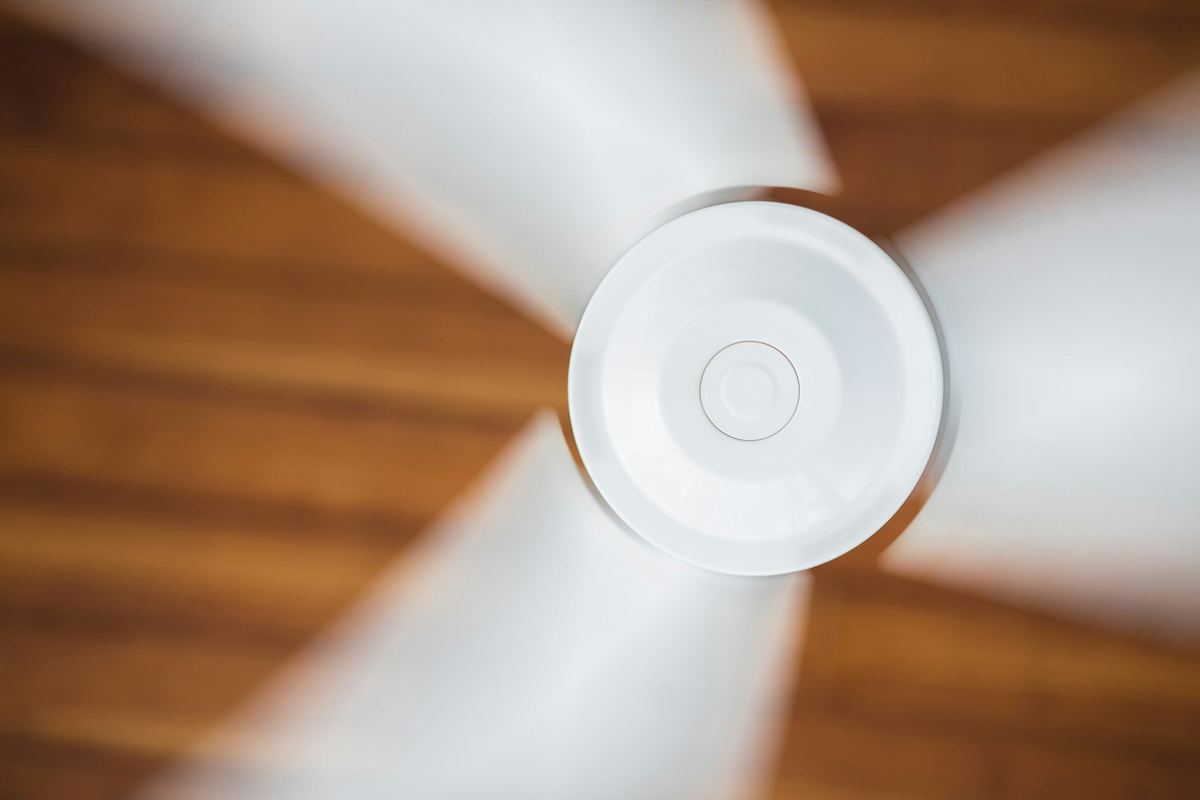
Ceiling fans in Thai tropical villa design are consistently treated as an aesthetic decision, merely chosen for how they look and positioned wherever the ceiling plan has a central point. Specified with this level of attention, they provide limited comfort benefit and require frequent replacement in coastal conditions.
Specified correctly with the right motor technology, appropriate blade diameter for the space, correct mounting height, coastal-grade materials, and positions designed around airflow rather than symmetry, ceiling fans are one of the most cost-effective passive cooling interventions available in tropical villa construction. They reduce perceived temperature by three to four degrees through wind chill, extend the hours in which natural ventilation alone is comfortable, and reduce air conditioning running time significantly in spaces that are well designed for natural airflow.
The specification decisions that determine which outcome you get are not complicated. They are simply decisions that get made by default rather than deliberately in most villa construction.
DC versus AC motors
The motor technology choice is the single most important ceiling fan specification decision. It affects energy consumption, noise levels, speed control quality, service life, and compatibility with solar power systems.
Standard alternating current motors have been used in ceiling fans for decades. They are less expensive to manufacture, which is why they dominate the budget end of the market. The limitations in a tropical villa context are significant. AC motors typically consume 50 to 80 watts per fan, produce audible hum at many speed settings (particularly at lower speeds), and offer only three fixed speeds rather than continuous adjustment. The heavier motor mass also requires more robust ceiling fixing, which becomes relevant for concrete soffits where fixing quality varies.
Direct current motors consume around 70 percent less energy than equivalent AC motors, typically 15 to 25 watts per fan. The energy saving is meaningful in a villa with multiple fans running for extended daily periods. DC motors operate virtually silently and the absence of audible motor noise in bedrooms and relaxation spaces is an immediate quality difference that occupants notice consistently. Speed control is continuous rather than stepped, so the fan can be set to exactly the airflow level required. Service life is longer, wear components are fewer, and compatibility with solar power systems is substantially better than AC motor alternatives.
The cost premium over AC motors has reduced significantly as DC technology has become mainstream. For any quality villa specification, DC motor fans are the correct default.
Sizing the fan to the space
Fan blade diameter determines the volume of air moved per minute. An undersized fan in a large space moves insufficient air to produce meaningful comfort. An oversized fan in a small space creates uncomfortable turbulence rather than gentle circulation.
As a guide: spaces up to 10 square metres suit a 90cm (36 inch) blade diameter; 10 to 20 square metres suit 110 to 120cm (44 to 48 inch); 20 to 35 square metres suit 130 to 140cm (52 to 56 inch); above 35 square metres requires either 150cm or larger, or multiple fans.
Open-plan living and dining areas in Thai villas frequently exceed 40 to 50 square metres. A single fan cannot move adequate air across this area regardless of its diameter. Multiple fans positioned to create overlapping airflow zones are more effective than one large fan attempting to cover the full space. Position them so their airflow zones overlap slightly as this creates consistent air movement across the full area, without dead zones between widely separated fans.
Outdoor salas and covered terraces need larger blade diameters than equivalent interior spaces because moving air dissipates more rapidly in semi-outdoor conditions. A sala that would require a 130cm fan indoors benefits from a 150cm fan outdoors. Any fan in a position that receives humidity, condensation, or occasional rain contact should be rated damp or wet accordingly.
Material specification for coastal conditions
The same material specification principles that apply to lighting fixtures, hardware, and fixings throughout a Thai coastal villa apply to ceiling fans. Salt air and humidity attack inadequately specified components predictably and progressively.
ABS plastic blades are lightweight, rust-resistant, and dimensionally stable through humidity cycling, which is the correct specification for coastal locations and any high-humidity interior. Timber blades require sealed edges and UV-stable finish; unsealed timber absorbs moisture at the edges and warps. Natural bamboo blades are appropriate for dry interior positions and inadequate for high-humidity or outdoor applications.
Motor housing fixings should be grade 316 stainless steel in coastal locations, consistent with all other fixings in salt air environments. Standard steel hardware corrodes at the ceiling junction and eventually fails structurally. A ceiling fan falling from a corroded mount is a serious safety risk that correct material specification prevents entirely.
Sealed motor housings (fans rated wet or damp) prevent moisture ingress. Wet-rated for direct rain contact or bathroom installation, damp-rated for high humidity without direct water contact. Standard indoor fans in outdoor salas or bathrooms fail at the motor within a few years in Thailand’s conditions regardless of how well they were specified for interior use.
Mounting height and positioning
Hang ceiling fans with blade height between 2.4 and 2.7 metres above finished floor level. Below 2.4 metres creates safety risk and uncomfortable direct turbulence. Above 2.7 metres reduces the comfort effect significantly because the air movement dissipates before reaching occupant level.
In villas with high ceilings — common in contemporary tropical design where ceiling height contributes to passive cooling — use extended downrods to bring the fan blade to the correct height rather than mounting directly to the ceiling. A fan mounted at four metres with no downrod provides minimal comfort benefit regardless of its specification.
Maintain a minimum 45cm clearance from blade tip to any wall, beam, or structural obstruction. Insufficient clearance creates turbulence at the blade tips that increases noise, reduces airflow efficiency, and accelerates motor bearing wear.
Avoid positioning fans directly above downlights. Fan blades interrupting a downlight beam create stroboscopic shadow patterns that are immediately irritating. Position fans so blade rotation does not cross downlight beams, or position downlights outside the fan blade sweep radius.
Ceiling fan mounting positions need to be coordinated with the structural and services design before concrete is poured. Fan mounting requires either a structural fixing point in the concrete soffit or a dedicated backing block between ceiling joists — the dynamic loads from a fan in motion exceed what standard ceiling board fixings can safely carry. Retrofitting fan positions to concrete soffit construction that was not designed for them requires core drilling and structural fixing installation. Include fan positions in the ceiling design from the start.
Smart controls and solar compatibility
DC motor fans are inherently compatible with remote control and smart home integration in ways that AC motor fans are not. For rental villas where guest convenience is a priority, app-controlled fans that guests can adjust from their phones are a straightforward upgrade over wall switches. For villas with home automation systems, fan speed can be integrated with temperature sensors, automatically increasing fan speed as room temperature rises and reducing it when air conditioning brings the temperature down.
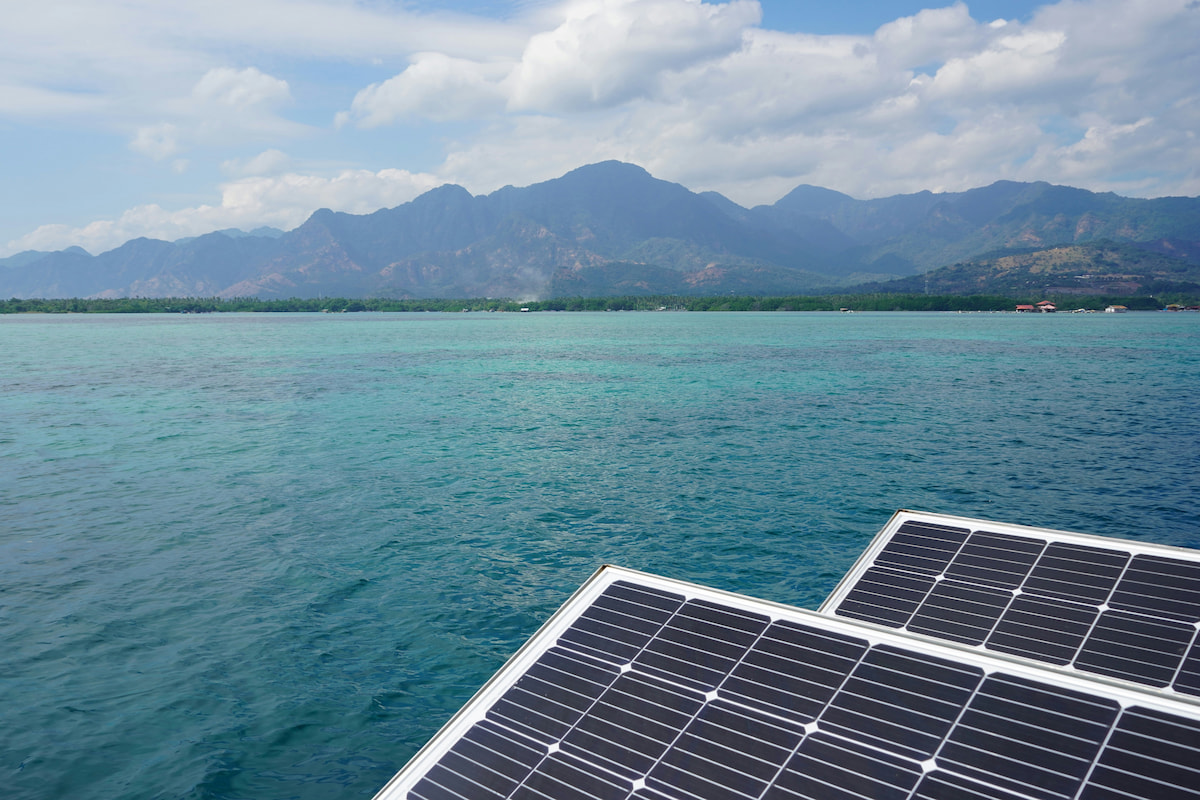
DC motor fans’ lower and more consistent power draw makes them significantly more compatible with solar power systems than AC alternatives. A villa running on solar with battery storage benefits from the DC motor’s efficiency, and the energy saving per fan per day is meaningful when the power budget is defined by battery capacity and daily generation. For off-grid or semi-off-grid villas in Thailand’s interior or island locations, DC motor fan specification is a practical energy management decision as much as a comfort one.
The contribution to passive cooling
Ceiling fans do not cool the air. They cool occupants through wind chill. This distinction matters for how they are used most effectively.
In a naturally ventilated villa, ceiling fans extend the hours of comfortable natural ventilation by increasing air movement when ambient breezes are insufficient. They work best in combination with cross-ventilation by supplementing and distributing natural airflow rather than replacing it.
In an air-conditioned space, ceiling fans allow the thermostat to be set three to four degrees higher while maintaining equivalent perceived comfort, because moving air compensates thermally for the higher ambient temperature. The energy saving from running air conditioning at 27 degrees with a ceiling fan rather than 23 degrees without one significantly exceeds the fan’s own energy consumption.
This combination (natural ventilation supplemented by ceiling fans during calm periods, air conditioning at higher thermostat settings with fans running) is the practical passive cooling strategy that well-designed Thai villas use to achieve comfortable living at substantially lower energy cost than mechanical cooling alone.
The bottom line
Ceiling fans are among the highest-return specifications available in Thai tropical villa construction: modest cost, immediate comfort benefit, meaningful energy reduction, and a design contribution that complements the spatial quality of a well-designed tropical interior.
The decisions that determine whether this return is realised — DC motor technology, correct blade diameter, coastal-grade materials, correct mounting height with appropriate downrods, and structural fixing provision designed in from the start — are straightforward when made deliberately. They are expensive to address when discovered after installation, and invisible when they have been made correctly.
For structured guidance on every stage of a villa build in Thailand — from land purchase through to handover — see The Thailand Build Blueprint™ at thetropicalarchitect.com/the-blueprint
For guidance on your specific project, book a strategy session with Architect Nay at thetropicalarchitect.com/consultations
Designing for the climate from day one
Most comfort problems are decided at the design stage, not fixed afterwards. Nay designs and supervises villas on Koh Samui through licensed Koh Samui architect and in Phuket through licensed Phuket architect; the Koh Samui overview and the Phuket build cost guide are useful starting points. For a second opinion on an existing design, get a second opinion.