The mistakes that are easier to prevent than to fix
Most design mistakes in tropical villa construction in Thailand are not dramatic failures but rather accumulated decisions that individually seem reasonable and collectively produce a building that is uncomfortable, expensive to run, or expensive to maintain. By the time the consequences are visible, the construction is complete and the cost of correction is significant.
The ten mistakes below are the ones that appear most consistently across villa projects in Thailand and are the recurring patterns that experienced tropical architects recognise immediately, but first-time builders often discover too late. Understanding them before design begins costs nothing. Discovering them after construction costs considerably more.
1. Copying designs from non-tropical climates
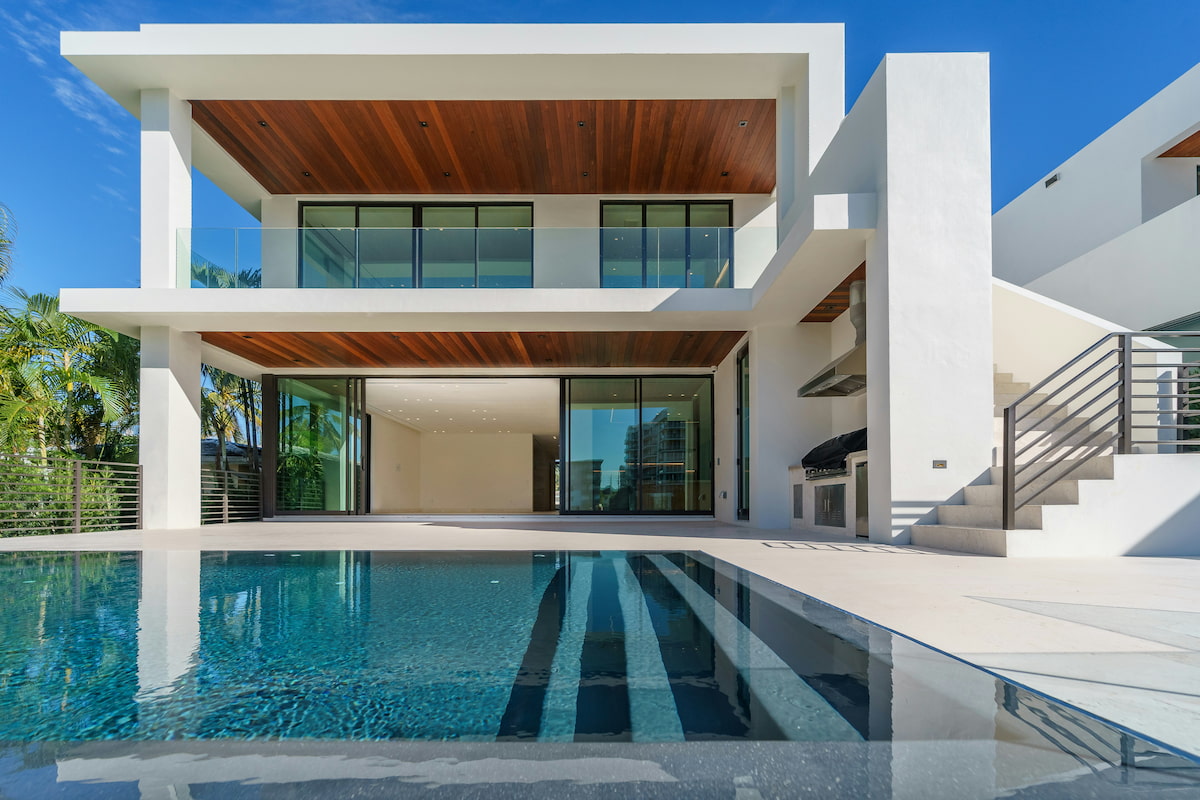
The most consequential and also the most common mistake in Thai villa construction. European and North American architectural aesthetics like the sealed glass box, the flat roof terrace, the minimal overhang, the heavily insulated envelope, all of these are designed for climates where the problem is keeping heat in. In Thailand the problem is keeping heat out.
A design that performs well in a temperate climate becomes a liability in Thailand’s conditions. Sealed glass facades create greenhouse conditions that force air conditioning to work constantly. Minimal roof overhangs expose walls and glazing to direct sun and monsoon rain. Flat or low-pitch roofs create drainage problems under monsoon rainfall intensity. Heavy thermal mass without ventilation stores heat rather than moderating it.
The correct reference points for Thai tropical villa design are tropical, found in traditional Thai architecture, Balinese residential design, and contemporary tropical architects working in Southeast Asia. These traditions evolved solutions to exactly the climate conditions a Thai villa faces. Deep overhangs, cross-ventilation, indoor-outdoor flow, and natural ventilation-first design are not stylistic preferences, they are functional responses to the climate, that have been refined over centuries.
2. Designing with too much concrete and glass without passive cooling strategy
Glass and concrete construction is often presented as contemporary and sophisticated. In Thailand’s climate without an adequate passive cooling strategy it produces buildings that are hot, energy-intensive, and expensive to maintain at comfortable temperatures.
Concrete has thermal mass so it absorbs heat during the day and releases it slowly. In a well-ventilated building this moderates temperature swings. In a sealed concrete box without ventilation it stores heat that the air conditioning must then remove, turning the thermal mass into a liability. Glass transmits solar heat gain directly. For example, a glass wall in direct afternoon sun becomes a radiant heater for the interior regardless of air conditioning capacity. The design response is shading through deep roof overhangs, external louvres, or solar control glazing rather than simply more powerful air conditioning.
The design principle: use concrete and glass where their performance characteristics serve the design, with adequate shading and ventilation to manage their thermal implications. Not as default materials because they are familiar or because the developer’s cost model suits them.
3. Building high concrete perimeter walls without adequate drainage and settling provision
Tall concrete boundary walls are a standard feature of Thai villa construction and one of the most reliably problematic. The failure modes follow a predictable pattern and they are almost always preventable at the design stage.
On sloped or recently earthworked sites, soil beneath and behind walls settles differentially over time. Walls constructed before the ground has stabilised carry stress loads they were not designed for, and cracking follows. The timeline is typically two to three wet seasons — long enough after handover that the connection between earthworks and wall failure is not immediately obvious, but short enough that the repair costs fall within what feels like the property’s early life.
The more acute risk is hydrostatic pressure. During monsoon season, water that has no designed drainage path accumulates behind boundary walls and exerts lateral pressure that standard wall construction is not specified to resist. The consequence ranges from progressive cracking to, on steep sites with poor drainage, catastrophic wall failure. Neither outcome is rare.
The design requirement is straightforward: drainage behind any retaining or boundary structure, sized for peak monsoon flow rather than average conditions. On sloped sites, a drainage layer of clean aggregate behind the wall and weep holes at the base to discharge water before pressure can build. The detail costs little to include in new construction. Retrofitting drainage behind a cracked wall that is already failing costs considerably more and the wall itself usually needs rebuilding.
4. Underestimating monsoon water management
Thailand’s monsoon rainfall arrives in volumes and at intensities that temperate climate design instincts do not adequately account for. Properties on hillside sites, in valleys, or in positions that receive runoff from adjacent higher ground are particularly vulnerable.
Water management must be designed for peak monsoon conditions and not average conditions. This includes roof drainage capacity, site surface drainage, subsurface drainage in areas with high water tables, and access road drainage on sloped sites. Properties in areas that receive hillside runoff need specific drainage engineering to divert that water away from the building before it becomes a recurring problem.
5. Too many stairs without alternative vertical access
Multi-level villas on Thailand’s hillside plots take advantage of views and terrain that make them attractive investments. They also create practical daily living challenges that are worth thinking through at the design stage rather than discovering after construction.
Multiple flights of stairs in Thailand’s heat are tiring under the best conditions. For elderly residents or guests, family members with mobility limitations, or staff carrying heavy items between levels, they become genuinely problematic. The practical consequence is that upper and lower levels of the villa are used less than the design assumed, so the villa’s usable living space is effectively smaller than its plan suggests.
Inconsistent step heights (a specific and common problem in Thailand’s villa construction) increase trip risk on staircases that are already being navigated in heat and sometimes in wet conditions. Specify consistent riser height throughout any staircase and verify compliance during construction.
Where budget allows, planning for a lift at the design stage, even if not installed immediately, maintains the option to add one later without structural intervention. The shaft space and structural provision cost far less to include in new construction than to retrofit.
6. Water features and complex decorative systems that cannot be sustained
Ponds, water walls, fountains, and ornamental water features appear in Thai villa designs regularly but also regularly stop functioning within a few years. The appeal at the design stage is understandable. The maintenance reality is not.
Pump and electrical components in water features operate in conditions of sustained heat and humidity that accelerate corrosion and mechanical deterioration. When a pump fails in a remotely managed property, the feature becomes a static body of stagnant water which becomes an ideal mosquito breeding environment within metres of living and sleeping areas. This is not a rare event. It is the most common trajectory for water features in Thai villas that lack dedicated, consistent maintenance.
The discipline worth applying at the design stage: for every water feature proposed, specify who will maintain it, at what frequency, and what the contingency is when the pump fails during a period the property is occupied by guests. If that question does not have a credible answer, the feature should not be in the design. A dry garden, a stone water channel that drains rather than recirculates, or a well-planted landscape achieves equivalent visual complexity without the ongoing mechanical dependency.
The same logic applies to any system whose operation depends on regular specialist attention, such as complex automated irrigation, elaborate lighting control systems, motorised louvre systems without manual override. Each adds operational fragility. In a primary residence with engaged management, fragility is manageable. In a rental property or second home, it becomes a recurring problem that is easier to design out than to manage in.
7. Poor access road and driveway design
A villa with problematic access is a villa with a persistent operational problem. Access roads and driveways that are inadequately designed for Thailand’s terrain and climate affect daily usability, safety, and long-term maintenance costs.
Gradients that are too steep become dangerous when wet. In Thailand, that means regularly. Slippery access roads mean guests cannot reach the property safely, service vehicles cannot deliver, and household staff cannot arrive reliably by the motorbike transport that is standard practice. Drainage is the primary design issue on hillside sites. Roads that do not drain effectively develop ruts, erosion, and surface deterioration rapidly under monsoon conditions and require proper cambering, regular culverts on sloped sections, and surface materials appropriate for the gradient and use intensity.
The practical test for any access road design: can it be used safely by a standard sedan vehicle in wet conditions? Can a small delivery truck reach the building? Can household staff arrive on a motorbike in rain? If any answer is no, the design needs revision before construction begins.
8. Landscaping choices that create maintenance and pest problems
Landscaping in Thai villa design is often treated as a late-stage aesthetic decision rather than an early-stage practical one. Plant selection has direct implications for maintenance load, water consumption, pest management, and the long-term performance of hard surfaces and drainage systems.
Fast-growing trees with aggressive root systems planted close to buildings, pools, and drainage infrastructure cause progressive structural damage. Roots penetrate concrete, lift paving, block drainage pipes, and undermine foundations over time. Non-native ornamental plants often require irrigation that puts pressure on water supply in locations where supply is variable or expensive. Trees and plants that shed significant leaf litter near pools require constant skimming and additional filtration load. Certain plants attract or harbour pests — mosquitoes breed in water that collects in leaf axils, fruit trees attract bats whose droppings damage surfaces, and dense ground cover provides habitat for rodents and insects.
Conversely, plants like lemongrass, which contains natural compounds that repel mosquitoes, are worth incorporating in outdoor relaxation areas. Native and regionally appropriate planting is adapted to Thailand’s rainfall patterns, requires less supplementary irrigation, and creates less maintenance demand than imported ornamental alternatives.
9. Window frame materials that will not last in the conditions
The window frame material decision is made once in new construction. Getting it wrong produces deterioration, maintenance costs, and eventually full window replacement, all of which are avoidable with correct specification at the outset.
Softwood timber is the most common incorrect choice in Thai villa construction. In Thailand’s combination of high humidity, intense UV, salt-laden coastal air, and sustained heat, softwood frames warp, rot, and provide direct pathways for moisture and pest ingress within a few years of installation. The deterioration is not gradual and it accelerates once the initial surface treatment fails, which in coastal locations happens faster than manufacturers’ specifications suggest.
Hardwood performs better, but the performance gap between a correctly specified tropical hardwood (teak, merbau, ironwood) and a poorly specified imported hardwood is significant. The correct specification for timber window frames in Thai villa construction is genuinely durable tropical hardwood with a proven track record in comparable conditions, not hardwood as a category. Any timber frame in a coastal location also requires a maintenance commitment that is realistic for how the property will be managed.
Aluminium has become the practical standard for window frames in Thai tropical construction for reasons that are directly about performance rather than aesthetics: dimensional stability regardless of humidity, corrosion resistance in salt air when correctly powder-coated or anodised to marine grade, low maintenance requirements, and long service life with minimal intervention. Thermal break profiles matter in air-conditioned spaces — a standard aluminium frame without a thermal break conducts heat across the frame and creates condensation on the interior face in heavily cooled rooms. The incremental cost of thermal break profiles is modest relative to the long-term performance improvement. Fixings throughout should be grade 316 stainless steel and the substitution of inferior fixings to reduce cost, is a recurring source of premature failure in coastal installations.
10. Failing to account for how the building will actually be lived in
This is the design mistake that encompasses all the others. It is designing for how a villa looks rather than how it will be used, maintained, and lived in over years.
Designs that require constant maintenance to function place ongoing demands on management resources that are often not available, particularly for remotely managed rental properties. Designs that are uncomfortable to live in daily with insufficient ventilation, too many stairs, inadequate shading, are the villas that their owners use less than they planned and find harder to rent than they expected. Designs that ignore the practical reality of how household staff, delivery vehicles, and service providers access and operate the property create frustrations that recur daily.
The discipline that prevents these outcomes is asking at each design decision: how will this actually work in practice? Not how will it look in a render, but how will it function on a Tuesday afternoon in October when it is hot, humid, and the afternoon rain has just started. That question, asked consistently through the design process, produces villas that work well as places to live rather than simply looking impressive as places to photograph.
The bottom line
Good tropical villa design in Thailand is not complicated in principle. It works with the climate rather than against it, uses materials suited to the conditions, provides practical access and circulation, and is designed for how people actually live in it rather than how it will be marketed.
The mistakes in this article are not rare and they appear consistently across Thailand’s villa construction market because they arise from familiar design instincts applied without adequate consideration of the specific conditions. Recognising them before design decisions are made is the most cost-effective investment available in any villa project.
For structured guidance on every stage of a villa build in Thailand — from land purchase through to handover — see The Thailand Build Blueprint™ at thetropicalarchitect.com/the-blueprint
For guidance on ventilation strategy for your specific project, book a strategy session with Architect Nay at thetropicalarchitect.com/consultations
Working with Nay on your build
If you are planning a build on Koh Samui, the six-step process from land viability to site supervision is set out at how the build process runs; for Phuket, start with licensed Phuket architect. If you are further along and want an experienced second opinion on drawings, a quote or a contractor, get a second opinion.