Design impact without design permanence — the question worth asking first
3D wall panels have become one of the most reached-for tools in contemporary tropical villa interiors. The appeal is understandable as they add texture, depth, and visual complexity to flat surfaces quickly and at relatively modest cost. In a villa context where a feature wall behind a bed or a textured surface in an entrance creates immediate design presence, they serve a real purpose.
They also fail more often than their marketing suggests in Thailand’s climate. Bubbling, surface degradation, mould establishment, and material breakdown that require removal and replacement within a few years are the consistent failure pattern for panels incorrectly specified for the conditions they face. Whether this happens depends almost entirely on material selection and installation position. The design outcome looks similar across the material range. The performance outcome is not.
The material categories and what they mean for performance
PVC panels are the most widely available and most commonly specified 3D panel type in Thai villa construction. They are moisture resistant, lightweight, and available in the widest range of surface textures and geometric patterns. They handle humidity well in protected interior positions and degrade faster in UV-exposed or semi-outdoor positions.
The geometry of 3D panels creates an additional consideration that flat panel systems do not share: the three-dimensional surface creates air pockets behind the panel that accumulate moisture if the wall behind has any dampness. Ensuring the substrate is dry and that the installation allows moisture to dissipate rather than trapping it is more critical for 3D panels than for flat alternatives. The pattern works against ventilation in a way that a flat surface does not.
The environmental concern with PVC is also worth acknowledging directly. PVC is a petrochemical product, not biodegradable, and end-of-life disposal options in Thailand are limited. For villa owners where environmental credentials are part of the brief, the alternatives below carry better credentials and are worth the additional cost.
Fibre-reinforced gypsum carries significantly better environmental credentials than PVC. Gypsum is a mineral material, fibre reinforcement is typically glass or natural fibre, and the product is inert at end of life. Performance in humidity is good when correctly specified. The limitation is weight, as gypsum panels are heavier than PVC equivalents, which affects both installation and the structural requirements of the substrate. The surface quality achievable in fibre-reinforced gypsum is excellent. The stone and architectural concrete effects are often more convincing than PVC equivalents and the material rewards skilled installation.
High-performance composites, like cement-based panels, calcium silicate board with surface treatment, and similar engineered materials, are the highest performance option for tropical conditions. They are genuinely moisture resistant throughout the panel thickness rather than just at the surface, dimensionally stable in humidity cycling, and durable under the UV exposure that PVC struggles with in exposed positions. They are higher cost, less available in decorative 3D formats, and require more skilled installation, but they are the correct specification for semi-outdoor positions and any application where long-term performance in demanding conditions is the priority.
Standard MDF-based 3D panels are the cheapest option and the one most commonly stocked by general building suppliers in Thailand. They are also the one to avoid entirely. MDF absorbs moisture, the surface coating usually fails when the substrate moves, and the three-dimensional geometry creates multiple edges and recesses where moisture accumulates. MDF 3D panels in Thailand’s climate have a short and predictable failure timeline regardless of how they are installed.
Where 3D panels genuinely add value
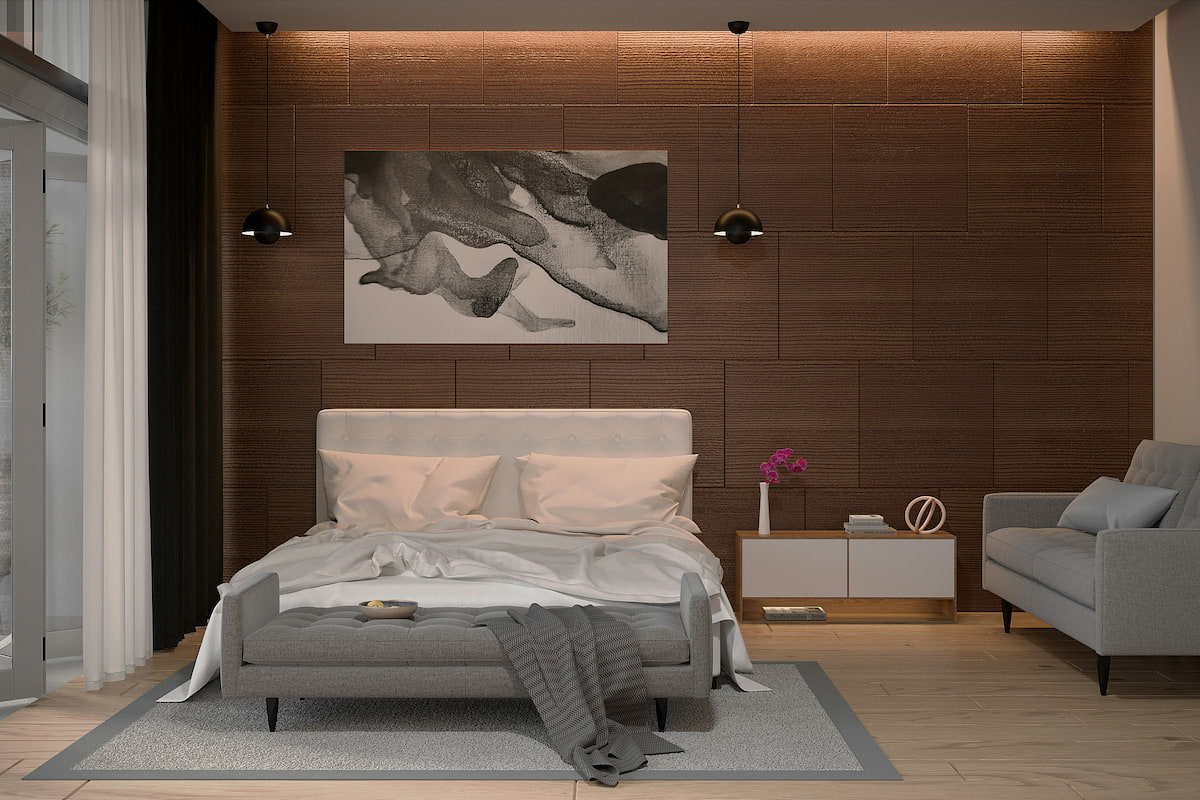
The positions where 3D panels perform well share common characteristics: protected from direct weather, limited humidity variation, low contact wear, and high visual prominence. A feature wall behind a bed is the most reliably successful application in Thai villa design. The air-conditioned bedroom environment limits humidity cycling, the panel is decorative rather than functional, and the visual impact from a position that is seen constantly but touched rarely is significant. PVC or fibre-reinforced gypsum both perform well here.
Stairwells and circulation spaces benefit from textural interest that compensates for the absence of furniture and art. 3D panels provide this effectively in a position seen from multiple angles and distances, protected from direct weather in most villa configurations. PVC performs adequately in dry interior stairwells; fibre-reinforced gypsum is worth specifying if the stairwell has any natural ventilation opening that introduces exterior humidity variation.
Entrance and lobby areas under adequate roof cover, where the panel receives shelter from direct rain but experiences more humidity variation than a fully interior room, suit composite materials or fibre-reinforced gypsum better than PVC. The visual impact of a textured entrance feature wall is significant and worth the additional material cost in these positions.
For rental properties where the aesthetic goal is contemporary and considered rather than premium and permanent, PVC panels in dry interior positions are a legitimate specification with realistic lifespan expectations. They deliver immediate design impact at lower cost than alternative feature wall treatments and are appropriate for the renovation cycle timelines that rental properties operate on.
Where 3D panels consistently underperform
Bathrooms and wet areas are the most common misapplication. The enclosed geometry of 3D panels traps moisture in ways that flat tile surfaces do not. Even moisture-resistant panel materials accumulate water in the recesses of the pattern in shower-adjacent positions where spray reaches the wall surface. Mould establishes itself in the recesses before it is visible on the surface and is very difficult to clean from three-dimensional geometry without damaging the panel. Large-format tile in textured stone or concrete effects achieves similar design results in bathroom feature wall positions with far better moisture management and a fraction of the maintenance burden.
External walls in direct weather exposure are the second consistent misapplication. Direct sun degrades PVC on a timeline that varies with UV intensity but is significantly shorter than the interior lifespan. Direct rain and salt spray attack the substrate and fixings regardless of panel material. Natural stone, fibre cement, or aluminium composite panels are the correct specification for external feature walls. Most available 3D decorative panel formats are interior products used outside, and they perform as interior products used outside, which is to say, poorly.
Any position without adequate airflow compounds the moisture risk that the three-dimensional surface geometry already creates. The panel surface reduces the effective ventilation of the wall it covers. In spaces with poor ventilation (enclosed rooms without cross-ventilation, spaces that are sealed and unoccupied for extended periods) this creates condensation and mould conditions that 3D panels are particularly poorly equipped to resist.
The installation details that determine long-term performance
The substrate condition before installation determines whether moisture problems develop behind the panel or not. A 3D panel installed over a wall with any residual dampness traps the moisture rather than concealing it. The problem continues invisibly and emerges eventually through the panel surface or at edges and fixings. Diagnose and resolve any wall moisture issues before panels are specified or installed.
Construction adhesive should be applied continuously across the back face of the panel rather than spot-applied at corners and edges. Continuous adhesive distributes thermal movement across the full panel area; spot adhesive leaves unsupported sections that flex under temperature cycling and eventually debond. Use adhesive formulated for tropical conditions as standard construction adhesives soften in sustained heat and lose bond strength over time.
All panel edges, perimeter joints, and fixing points should be sealed with neutral-cure silicone or appropriate sealant after installation. The edge sealing is the primary barrier against moisture reaching the substrate through the panel perimeter and it requires the same attention as any other sealant joint in a Thai tropical villa. For panel systems with visible joints between panels, epoxy grout or colour-matched sealant provides better moisture resistance than standard tile grout in humid conditions.
The design discipline that makes 3D panels work
Used extensively they become visual noise. The effect that makes a single textured feature wall feel considered becomes oppressive when repeated on every surface. The restraint that makes 3D panels work is the same restraint that makes any strong design gesture work: one prominent application in the right position, as a deliberate contrast to simpler surrounding surfaces.
The villa designs that use 3D panels most effectively treat them as punctuation rather than language. A single textured wall that reads against polished concrete floors, a ceiling feature in a double-height space, an entrance element that creates immediate impression without competing with the views beyond. The panels earn their place by doing one thing clearly rather than filling space decoratively.
The designs that struggle are the ones that reach for 3D panels as a solution to a space that lacks character. The panels add texture without solving the underlying spatial or proportional problem, and the result feels applied rather than considered.
The bottom line
3D wall panels are a legitimate design tool in Thai tropical villa construction when the material is appropriate for the specific position, the substrate is properly prepared, the installation is sealed correctly, and the application is disciplined rather than extensive.
They are not a shortcut to good design and they do not perform in all conditions as their marketing often implies. In the right position (a dry interior feature wall in an air-conditioned space, a sheltered entrance feature under adequate roof cover) they deliver genuine design value with acceptable performance. Outside those conditions the failure timeline is predictable and the remediation work undoes the design impact that made them appealing in the first place.
For structured guidance on every stage of a villa build in Thailand — from land purchase through to handover — see The Thailand Build Blueprint™ at thetropicalarchitect.com/the-blueprint
For guidance on any specific issue with your build or project, book a strategy session with Architect Nay at thetropicalarchitect.com/consultations
Working with Nay on your build
If you are planning a build on Koh Samui, the six-step process from land viability to site supervision is set out at how the build process runs; for Phuket, start with licensed Phuket architect. If you are further along and want an experienced second opinion on drawings, a quote or a contractor, get a second opinion.